The Good Life Part 2: The Path to “Happierness”

A message from Carl Jung: you can’t have a good life if you don’t leave the safety of your home.
(Note: This is the second part of a series. Part 1 is here.)
I’ve been searching for a way to summarize the state of American anxiety. I found it last week – in a slamming door.
My wife and I decided to stay in a dorm room at my college reunion. Late Thursday night, we turned a key, muscled open a hundred-pound door, then squeezed in and got out of the way as it automatically slammed shut behind us. The noise reverberated down the entire hall.
The room shook around us. But then the shaking stopped and we were alone, safe from… well, it wasn’t clear what.
The doors were different when I was in school in the Pleistocene Era. Unless we had to study or sleep, they stayed open. We moved easily up and down the hall, listening to each other’s music, yelling questions about classes or parties or nothing in particular.
Jonathan Haidt has called Gen Z “The Anxious Generation.” Axios recently called it “The Rattled Generation.” More than older folks, the generation has grown up in a world that is social media-centric, COVID-confused, political-radioactive, institution-toxic. They have higher rates of depression, anxiety, and cynicism than previous generations.
So, yeah, I get that they might be comforted by a door that slams behind them and keeps the world at bay.
But the metaphor goes beyond 18-28-year-olds. Over the past few years we’ve been building door slam nation.
Earlier this week my son and I were apartment-hunting in the DC area. He asked ChatGPT about the vibe of one of the complexes he was looking at, a clump of 700-100 square foot boxes with a range of young singles, families and older adults living inside. Chat’s analysis? “You might go months without learning your neighbor’s name.”
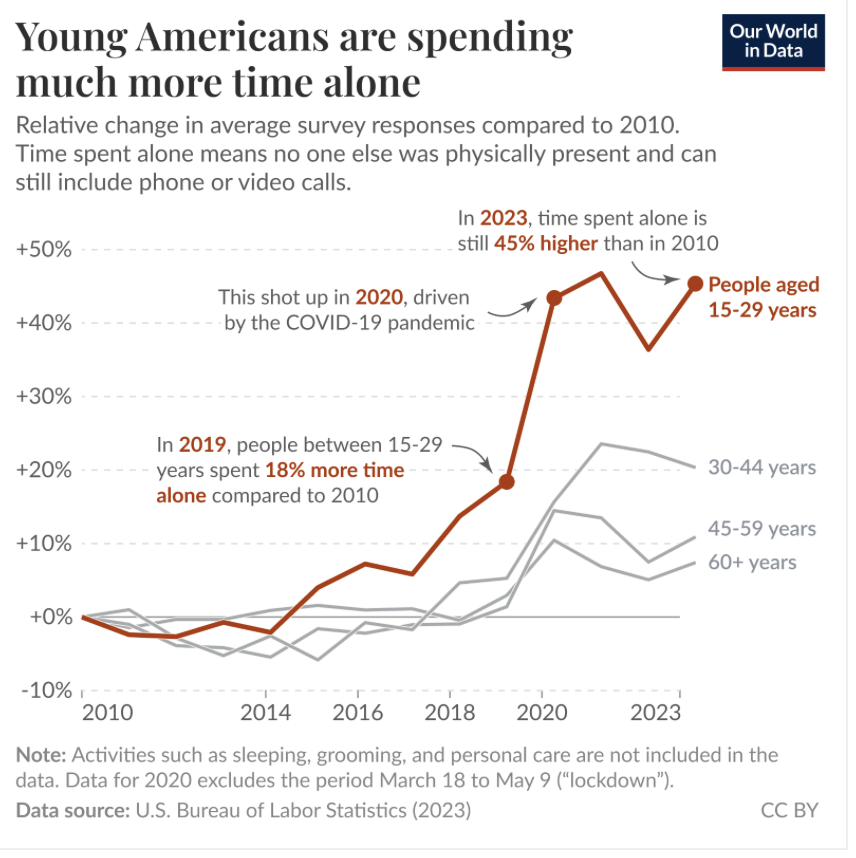
Yes, young people are spending more time alone. But so are ALL of us. (Chart from Our World in Data)
And it goes beyond just one place in McLean, Virginia. Across the US the amount of time we spend alone is up for every age group over the past 15 years. We go to 50% fewer parties than we did twenty years ago and spend 50% less time with our friends than we did a decade ago. In an article last year in The Atlantic, Ellen Cushing summarized it this way: “Many Americans are alone, friendless, isolated, undersexed, sick of online dating, glued to their couches, and transfixed by their phones, their mouths starting to close over from lack of use.”
Enough. I’m declaring an end to the closed door policy right here, right now. I think you’re ready to join me. And there’s a pre-vetted starter set of tips we can all use to start our turnaround.
Here’s the thread I am pulling to suggest we are ready.

Project Hail Mary asked us to believe that in time of crisis we could all come together to save the world. We apparently believed it (Screenshot Amazon/MGM).
The buzziest movie of the year so far is Project Hail Mary, a tale of how a coalition of nations that hate each other come together to solve an existential problem, led by a plucky, optimistic everyman (not to be confused with the plucky, optimistic everyman in The Martian, by the same author) who focuses less on the problems he faces (there are plenty) than solutions (he finds them, eventually). The current #1 best-selling novel in the US is Theo of Golden, the story of a mysterious Good Samaritan who brings together the people of an indifferent town through random acts of kindness. And America’s current highest-grossing comedian is the devoutly religious and scrupulously clean comedian Nate Bargatze.
We want to believe again. We want to be happier. Deep down, we want to open our doors. Don’t we?
I’m not asking anyone to ignore the world’s problems. I am asking each of us to spend a little bit more time focusing on solutions.
I’m not asking anyone to be irrationally exuberant.
Instead let’s set a goal of “happierness.”
It’s a term invented by Arthur Brooks and Oprah Winfrey (!). In a recent column, Brooks credited Swiss psychoanalyst Carl Jung with helping him come up with the concept. Jung, Brooks says, was skeptical of whether true, unnuanced happiness was possible, but he had a surprisingly practical guide to why and how we might inch our way from behind our closed doors into engagement with the outside world, and approach happierness. These are Jung’s five categories for what it takes to have a “good life,” with some evidence to back them up:
We need to take care of our mental and physical health – The Harvard Study of Adult Development (HSAD), the longest-ever study of happiness – finds that the people who live longest don’t smoke or drink much, if at all. They keep their body weight under control. And they exercise. Another study of English, Australian and German subjects finds that people in poor mental health are six times more likely to be miserable as those in poor physical health. To be happier, take care of your physical and mental health.
We should actively cultivate deep relationships – The biggest takeaway from the 90-year HSAD is that we need to be in meaningful relationships with one another. Lately we have fewer and fewer friends: One in eight of us report having “no close friends” at all. And, Jung argued, deep relationships matter a lot – with family, with friends. Marriage doesn’t always work out for people, but evidence is mounting that the overwhelming majority of people are happier married than they otherwise would be. Robert Waldinger, director of the HSAD, boils it down: “Good relationships keep us healthier and happier. Period.” Happierness involves being willing to open your door to the vulnerability and joy that comes from deep friends.

“Weeping Beech in Fog,” 2018 (photograph by Kristin V. Rehder)
We should find ways to regularly experience beauty in art or nature – Jung thought that an appreciation for beautiful things and experiences was essential to happiness. A 2017 study in Sage Journals provided some evidence that this was the case. Looking at people from Canada, Russia and Japan researchers found that “Engagement with natural beauty and nature connectedness were positively associated with a variety of well-being measures.’ A separate study found, not surprisingly, that people who listened to happy music were happier than those that listened to sad music. Want to be happier? Open your door and go find some inspiring nature and happy music.
Meaningful “work” matters a lot– No surprise here: men and women are more depressed if they are unemployed; and, up to a point, unhappiness decreases as we make more and more money. Work doesn’t just give us more resources; the fact of working in itself protects mental health.
So far so good. But Jung isn’t just trying to alleviate unhappiness; he wants to nudge us toward a “good life” -- to promote happierness. For that we need to find what he calls “meaningful work.” That sense of meaningfulness comes from two sources: we need to feel that we have “earned success” – the work we are doing has resulted in something valuable; and we need to feel that we have been of “service to others.” Both of these have less to do with compensation and more to do with meaning. Both are easier if we keep our office/apartment/home/dorm doors open.
Care about and believe in something beyond yourself– It’s hard to have a good life if you make your life all about you. Jung argues that we need to have an organizing framework, a belief system that helps us put life’s events into some kind of perspective.
There’s some evidence that this is right. People with religious belief are more likely to find meaning in life; people with some kind of spirituality have better mental health, less depression. Jung was a Christian, but he did not insist that “I have uttered a final truth.” What he did think was essential was that, if we want a good life, each of us should find a transcendent belief that buoys us in times of trouble and motivates us to act beyond pure self-interest.
Life is too hard for us to make it if we skulk warily behind a door. Having a good life means cracking it open, stepping out into the hallway, engaging our neighbors.
It means seeking meaning in our work, joy in our play, love and support in our relationships and slowly, thoughtfully coming to understand a sense of spirit and purpose behind it all.
That’s pretty much the underlying purpose of what I’ve been trying to get at in this blogspace for the past three years and 150+ posts (here’s the first post, that tries to bring together music, spirituality and friendship). If you’ve never gone to the “About” page, here’s how it concludes:
“In the past I’ve tried to put walls between these parts of my life: work, play and spirit. I don’t think I — or we — can afford to do it any more. Work informs spirit; play teaches us about work; spirit helps us make sense of work and life. As the pace of change accelerates and problems complexify, I want to look for insights from each of these parts of life that can give our whole lives more meaning.
I hope you’ll join me as I try to connect the dots.”
And maybe if we all do that in our own way, we’ll find happierness.
Notes:
The “rattled generation” and the “anxious generation”: https://www.axios.com/2026/06/01/rattled-generation-reality-gap-social-media-covid-ai?utm_source=newsletter&utm_medium=email&utm_campaign=newsletter_axiosam&stream=top
Party-going is way down: https://www.inc.com/jessica-stillman/new-data-proves-it-you-need-to-go-to-more-parties/91212532; https://www.theatlantic.com/family/archive/2025/01/throw-more-parties-loneliness/681203/
Time alone is increasing: https://ourworldindata.org/data-insights/young-americans-spend-much-more-time-alone-than-they-did-fifteen-years-ago
Mental health and unhappiness: https://papers.ssrn.com/sol3/papers.cfm?abstract_id=2336397
Importance of increasing gratitude: https://www.theatlantic.com/ideas/2025/11/thankful-grateful-thanksgiving-happiness/685060/
Our fatigue with anger, yearning for something more: https://www.digitalliturgies.net/p/millennials-tried-being-angry-it
Project Hail Mary success: https://www.forbes.com/sites/timlammers/2026/05/11/project-hail-mary-arrives-on-streaming-this-week-as-film-tops-655-million-at-box-office/
Theo of Golden goes to #1: https://www.simonandschuster.biz/p/theo-of-golden-one-million-copies#:~:text=Self%2Dpublished%20in%202023%2C%20THEO,rising%20to%20%231%20last%20month.
Nate Bargatze stats: https://en.wikipedia.org/wiki/Nate_Bargatze
Brooks article on Jung’s “Five Pillars”: https://www.theatlantic.com/ideas/archive/2024/04/carl-jung-pillars-life-happiness/678009/
Experiencing the natural environment increases happiness: https://journals.sagepub.com/doi/abs/10.1089/eco.2017.0008?cf-mal-redirected=true&#con1
…And boosts mental health: https://www.psychiatrist.com/news/new-study-reveals-natures-ability-to-boost-mental-health/
Spirituality can make traumatic experiences less traumatic: https://academic.oup.com/cercor/article/29/6/2331/5017785?login=false
Our tendency toward spirituality: https://oshercenter.org/files/2022/02/A_neural_circuit_for_spirituality_Ferguson_2021.pdf