The Good Life Part 1: The Joy of “Satisficing”
Pity Clavicular. Since he was 14, the now-20-year-old, born as Braden Peters, has been rebranding, devoting his entire life to “looksmaxxing.” He has dieted and dyed, injected and ingested. He’s devoted himself to working out and working himself over, spending boatloads on skin care (softlooksmaxxing) and breaking and rebreaking his own jaw (hardlooksmaxxing).

Clavicular estimates with a couple more strategic breaks, he might be able to maximize his jawline.
He’s coming closer to his dream. His body stands at 6’2”, 180 pounds. His waist is 31 inches. A particular focus has been his clavicle span (hence his adopted name). That stands at 19.5 inches. The pupil-to-mouth and pupil-to-pupil ratio is almost exactly 1:1.
And yet… despite all that, he knows he is no Matt Bomer. Someday, Clavicular believes, he might approach that actor’s beauty.

Clavicular’s idea of a “maxxed” male, actor Matt Bomer.
In the meantime, Clavicular is confident he is “ascending” on the beauty scale (to reassure himself, he regularly poses himself alongside lesser males (“mogging” them)), in relentless pursuit of making himself an increasingly “high value male.” And he’s making bank on social media, pulling in somewhere north of $100,000 a month thanks to other looksmaxxers dedicated to ascent.
“Maxxing” of all sorts is all the rage these days. Across social media you’ll find folks who are “slaymaxxing” (achieving maximum number of sexual partners), AI “tokenmaxxing,” “gymmaxxing,” “sleepmaxxing,” “fibermaxxing,” “moneymaxxing,” “tanmaxxing,” even “charismamaxxing.” This in turn has spurred creation of ironic maxxes: “comfymaxxing,” “bookmaxxing,” “nothingmaxxing” (at least they seem to be ironic – hard to be sure).
Implicit in all this is the suggestion that if we work hard enough, we can (and should aspire to) find the very best solution to every problem or opportunity or choice we have in life.
It’s a dangerous pursuit.
In an article based on his 2004 book The Paradox of Choice, behavioral economist Barry Schwartz calculated that modern consumers have roughly 100 million times more consumer options than their preindustrial counterparts. These days we have near infinite choice about where we live and the work we do, what we eat and what we wear. We can choose how many kids we have, who we marry and how many times, what God we believe in and, apparently, how far apart we want our clavicles to be (I checked: mine are just 19.0.” Surely if I pump enough iron I could get to 19.5” right?).
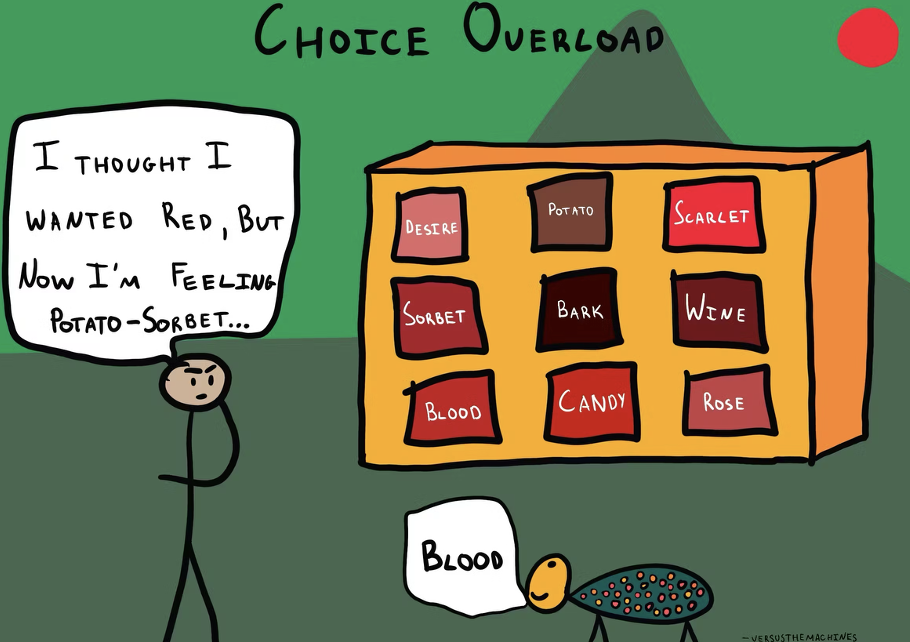
In the old days, we could just paint our wagon “red.” (Image from thedecisionlab.com)
The people Schwartz called “maximizers” try to analyze every one of those decisions to make the perfect choice. Rather than rejoicing in life’s richness, they agonize over their autonomy. As David Epstein, author of the book Inside the Box: How Constraints Make Us Better, put it in a recent article, maximizers “tend to be less satisfied with their decisions and their lives. They are typically less happy, more prone to regret and more likely to compare themselves endlessly with others.”
To understand the cause of this unhappiness, Epstein turns to the work of the late Nobel-prize winning economist Herbert Simon, who argued that human minds just aren’t capable of evaluating all the choices we have, and if we try, we will be perpetually frustrated.
Instead, Simon says, we should “satisfice.”
Satisficing (satisfy + suffice) means considering a small number of options, choosing the one that is good enough, then moving on with our lives. According to Simon’s daughter, her father decisions he considered less important – what to wear, what to eat, where to live – off the table. That in turn freed up more time for him to spend on the kind of relationships and work projects that he wanted to spend more time on. Making a decision based on what is “good enough for me” instead of “the best possible” was liberating. For Simon, “the best is the enemy of the good.”
It’s easier to see how satisficing could work in low stakes cases, but proponents argue we could use it far beyond that. Epstein cites an argument made by mathematician John Allen Paulos on choosing a life partner.
See what you think about it:
· Paulos suggests we estimate the number of people we are likely to date over the course of our lives.
· We should date the first third of them not intending to commit but to determine what sort of people we like and don’t like.
· Then we should commit to the next person we meet who we like better than all the ones we’ve already dated – the probability is that is we keep going beyond that, we will end up with someone less suited or with no one at all.

Paulos would advise “The Bachelorette” to date the first ten bachelors, then choose the first one she met after that who is better than any of the first ten. Of course that would ruin the show… (Photo ABC).
The big point is that we should consider stopping our search well before we have run through every possible option.
It’s a challenging idea. Satisficing runs counter to most of what we hear in the zeitgeist these days.
“We can (and should) have the best of everything.”
“We can (and should) never be satisfied with our current job/car/home/partner.”
“Whatever you do, don’t ‘settle.’”
And yet… If we can make peace with satisficing, we can spend less time on small decisions and more time on big ones. We can admit that even for some big decisions we will never have enough data. And we can get off of the couch and into the arena. Epstein quotes psychologist Mihaly Csikszenthimalyi, who summarizes satisficing this way: “a great deal of energy gets freed up for living, instead of being spent on wondering how to live.”
The seduction of the digital age is that it makes available to us geometrically more choices on everything; AI suggests that, with its help, we can discover the “right” answer to every one of them. Satisficing rejects the premise. It urges us to end the scrolling, make the best choice we can and stop obsessing about perfection. Even if it means a suboptimal clavicle span.
-Leslie
Next time: “Good Life 2: The Path to Happierness”
Notes:
Profile of Clavicular: https://www.nytimes.com/2026/02/13/style/clavicular-looksmaxxing-braden-peters.html
Careermaxxing: https://www.forbes.com/sites/bryanrobinson/2026/05/07/why-the-career-maxxing-trend-is-everywhere-in-the-workplace/
Tanmaxxing: https://www.nytimes.com/2026/05/25/well/gen-z-sun-tanning-dermatologists.html
Why are we maxxing everything?: https://www.theatlantic.com/ideas/2026/03/maxxing-tiktok-internet-clavicular/686616/
Schwartz on 100 million choices: https://hbr.org/2006/06/more-isnt-always-better
Epstein on “satisficing”: https://www.nytimes.com/2026/05/12/opinion/decision-making-herbert-simon.html