Finding Your Work
Dear Class of 2026:
There’s no denying it: the job market you are graduating into this year is, to use a technical term, sucky. For the first time in recent memory since anybody’s been tracking it, the unemployment rate for recent college graduates is actually higher (5.6%) than for the overall population (4.2%).
There’s a bunch of stuff going on that makes it hard right now. Employers overhired during COVID. Everybody’s uncertain what’s going to happen with oil, tariffs, trade, wars or elections. AI is already replacing some jobs, and even when it is not, CEO’s are taking a pause – because it might eventually replace more jobs. So why hire?
Of course you’ve already noticed that. The percentage of young folks saying it is a “good” time to find a “quality” job is at 20% -- 5 years ago it was 62%.

Yes, it’s hard. Don’t give up. We need you. There are big problems old people aren’t smart enough to solve.
I feel ya.
The year I graduated from school and started looking for work was similarly grim. In May 1981, a recession was beginning, unemployment was 8.8%, heading toward 11%. Inflation was at 10%; the prime rate at 20%. The Cold War had everyone freaked. Logistics were just getting to the point where US companies could source labor all over the world.
I spent the first six months of that year applying, by typewriter and US mail, for teaching jobs. One by one, my rejection letters came in and, just to wallow in my self-pity, I taped them all to the walls of my bedroom. Out of my 47 carefully-prepared applications, I got 44 outright rejections, three interviews and, eventually… one job!
Since then, I’ve learned a lot about finding jobs, as a seeker and a hirer. There are four big ideas I wish I had understood better when I was getting out.
Volume matters, but quality matters more. Looking back, I wish I had done more research and applied to fewer jobs – I wasted a lot of time applying to places I had no shot at. These days sending in an application is both easier (job aggregating sites and online applications make it easier to apply for more jobs with less effort), and harder (because it is so easy, companies have more applicants, so they deploy AI to do the screening, and applicants have to figure out how to game the algorithm to get past soulless AI screeners). The sheer volume of rejection is greater than it has ever been.
If you think of the job market as a game of roulette, it makes sense to try to put bets on as many numbers as possible to increase your chances of winning. But the job market is actually something closer to a game of poker: you have limited resources, so you need to be strategic about which hands you bet on and how much time and mental effort you invest in each one.

Think of job search as poker, not roulette (Image generated by deepai.org)
Instead you need to ask yourself questions upfront. Which of all the jobs you see sound closest to the ones you actually have skills for and interests in? (not ones you have to stand on your head to imagine working for) For those, can you figure out the name of the hiring manager so you can send your application directly to that person? (that at least gets you beyond the soulless AI algorithm) Can you personalize your resume or cover letter to make sure you show you understand what that particular company does? (I hated getting apps from folks who clearly didn’t know anything about my organization) Can you figure out the key words to use in a cover note that might set you apart? (either from the job description or the company website) And is there anyone you know from anywhere who works for the company or knows someone who works there that you might talk to? (a search on LinkedIn)
Back in 1973 , Stanford sociologist Mark Granovetter first proposed the idea that we are most likely to find jobs through what he called “weak ties” – not our closest friends but friends of friends (and their friends). A few years ago, in the largest study done to date, MIT put a number to it using data from LinkedIn: using weak ties to help you find jobs rather than your closest ties increased your chances of finding work by 58%.
Their bottom line finding: any connection is better than no connection when finding a job, and a big number of shallow connections are more likely to yield fruit than a very small number of deep connections.
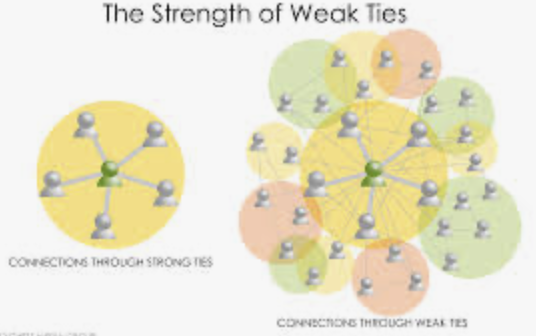
The math is hard to argue with: you are more likely to get a job through a friend of a friend than through a friend.
It’s worth taking the time to figure out what you are good at. Coming out of school, I had one job idea: I was going to be a high school classroom teacher. When I tried doing that for three years and realized that wasn’t my thing, I didn’t have a Plan B. It would have been good to do an inventory of what I did well.
Jodi Kantor, the author of How to Start: Discovering Your Life’s Work, thinks everyone should develop what she calls their particular “craft,” and notes that “most successful, fulfilled people practice a special thing they know how to do that other people do not.” Once we identify and hone our crafts, she says, “we build up protections against being regarded as disposable and interchangeable.
“Any employer can eliminate any job at any time. But your craft is yours and cannot be taken away.”
That “special thing” is probably not just one thing, and it is different for everyone. It could be could be playing a trombone, diagnosing illnesses, fixing a clogged drain, making a spreadsheet sing or organizing a project.
When I looked at myself as I was leaving teaching, I realized that one of the things I seemed to be good at was translating complicated ideas into language other people can understand. And once I saw that I realized it was valuable beyond the classroom: I could use it for reporting; for speechwriting; for public policy papers; even for posts on Boneconnector.com.
If you’re a young person just graduating, you may not have experience in the workplace with what you discover to be your “craft,” but you do have data points – teams and clubs you’ve been part of, summer jobs you’ve tried, relationships you’ve had. Kantor suggests you buy a cheap notebook and start taking notes on what things you like doing and which ones you don’t, whom you like and whom you don’t, what you’re good at and what ideas get you excited. Then look to your friends and “think about what roles you take on with them: math tutor, party planner, psychologist, workout coach…our friends have needs, and by noticing how we respond to them, we can learn who we are.”
If you’d rather have an LLM do that work for you, you might appreciate a new tool, free on GitHub, called JobClaw, built by the New Work Foundation, which gives you a short screening tool, then recommends jobs that might be perfect for you, based on “your actual strengths, not just keywords.” (you’ll need to download the OpenClaw app).
It’s worth forcing yourself to imagine what other people need: Of course if you want to earn money, you need to find a way to connect what you are good at to a real-world need. What kinds of things are the people you know — and those you are reading about — likely to need over the next 40-50 years? What kind of care? Which products? What information? Who’s doing work in that area and what would you need to know and be able to do to help them? Think long-term: this is not about predicting which AI firm is going to come out on top or which country is going to feel climate change first (that’s harder); it’s about the overall direction the world seems to be taking and what your role (admit it, you have some ideas), given what you know about your passions and abilities and instincts and insights, might be.
I’ve written about the impact that kind of thinking and planning has made in my life. When I make my regularly-updated lists of T3PMO (Ten Things That Piss Me Off), I force myself to imagine which problems I know about that need solving, then to imagine what role I could play in solving them.
You can learn something anywhere: In an ideal world, a young graduate can find a place to identify and hone their unique “craft” in a job that is meeting an important “need.” Finding that kind of job launches us into what Arthur Brooks calls “subjective” careers – the kind of places that give us a sense of calling.
But other times we find ourselves in jobs that serve “objective” needs – the need to support a family, pay back loans or make a car payment – those jobs provide us with a means to an end.
But Brooks makes a strong case that even in an “objective” job we should look for ways to find intrinsic meaning. That doesn’t mean you have to do a boring, low-paying job forever. It means if you look hard enough, you can make any workplace a learning and growing opportunity in the moment. You can learn something in any job. And you can use any job to prepare you for another job.
“Even a job taken out of sheer desperation may have some interesting facets,” he notes. “If you avail yourself of opportunities to help others, your job will become more satisfying – more like a calling, in fact.”
You could be the person who brings your colleague a fresh cup of coffee when you notice her lagging, who looks for ways to improve office morale even though nobody’s asking you to, who chips in when a co-worker is under the gun, who takes time to think about how an internal process could be more efficient, who is kind to the struggling supplier, patient with the difficult customer, encouraging to the new job applicant. “Being that person” to your colleagues, Brooks says, will change for the better how you see your role in that workplace.
That kind of reputation has legs.
A few years ago, a woman came to work with me in a job that she was over-qualified for. Rather than mailing it in and doing the minimum, she looked for every opportunity to take on new responsibilities, learn new stuff. She became what I call a “culture carrier” in our office – the kind of person who brought positive, can-do energy to the place every day. We promoted her as much as we could, but ultimately she left for a job where she could use all of her skills and make more money.
I got a reference call for her last week from a new potential employer. “Do whatever you can to hire her,” I said. “She has skills, she cares about your mission and, most importantly, she will make your office more positive and interesting and fun.” “That’s what we thought too,” her now-boss said. “But it’s really good to hear that from someone who knows her well.”
Class of 2026: what can you do to make yourself that person in your next job?
-Leslie
Next up: Finding Your Whistle - what makes you special to the others in your life?
Notes:
Latest Zip Recruiter job market survey: https://www.ziprecruiter-research.org/annual-grad-report
Axios analysis of current job market for young graduates: https://www.axios.com/2026/04/21/gen-z-jobs-unemployment-college-grads-ai?utm_source=newsletter&utm_medium=email&utm_campaign=newsletter_axiosam&stream=top
Kantor on craft and need: https://www.nytimes.com/2026/04/19/business/career-graduation-jobs-gen-z.html
Granovetter on strength of weak ties: https://news.stanford.edu/stories/2023/07/strength-weak-ties
MIT study on the power of weak ties: https://news.mit.edu/2022/weak-ties-linkedin-employment-0915
My take on the value of “T3PMO”: https://www.boneconnector.com/writings/work-t3pmo
About the New Work Foundation’s jobs initiative: https://www.dearcc.org
Brooks on finding a calling: https://www.theatlantic.com/ideas/archive/2025/06/make-your-work-your-calling/683330/?utm_campaign=how-to-build-a-life&utm_content=20260416&utm_source=newsletter&utm_medium=email&lctg=66c4fcd2bd3bd16ce40b655e&utm_term=How%20to%20Build%20a%20Life