Finding Your Whistle
We all need to find our work – some thing that we do that pays the bills, and, if possible, fulfills us.
But there’s this other thing I’ve found myself thinking about a lot lately that’s almost bigger. It has to do with how we interact with other people, and it goes way beyond our jobs.
We need to find something we do that brings special joy or comfort to other people… and then start doing more of it. Not expecting any payment. Not necessarily even expecting thanks.
We need to find our whistle.
Chris Ullman lays out the argument in his 2017 memoir Find Your Whistle: Simple Gifts Touch Hearts and Change Lives.
Our “whistle,” he writes, is a special ability each of us has to “do good things for people, often strangers, expecting nothing tangible in return.”
When we find that, it’s good for the world, and for us personally: “The feeling of being relevant, of mattering, of feeling that your presence has made a difference, is a powerful tangible reward.”
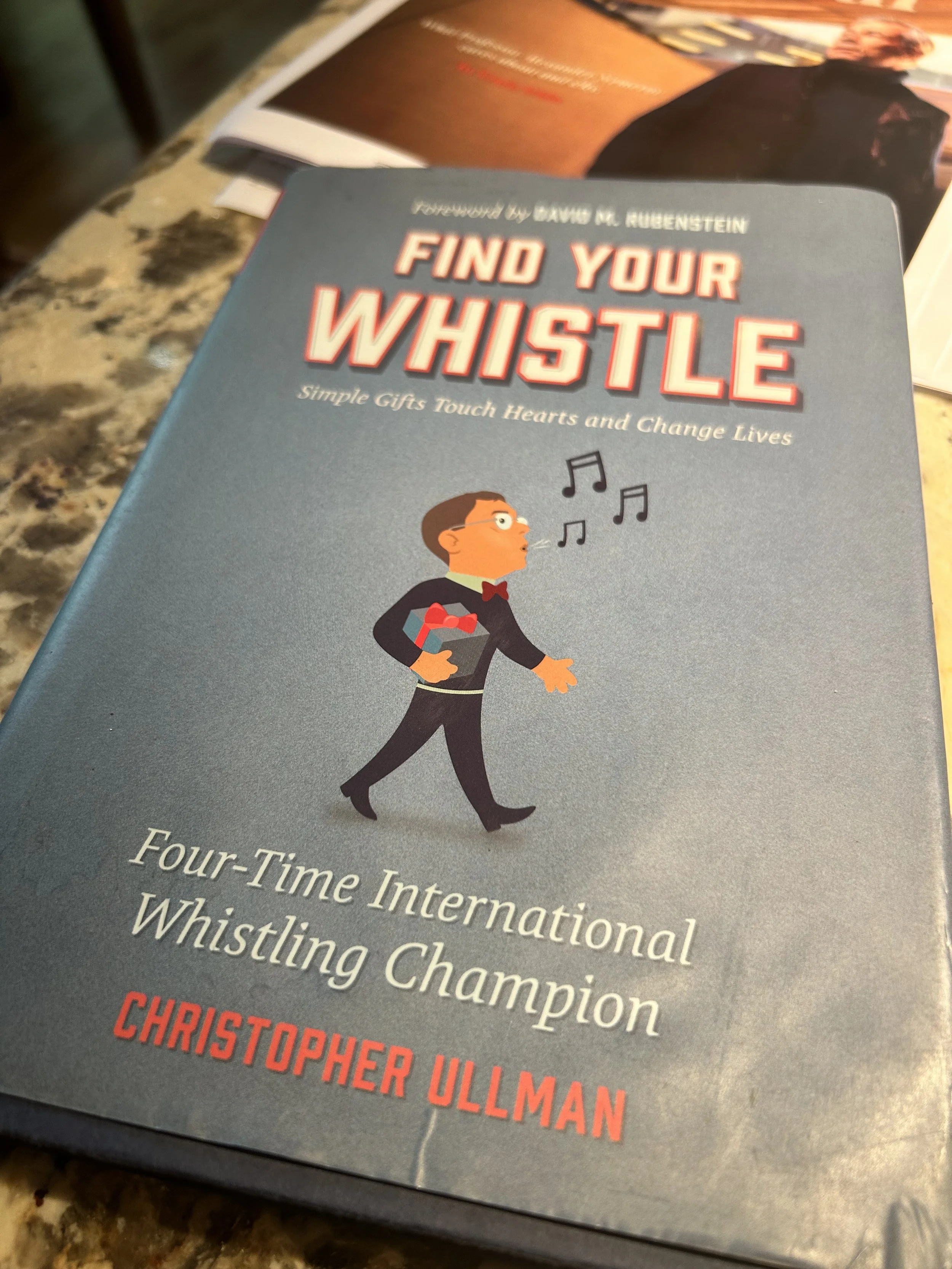
Ullman’s book makes a simple argument. Find a thing you can do that brings joy to others — then start doing it.
Ullman’s whistle is, well, his whistle. A four-time world whistling champion (yes, that’s a thing – more on that in a future post), a few years ago he started recording whistled voice mails for a few friends each year on their birthday. By the time I met with him in his office in Alexandria, Virginia last month, that list had grown to more than 650 people a year.
We can’t all be world class whistlers, of course, but we can all do something. As the Rev. Martin Luther King, Jr., noted, “Everyone can be great because anyone can serve.”
“The concept of ‘finding your whistle,’” says Ullman, “is so powerful because it puts aside the quest for, or reliance on, heroic achievement, and gives license to us mere mortals to find and develop our simple gifts, our whistles, and then share them with the people in our lives, friend and stranger alike.”

If you don’t have good lips, maybe your whistle is your hands.
Throughout his book, Ullman points to the “whistles” of various people in his life: a babysitter who is relentlessly optimistic; a work colleague who makes awesome carrot cake for his fellow workers on special occasions; a friend who creates amazing handmade Christmas cards; a priest who records internet videos in New York City about humility, sin, forgiveness and love; a guy who is particularly gifted at providing friends with moral clarity in obtuse situations.
In my life, I have one sister who is gifted at connecting people from all different backgrounds; another sister who brings can-do enthusiasm to bleak situations; a bride who is exceptional at helping others extract clarity out of chaos. My friend Jay is an amazing storyteller; he’s the one I want to have along for any adventure because he can turn it into an epic tale.
But when I think of “whistles,” it’s my father who comes to mind first.
His day job was building an architectural firm that created lovely buildings and, in the conventional assessment of “success,” he did great. When I think back on his life, though, what I remember is something he did well below the world’s radar: his spirit, maybe best embodied in his letter writing.
When he wasn’t working, Dad was always scribbling a note to a friend or a colleague or someone he’d just met. When any one of hundreds of people went to the hospital, headed off for college, finished second in a spelling bee, got a merit badge, made the JV team, learned to ride a bike, or lost a loved one, they got a letter or a post card from him.
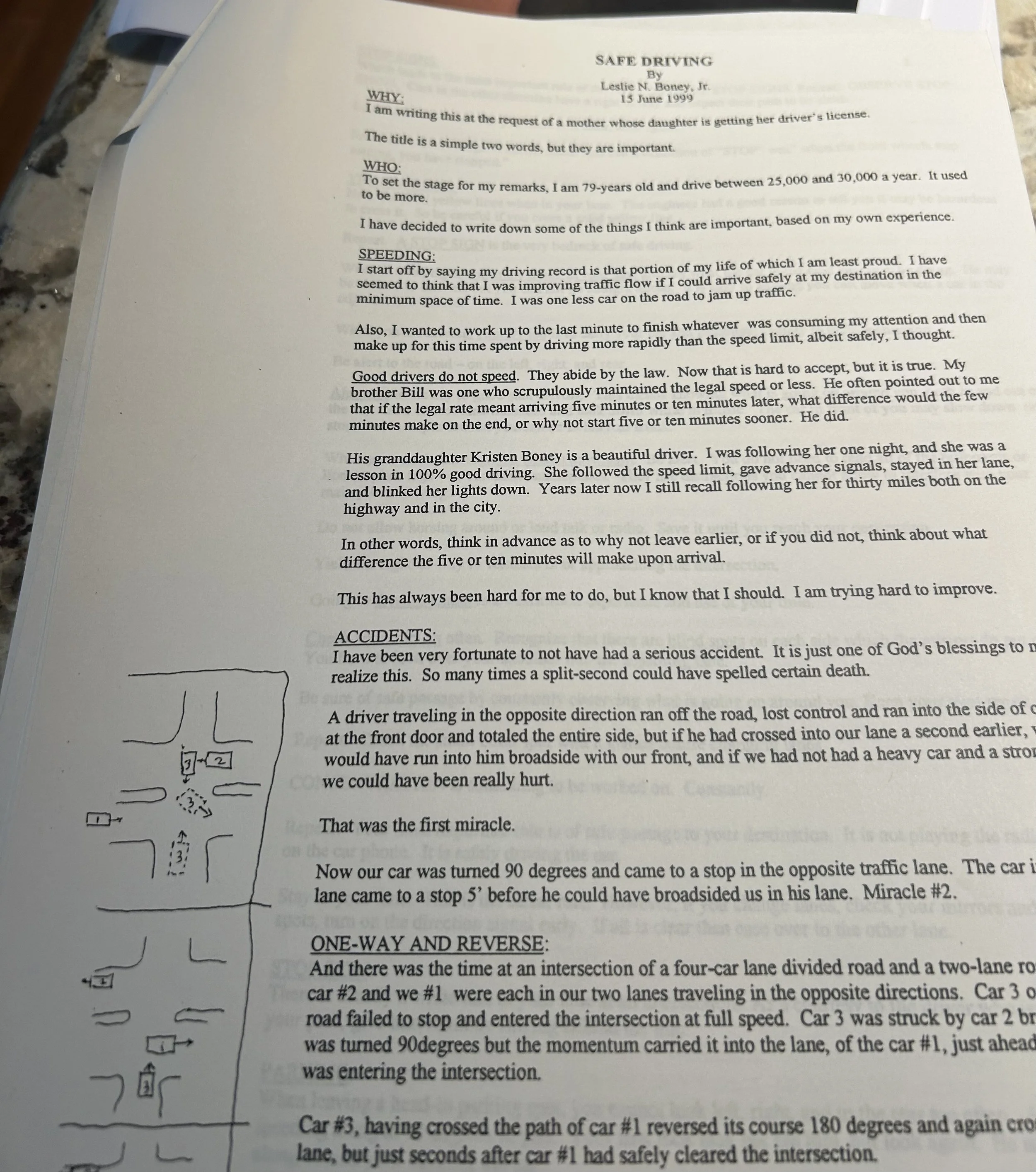
After my father’s death, folks started sending me copies of letters they got from him. He wrote this one after he met someone whose daughter was just learning to drive. It went on for three pages, then included additional notes from AARP.
When he realized I was going through a bad time one year, he started sending me numbered notes around my birthday. I didn’t quite figure out what was going on till a few days after my birthday, when I realized he had sent me 100 letters. I got over my funk.
That kind of “whistling” adds up over time. At Dad’s funeral, I asked those in attendance to stand if they had received a letter from him. 600/600 people rose to their feet.
But this isn’t really about letter-writing either. It has more to do with the power of intentionality. My father’s letters were good, but looking back on it, the most important thing was that he took the time to move from hearing something that was going on in someone’s life to sending them a letter. He thought about what that person might be thinking or feeling, reflected on it, wrote his thoughts down, tracked down an address and sent it. Every one of those things takes time.
And those of us who received them understood that another human being was thinking about us, acknowledging our joy or pain or accomplishment. We felt acknowledged and seen.
I want to spend the next season of my life finding ways to be more generous. It’s not a bad goal for any time; as our world coarsens, it is more important than ever.
And just imagine what would happen if we all were to discover and deploy our unique whistles at scale. Chris Ullman has imagined just that: “The only way to truly make the world a happier, safer, healthier, and more joyous place is to harness the energy and talents and passions – the whistles – of countless everyday people who want to make a difference, to touch hearts and change lives.”

Rubens’ portrait of Teresa. She founded a convent, lived in abject poverty, wrote books of prayer and meditation, and shared her “whistle” with others everyday.
There’s a poem written by the 16th century Christian mystic Teresa of Avila that has been beating me over the head since I first read it 30 years ago. It expresses her belief that we are God’s instruments on earth, and adds additional motivation for us to find our whistle and start using it. Here’s the version I’ve memorized:
Christ has no body now on earth but yours
No hands but yours. No feet but yours.
Yours are the eyes through which to look out Christ’s compassion on the earth.
Yours the feet with which he is to go about doing good.
Yours the hands with which he is to bless now.
How do we start? I asked Ullman during my visit with him. He had three suggestions:
Do a personal inventory — how do we interact with the world. What do we think we do well?
Ask others what they think makes you unique. They may see something you don’t, something that you undervalue, but is meaningful.
Develop your thing and persevere. You’ll find your rhythm and get better over time.
And there was one other important thing.
“Instead of trying to ‘change the world,’ which is unrealistic,” he said, “focus on changing the lives of people around you. That’s achievable. Start small, build from there.”
So…. what’s your whistle? And, if you already know, how could you take it to a higher key?
-Leslie

Related: Finding Your Work
Notes:
Find Your Whistle: https://amplifypublishinggroup.com/product/nonfiction/biographies-and-memoirs/general/find-your-whistle/
Chris Ullman bio: https://chrisullman.com/about/
Teresa of Avila wiki: https://simple.wikipedia.org/wiki/Teresa_of_Ávila