Grammar at Work and School, Part 2: Pronoun Paranoia and Danglers
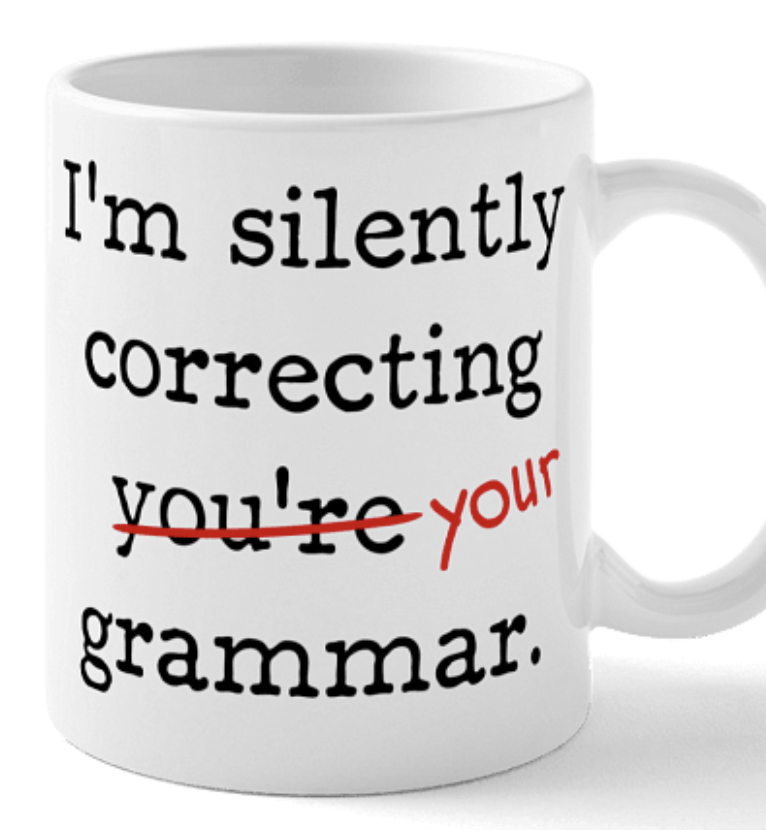
You’re — uh, your — grammar matters to more people than you think.
You’ve seen folks displaying the message on their t-shirts, coffee cups and office signs: “I’m silently correcting your grammar.”
But if you think it’s just one in a hundred people doing that, you’re wrong. As we discovered in Part 1, about ninety-seven out of every hundred folks are, usually silently, judging you and your grammar (even though only about 3% are consistently judging correctly).
I’m trying in this series of three posts to do a modern-day assessment of grammar, which grammar errors are most likely to be judged and to give you some tips on how to avoid them.
In this piece, I’ll hit two problem areas. Then, next time, I’ll review a few more.
1. The Problem with Pronouns: Subject vs. Object:
I don’t have data to prove this, but I think pronoun paranoia causes more angst than any other grammar challenge. She and I? Him and me? You and myself? When we come up to the part of a sentence where there are two pronouns in a row, we hesitate. We freeze. We randomly pick some pronouns. Then we silently second-guess ourselves.

Pronoun paranoia is real. Two tricks can prevent a lot of angst. (Image created using Sora)
There are two big pronoun problem areas and a pretty-easy trick for each one.
A. When you have two pronouns together and you aren’t sure which version to use, take one of them away and see how the sentence sounds.
Which are the correct pronouns in each of these sentences?
· She and I/Me and her/She and myself are both fashionistas.
· Ret gave the Mountain Dew to him and me/he and I.
· Hector and Chase made a bigger bet than she and he/her and him.
I just want to say a few words about my Dad, to who/whom I owe so much.
In Example 1 the pronouns are subjects; in Example 2 and 3 they are objects. But the trick works the same whenever you have two pronouns. Remove one of the pronouns and see how the sentence sounds. You wouldn’t say “me” or “myself” is a fashionista – you’d say “I am.” You wouldn’t say “Ret gave the Mountain Dew to “he” – you’d say she gave it to “him.” Eliminate one of the two pronouns and you’ll know what form to use.
To figure out Example 3 you need one more trick. “Than” is a conjunction starting a new clause (even if you can’t see the verb in the clause). So you’ll need a subject pronoun. To figure out the correct pronoun in a “than” sentence, add a verb after the pronoun. If you tack on “did” at the end of the example, you’ll see that it should be “Hector and Chase made a bigger bet than she and he (did).” Another example: “She is a bigger fan than I (am).”
Example 4 is a reminder that you need to know which pronoun you use as a “subject” and which one as an “object.” If the pronoun is the subject of the sentence, use “Who” or “He” or “She” or “I.” When the pronoun is not the subject, you use the object form: “whom,” “him,” “her,” “me.” Example 4 is also a direct quote from one of the funniest (admittedly the competition is not keen) grammar videos, here).
B. The second problem with pronouns comes when you’re trying to decide the correct one to use for sentences in which the verb expresses an equivalence. This happens most often in sentences with forms of the verb “be.”
Think about that verb as an “=” sign. Since one side of the sentence is equal to the other side you can flip it, and that makes everything easier.
· “Is that Gertrude on the phone?” “Yes it is SHE.” How you know that’s correct: You would say “She is on the phone,” not “Her is on the phone.”
· “Is that you at the door, Leslie?” “It is I.” How you know that’s correct: You would say “I am at the door,” not “Me is at the door.”
· “The best singer is HE.” How you know that’s correct: You would say “He is the best singer,” not “Him is the best singer.”
So that’s what grammar tells us the correct pronouns are for those sentences.
My opinion: You don’t want someone to negatively judge you for getting the grammar wrong, but you also don’t want to come off as a showoff. If you think the grammatically-correct sentence is going to sound stilted or snotty, find a way to say it that is correct, but sounds more natural.
· “Yes, this is Gertrude speaking.”
· “It’s Leslie.”
· “He’s the best singer.”
2. How do we know when something is dangling?
· Most of the problems folks get in with dangles are with introductory phrases or clauses. The next three examples are all cases where the introduction of the sentence is modifying the wrong subject
“Walking down the street, the buildings looked tall” (Who was walking down the street? Not the buildings.)

Walking buildings? The first time you read a dangle, it can confuse you or the person reading your stuff. Take steps to avoid it. (Image created using Sora)
· “After reading the Boneconnector post on grammar, the mistakes were obvious.” (Who was reading? Not the mistakes.)
· “Windshield covered in snow, I drove the car down the street.” (I wasn’t covered in snow; the car windshield was, right?)
Some people also care about dangling prepositions, which happen when you have a preposition ending a phrase or a sentence and no object after the preposition. (“Which movie are you going to?” or “That’s the team he bet all his money on” or “That’s a criticism I won’t put up with.”) The grammar police will call you out on those.
My opinion: Dangling phrases or clauses happen mostly in print. I think they are worth avoiding. The easiest fix is to make sure that the subject of the introductory phrase or clause comes immediately after the comma (“Walking down the street, I felt tiny next to the towering buildings,” or “After reading the Boneconnector post on grammar, Hector began silently correcting his friends,” or “Windshield covered in snow, the car looked like a mechanical snowman as it moved down the street.”
Most of the fixes to dangling prepositions strike me as stilted or performative (“To which movie are you going?” or “That’s the team on which he bet all his money” or “That is a criticism up with which I will not put.”) My advice is that if you think someone might call you out on a dangling preposition, just rephrase it. (“Did you pick a movie?” or “Where’d you place your bet?” or “That criticism annoys me.”)
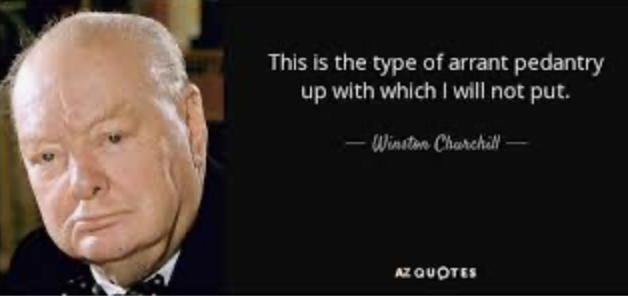
We know how Churchill felt about criticism of his sometimes-dangling prepositions.
So those are the first two “rules” I think worth having a handle on. There are three more areas of grammar confusion I think it’s worthwhile to know. I’ll get to those, and share some thoughts on how to think about big words, in Part 3.
Let me know what you think!
-Leslie