Thirty Seconds for Glory
Take a minute to think of the full list of things you would pay $333,333 to own for a lifetime. A house? A college education? A Nolan Ryan rookie card (I have one; glad to sell)?
Okay, now that I have you in the right frame of mind, maybe this is the time to tell you that the price of running an ad on the Super Bowl this year has increased, again. If you wanted to buy a 30 second ad during this year’s game, you needed to pay $10 million for 30 seconds, or $333,333 a second. How did it get to this?
$7 million? $10 million? $35 million? What would you pay to have 30 seconds of 100 million people’s attention?
It sure started cheaper. For the first Super Bowl in 1967, 30-second ads started at $37,500. Since then, even taking inflation into account, the costs in real dollars are up 30x. This fall, word initially got out that ads were going for the outrageous cost of $7 million per 30 seconds (that’s $233,333 a second). Then the price just kept rising.
Why? Limited supply – just 80 ad slots available during the game – and off the charts interest. “There just was so much demand against it, and there were just not enough spots for everyone who wanted to be in,” Mark Marshall, president of global advertising and partnerships at NBC Universal (NBCU) told AdWeek. “So the marketplace just drove the pricing up to $10 million-plus over the course of the summer and into the fall.”
Oh but wait. The actual cost to a company who wants to run an ad on the Super Bowl is much higher than $10 million.
· NBCU requires anyone who wants the privilege of buying a Super Bowl ad to buy at least as much in advertising on other shows or events (NBC’s daytime soaps, the Today Show, other sports events, etc.). So to buy a $10 million Super Bowl ad, you really have to pay NBCU $20 million. Additional ad buy +$10 million
· You’re gonna want to buy a celebrity. About 2/3 (63%) of Super Bowl ads these days have a celebrity in them. Buying a celebrity will run you from $1mm-$5mm, depending on who you get and how much you need them to do. Midrange celebrity +$3 million
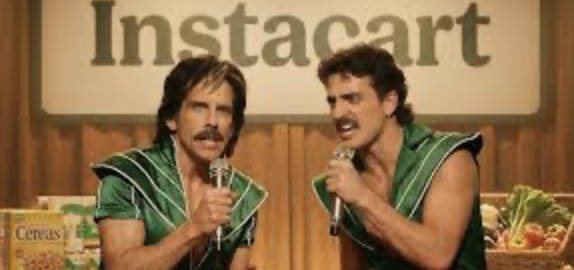
Over the years, companies have collectively decided you can’t just talk about your product at the Super Bowl. You need to hire folks like Ben Stiller and Benson Boone to do it for you.
· You’ll want the ad to look spectacular — everybody expects that. The estimated cost of filming a Super Bowl ad ranges from $1mm-$4mm. Average spectacularity +$2.5 million
· You’ll almost certainly want to follow up the Super Bowl ad with a boatload of other ads. You don’t want to spend that much making an ad and have it only seen once. And it’s unlikely anyone is going to buy your product simply based on a single 30-second exposure — you’ll need to hit them with the ad multiple times in all sorts of other places. Accompanying ad campaign +$10 million
So what should you budget if you want to do a 30-second Super Bowl ad? $10+$10+$3+$2.5+$10=? Ballpark $35.5 million.
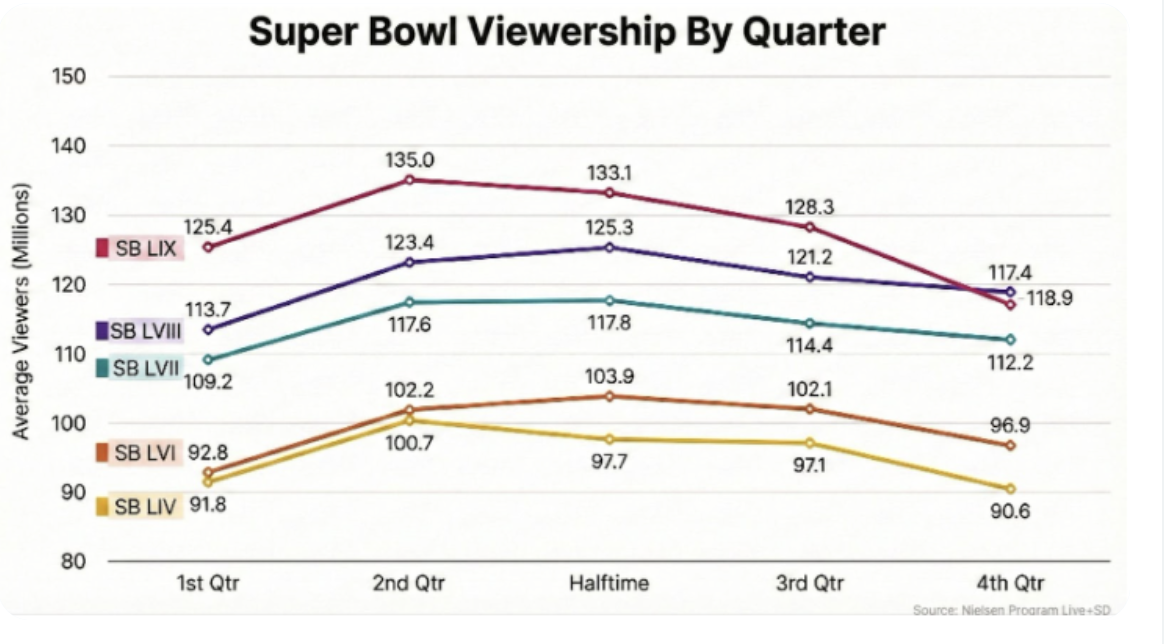
For the record, you also have to pay more if you want your ad at a particular time during the game, or if you want your ad to be the only one for a category of product. Looks like just before halftime will get you 135 million sets of eyeballs.
Given that total price tag, you might wonder why so many brilliant, sane CEO’s spend a seemingly-insane amount of money to buy Super Bowl ads each year.
Until this week I’ve always thought the decision was mostly about vanity – “hey look Ma, my company’s on the Super Bowl; we’ve made it.” Or maybe peer pressure – “My ad’s bigger than yours.”
I still think that’s part of it, but an article I read this week helps me understand how the decision to buy might – almost – be a good business decision.
Writing this week on X, Zacharia Reitano, co-founder and CEO of Ro, posted a detailed rationale for his company’s decision to buy an ad for its weightloss product at this year’s Super Bowl. His argument convinced me that the decision may – almost – be rational. See what you think.

For Ro, Serena Williams + cost of Super Bowl ad pencils out, eventually, to a good business decision.
For once, ads are part of the event: In every other part of our media year, advertisements are an interruption of the main event – we do everything we can to avoid them – we push skip or +30 seconds or fast forward through them to get back to the “real thing.” But, Reitano argues,
“There is exactly one moment each year when….on a Sunday night in February,…people sit down and are excited to watch an ad. They aren’t scrolling on TikTok. They aren’t going to the bathroom. They are actively watching…ads.”
And then they talk about them – we rate, we rewatch, we critique. There is a dramatically higher likelihood that people will actually see your ad if you show it during the Super Bowl than at any other time.
One chance to share with “everyone”: When I grew up we had two TV channels to choose from (the folks in the big city got 50% more – three); now there are a gazillion. That means that for 364 days, 20 hours of the year, each of us is watching a different sliver of the world. Except during the Super Bowl, when 100 million of us are watching the exact same thing at the exact same time. “With today’s algorithms,” writes Reitano, “even what goes ‘viral’ might be only in your bubble. During the Super Bowl, we all share the same bubble.” If you are trying to erase a misconception, differentiate yourself from competitors or acquire brand new customers, there’s no place like the Super Bowl to begin that process. For Reitano, the Super Bowl is super “efficient,” a chance to “increase brand awareness and compress years of advertising.”
There’s an “asymmetric upside”: This next part gets wonky, but basically Reitano argues that, even if the Super Bowl ad is really expensive, for most companies doing it that number is really only a fraction of its annual ad spend. If the ad bombs, they’ve completely wasted a small, known portion of the budget. On the other hand, if the ad succeeds, it could go viral. As Reitano puts it: “This is not a moonshot. It’s a portfolio decision with a capped downside and asymmetric upside.”
From there Reitano explains all the three-letter-acronym strategies his company will use (for the record, he’s big on SEO, CRM, OOH, and DTC) to reinforce the effectiveness of the ad. Then he explains the math the company will use to compute if the ad paid off. Some of the metrics are elegant and quantifiable; others are fuzzier.
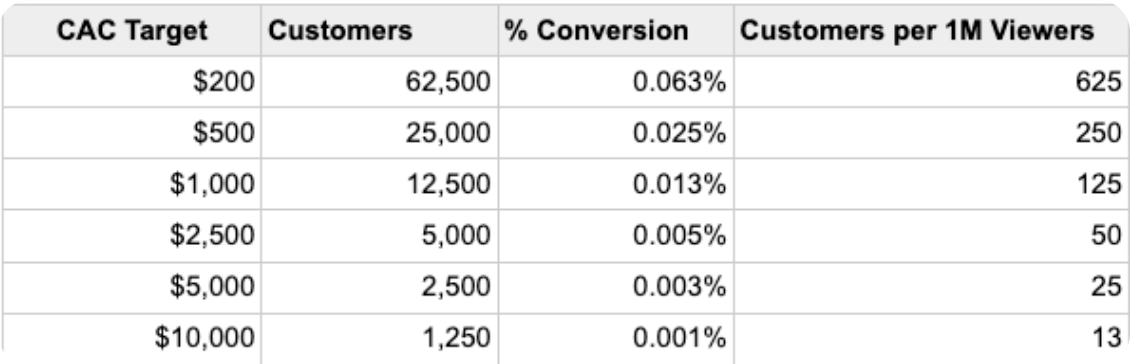
The way Reitano figures it, if it costs a company on average $1,000 to get a new customer, a Super Bowl ad pays for itself if it gets 125 customers out of every million watching.
But in the end his argument comes down to a few key elements.
· There’s a credibility and halo effect of having your ad on the Super Bowl – people will take his brand more seriously and the company will differentiate itself meaningfully from competitors
· It’s likely to bring in new customers more efficiently than other strategies he could try. It will lower CAC (Customer Acquisition Costs) and add LTV (Long Term Value)
· And then, after all the intuitive arguments, acronyms and mathing, it comes down to a shrug. Basically, ‘Oh, what the hell?’
Reitano says:
“There will never be a spreadsheet that tell you it’s ‘time.’ There’s just a moment when the math is good enough, the upside is asymmetric and your gut – earned through years of building – says go. Sometimes you just have to grip it and rip it. We felt it was worth the swing.”
The good news for us is we (the viewers/consumers/critics) get inspiring, memorable, absurd, spectacular, sometimes disappointing ads, typically about as interesting as the game itself.
Just below I’m listing my top 5 favorites from this year. After the game, let me know your best and worst!
Happy Super Bowl!
-Leslie
The “Ro” ad is not one of my top 5, but out of gratitude to Reitano for sharing his rationale for buying it, I’m sharing the link here.
My top 5 are a mix -- 3 ads made me feel something and did a good job selling the product; 2 perfectly captured Super Bowl ad excess (for entertainment value, I’m linking to the “full” versions – the actual Super Bowl ads are all shorter).
5 Memorable 2026 Super Bowl ads
1. Relax your tight end. Novartis. Various NFL tight ends. Increases chance somebody might actually act on the message of a Public Service Announcement that sells a product. I didn’t like the Will Shat one quite as much, but interestingly it targets a similar part of the body.
2. American icons. Bud. Clydesdale celeb. I’m having some worries about the US these days, and I prefer beer with flavor, but this one got me choked up in 60 seconds.
3. For Papa! Instacart. Ben Stiller and Benson Boone in a classic “only for the Super Bowl” commercial. So ridiculously over the top. So close to making people totally forget what product it is pitching. But you have to admire the passion.
4. Jurassic Park. Xfinity. Most of the cast of Jurassic Park. Another stunning monument to Super Bowl excess. How could anyone spend this much on a commercial? See argument in the post above.
5. Won’t you be my neighbor? Rocket. Lady Gaga somehow makes me positively associate Mr. Rogers with getting a mortgage.
Notes:
AdWeek article on cost of this year’s Super Bowl ads: https://www.adweek.com/convergent-tv/nbcuniversal-first-10-million-super-bowl-ads/
Ro on rationale for Super Bowl ad spending: https://x.com/zreitano/status/2016862026501378535?s=46