AI Update Part 4: How Government Can Help With the Job Transition
Note: This is the 4th part of a series looking at how people and companies and governmental organizations are preparing for the impact of widespread implementation of AI on employment in the US. You can find the first three parts beginning here.
The United States has faced some dramatic shifts in employment over its history. During its first century most of its residents worked in agriculture. As late as 1900, in North Carolina, where I live, 80% of the population worked on farms. With industrialization, machines took over much of the farm work, and increasingly we encouraged the former farm workers to find jobs in factories. That happened: by 1950, manufacturing had passed farming as the largest sector of the North Carolina economy, and by 1970, 31% of adults worked in manufacturing.

In the 1960’s photographer Billy Barnes captured the transition of the workforce in North Carolina from farm to factory.
Beginning in the 1990’s products increasingly were made either by machines in the US or by workers in lower cost countries around the world, and we encouraged the former factory workers to find jobs in the service sector. That happened: today about 82% of the people in my state work in the service-related jobs; just 10.5% of folks work in manufacturing, and only 3% work on the farm.

Later Barnes documented the closure of many of North Carolina’s manufacturing plants.
Those tidal change transitions in the kind of work we do were ugly and painful for millions of people, but at least they happened over decades. The AI transition we are living in is moving much more quickly, and is threatening both blue- and white-collar jobs.
As Bill Gates noted in a LinkedIn post earlier this week: “The people who need the most time (to get ready for transition) are the ones who have the least - the accounting workers who’s replaced by a bot or the $20-an-hour workers who loses their job to a $10-an-hour robot.”
Gates continued, “market forces will make adoption go faster and faster, and, unless we intervene, there will be fewer good jobs available and the benefits will accrue to a small group.”
For the past few months I’ve been part of a government commission that is trying to figure out, in part, how to help people prepare for the transitions AI will bring to our work lives.
The State of North Carolina AI Leadership Council issued a preliminary set of ideas last month. The full report makes 17 recommendations, including ideas about how to reduce AI-based fraud, boost cybersecurity, deal with the potential impact of AI on water and electricity costs and establish governmental AI resources. In announcing the findings, NC Governor Josh Stein gave this overview: “This roadmap gives our state a strategy to protect people from harm, prepare our workforce for opportunity, and transform how government serves the public.”
None of the ideas in our first report offer a “solution” to the challenges AI is creating. All of the recommendations will need to be updated (the Council will issue at least two more reports over the next couple of years). And I wish there was more of a tone of urgency in the report. But it’s a start, and I think it’s a report worth reading in its entirety (or asking AI to read for you and summarize).
For this series I’m doing on the implications of AI for the US workforce, I wanted to focus on the recommendations of a council subcommittee I worked on that focused on some of the questions government faces when it comes to AI education and retraining.
How can we get everyone up the learning curve to understand how to use (and protect themselves from) AI in their home and work lives? The latest polling suggests that about 52% of Americans (66% of Hispanics, 57% of Blacks; 47% of whites) have used Large Language Models, a remarkably fast adoption of an emerging technology. But that means 48% of us still haven’t, and among those using LLM’s, an Elon University survey characterizes the use by most people as “superficial” – the majority are using the models for things like search, brainstorming and trip planning. We need a mass public education campaign to teach people how to use the technology in their personal lives and in their work lives.
The AI Council report recommends a “statewide AI literacy initiative… to deliver free, foundational AI training” across the state, perhaps staged at places like libraries and senior centers, and building off of institutions like cooperative extension and community colleges.
How can we ensure young people are prepared for an AI-dominated workplace? There is ongoing debate about how much students should use AI in their classwork and more than half of US states have set guidelines restricting AI use in schools. But only half of teachers say they feel confident preparing students for our AI future.
The AI Council report recommends asking each public school unit to “adopt an AI policy, AI guidelines and an AI-focused professional learning plan” with a “focus on ethics, human judgment, agency and AI fluency.” A separate recommendation proposes a pilot between 10 North Carolina employers and higher education institutions to coordinate course material with evolving employer expectations.
How can we help young people get the entry-level jobs they need to get their careers going? A new study by Cadient (an AI-powered hiring platform!) finds that the number of salaried jobs open to people with no previous job experience has fallen 73% in four years.
Inexperienced candidates are now welcome to apply for only about 2% of jobs. As the CEO of Cadient, Bill Mastin, told Forbes, “employers increasingly expect candidates to arrive with experience before they're given the opportunity to gain it.”
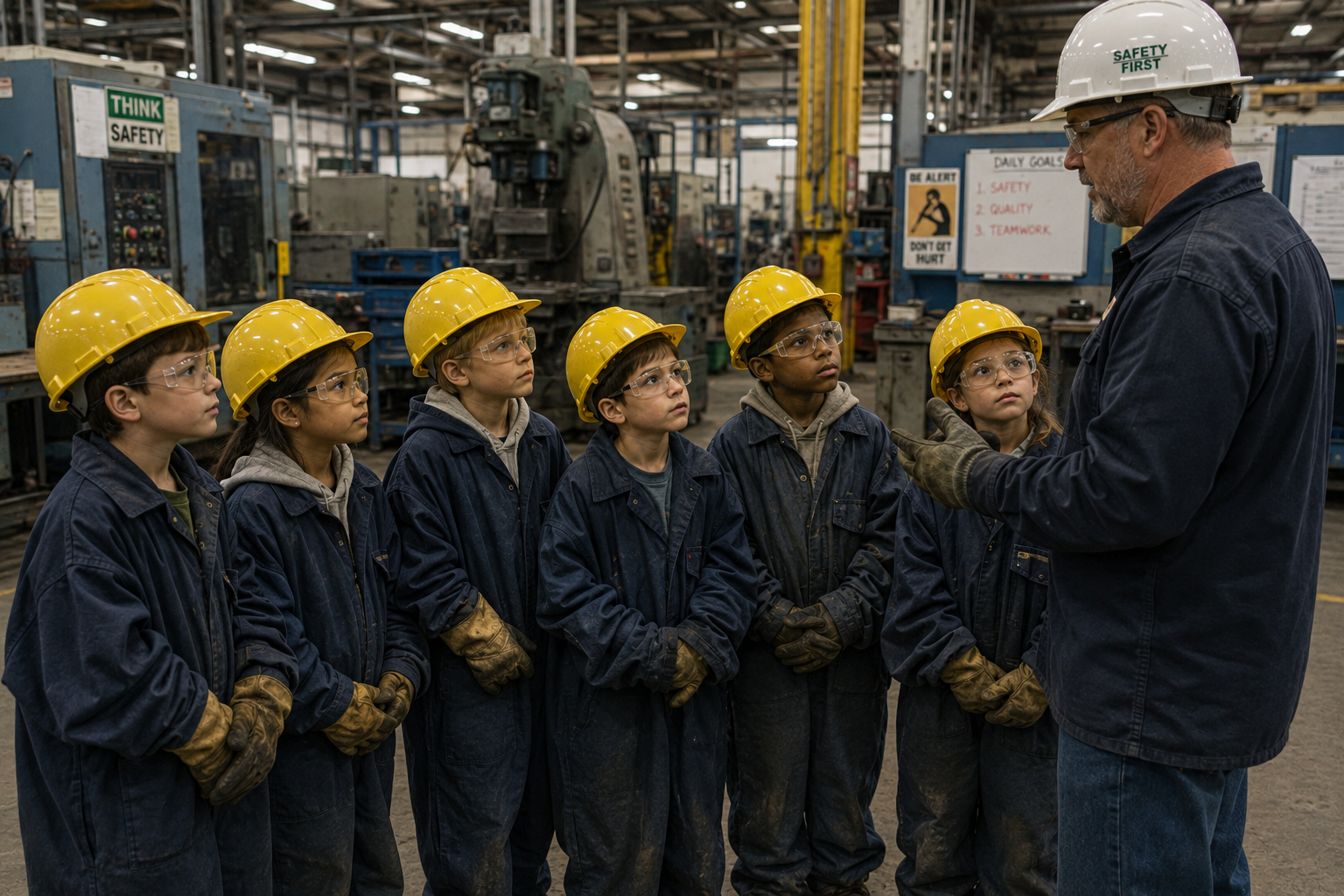
If employers want you to have long-term work experience before the age of 22…. (image generated with Chat GPT)
Those company-by-company decisions are adding up: for the first time in history, for example, young college graduates are unemployed at a higher rate (5.6%) than the general population (4.2%).
At the same time, state government is facing a talent shortfall – a significant portion of current state government workers expect to retire in the next 3-5 years. It will need lots of entry-level workers.
That presents an opportunity.
The AI Council report recommends that the state pave an intentional on-ramp for entry-level workers to start in state government, creating “entry-level placement pathways that position state government as a model employer for a future-ready workforce.” Each cabinet agency would establish a dedicated “AI Liaison,” responsible for (among other things) overseeing a redesign of jobs to ensure that early-career workers get meaningful AI-specific experience that would set young people up for private sector jobs or long-term positions in state government.
Is there anything we can do to slow down AI-related layoffs? The state has no control over decisions private companies make on layoffs, but it might be able to require companies to provide more information about the layoffs sooner. That way, government agencies can respond more quickly and more accurately when AI-related layoffs occur. As Gates put it in his LinkedIn post, “Waiting until people are already displaced or unemployed will be too late.”
The AI Council report also outlines an approach that might enable companies to stop short of a complete layoff of an employee, creating a tweak to allow an employee to receive partial unemployment while working reduced hours. This would give the employee important time to gain new skills that might enable them to stay on long-term or get re-employed elsewhere more quickly.
How do we get people back to work after layoffs? The state needs to up its game both upstream – identifying and preparing for layoffs of workers in particularly vulnerable jobs – and downstream – reacting quickly to ensure people get the skills and supports they need once a layoff comes.
A 2024 report from Microsoft and LinkedIn shows that 66% of businesses across all sectors “would not hire someone without AI skills.”
A similar percentage would choose to keep a less-experienced employee with AI skills than a more-experienced worker without those skills. The AI Council report recommends an initiative to equip 50,000 people in North Carolina over the next two years with “micro-credentials” – short courses intended to equip existing and prospective workers with various kinds of AI skills identified by employers as important. This initiative would form a key part of a “statewide AI career transition program” which would connect “participants directly with employers, apprenticeships, career support pathways, and incubators to accelerate re-employment.”
In the near term AI will not replace as many jobs as it reshapes -- it’s not “coming” for every job. One estimate is that the technology will “transform” about half of US jobs over the next three years. And there are professions where AI is likely to have less of an impact in the near term (I’ve written before about those -- here and here).
My work on the North Carolina AI Council reminds me how important it is for all of us to be ready for that replacement and transformation. That’s on all of us. But government can and should and must be on the job, getting ahead of the challenges that are coming, ready to help and prepared to try a variety of approaches to anticipate and respond.
Notes:
Farm employment change over time: https://carolinademography.cpc.unc.edu/2015/02/19/nc-in-focus-employment-in-3-industries-1850-2010/
Manufacturing employment change over time: https://ncmep.org/about/manufacturing-matters/
Service sector employment: https://www.commerce.nc.gov/data-tools-reports/labor-market-data-tools/employment-projections/north-carolina-employment-projections-2024-2034-statewide-projections
Bill Gates on speed of AI: https://www.linkedin.com/posts/williamhgates_ai-will-either-be-the-greatest-equalizer-activity-7498273886308966401-Vq56?utm_source=share&utm_medium=member_desktop&rcm=ACoAAACgkhoBdnSnP73EsqDdtXGx00QUdgxlWtU
Report of NC Governor’s AI Council: https://governor.nc.gov/news/press-releases/2026/07/01/governor-stein-announces-ai-strategic-roadmap-protect-and-better-serve-north-carolinians-prepare
Elon University study on use of LLM’s: https://imaginingthedigitalfuture.org/reports-and-publications/close-encounters-of-the-ai-kind/close-encounters-of-the-ai-kind-main-report/
Forbes story on entry-level job decline: https://www.forbes.com/sites/michaeltnietzel/2026/08/02/what-the-changes-in-entry-level-jobs-mean-for-new-college-graduates/
AI reshaping vs. replacing: https://www.bcg.com/publications/2026/ai-will-reshape-more-jobs-than-it-replaces
Employers prefer to hire people with AI skills: https://assets-c4akfrf5b4d3f4b7.z01.azurefd.net/assets/2024/05/2024_Work_Trend_Index_Annual_Report_6_7_24_666b2e2fafceb.pdf
The percentage of entry-level jobs officially requiring AI skills is lower, according to a new report by NACE — about 35% — but that number has tripled in the past six months.https://www.naceweb.org/job-market/trends-and-predictions/demand-for-ai-skills-in-entry-level-jobs-nearly-triples-since-fall-2025