AI Update Part 1: Jobpocalypse When?

Note: This is the first of a five-part series examining how America is preparing for the impact AI will have on jobs and work. Future posts will look at how individuals need to adjust their perspective on work, the opportunities AI brings to entrepreneurs, what government can do to prepare for massive job transition and how AI data centers are serving as a vessel for our fears about our job future.
It’s apparently impossible for people to avoid using catastrophic language when discussing the impact of AI on the job market (see my headline above!). The head of the International Monetary Fund says AI will hit the job market “like a tsunami.” The Institute for Public Policy Research warns of an “AI apocalypse” that will “destroy” millions of jobs in England. Anthropic’s Dario Amodei famously predicted AI would cause a “white collar bloodbath.” Venture capitalist Chris Sacca went blunt in a different direction on Tim Ferriss’s podcast: “We are super f*cked.” More cautious reports will use words like “rising tides” and “crashing waves.” And even tech optimistic analyses will still use the words, if only to say what they think will not happen.
Over the past few weeks, I’ve looked through about ten of these reports. They use different methodologies and come up with different specific numbers, but they have a few things in common when it comes to predicting what AI will do to jobs. At the end of the day, each of them concludes that 1) AI-related job loss is coming; 2) Some existing jobs will go away; 3) Some existing jobs are relatively safe; 4) Some new jobs will be created; 5) We can’t say for sure which jobs, and when.
The newest of those reports offers a new frame, and some useful nuance for trying to project what will happen. Goldman Sachs Research’s latest paper “An AI Jobs Apocalypse?” (nobody can resist scare words, even if they soften them with a “?”) brings multiple economists to the table and provides some useful guidance on each of those five categories.
The chart in the report that has me excited is this one. It looks at which jobs have most “exposure” to significant change in an era of AI. But then it overlays a calculation of “complementarity.” And that teases out some important issues related to timing. For example:
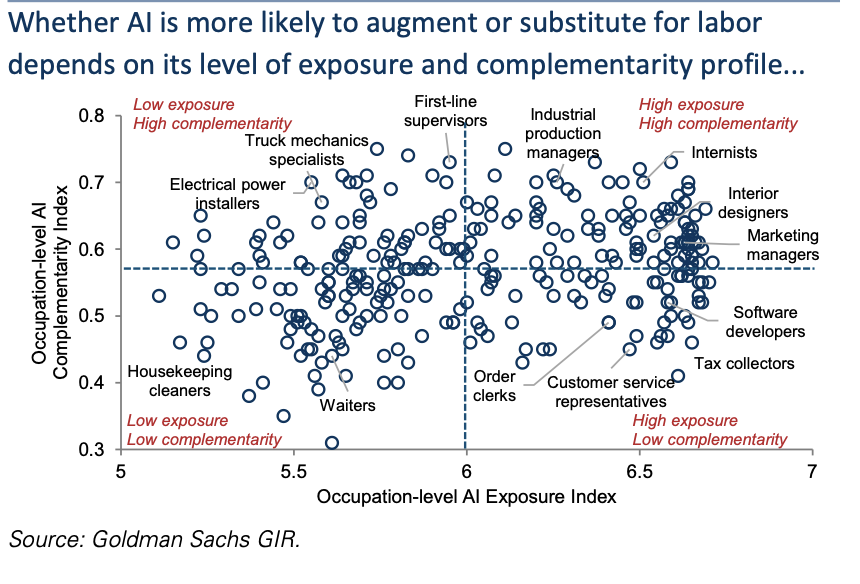
One chart to rule them all? This one brings more nuance than others I have found to how AI implementation might impact jobs.
· Customer service representatives have “high exposure” and “low complementarity.” That means AI can take on a number of their tasks (high exposure) and there aren’t many new tasks reps can do more effectively (low complementarity). So lots of those jobs are likely to go away.
· Interior designers also have “high exposure.” AI can make a lot of the technical elements of their job easier. But that could free them up to develop more ideas and focus more on the relationship-centric, hands-on, site-specific work they do and enable them to share more ideas (high complementarity). So maybe they will be able to serve more clients than they could in the past with lower overhead.
· Housekeepers have low exposure and low complementarity — AI doesn’t make their jobs much more vulnerable, but also isn’t likely to make them much more productive. That work won’t change dramatically and there may even be more of it as income for wealthy individuals grows.
· AI won’t replace the hands-on work truck mechanics do anytime soon (low exposure) but could help them with diagnosing problems (high complementarity). The number of jobs will likely stay steady and wages may increase.
Here’s how the chart plays out when it comes to the big five “AI and Jobs” questions.
1. AI-related job loss is coming
“AI washing” (the strategy of companies using “AI” as the justification for doing layoffs they would have done anyway) is real, but the report is clear: AI is already resulting in some corporate layoffs and a slowing of new hires at some companies and those efforts will continue. After wrestling with multiple variables, the Goldman Sachs report estimates that, over the next ten years, as AI moves toward full adoption, this will result in what it calls “moderate near-term displacement” – about 9% of workers in the US, or 15 million people, will be unemployed for some period of time as a result of AI.
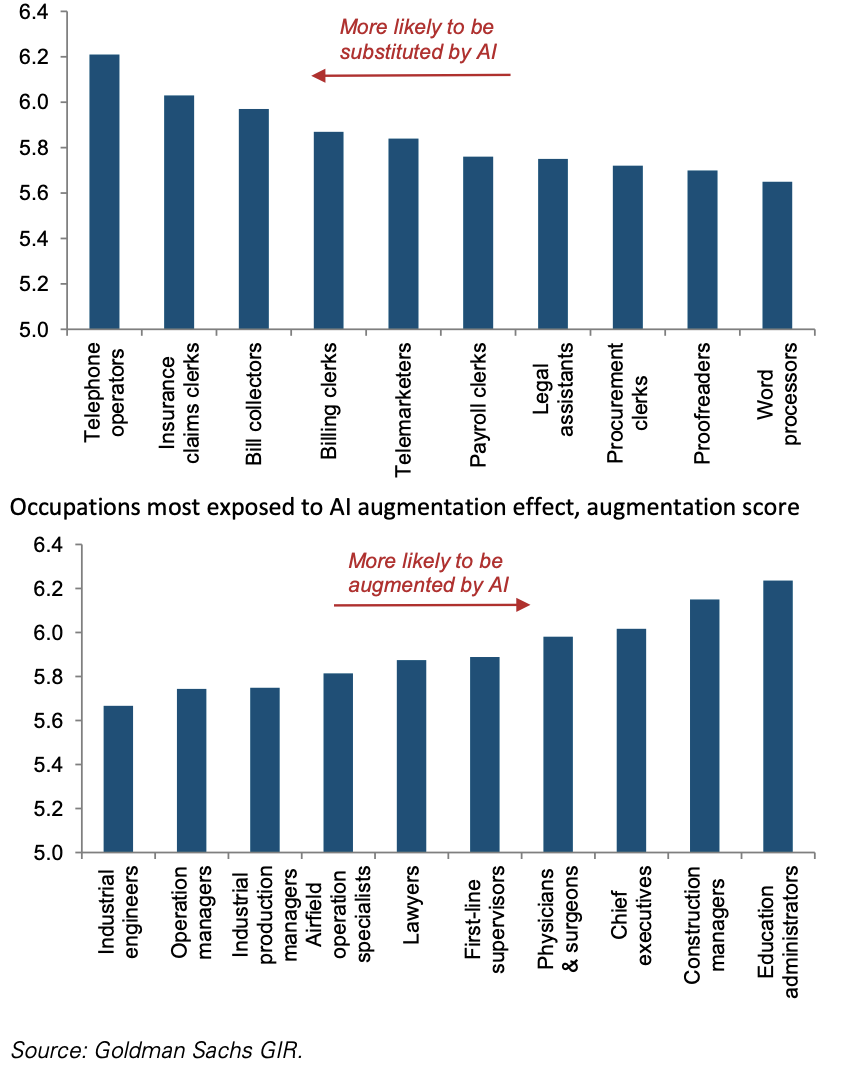
“Substituted” means your job may go away; “augmented” means your job could get bigger.
2. Some jobs will go away sooner
The first set of jobs AI is replacing are in the “high exposure, low complementarity” category – customer service jobs, tax collectors, order processors, legal assistants and low-skill coders are all vulnerable. Some of these jobs may persist at a higher level; for example, customer service for elite customers or for impossible questions – but the routine tasks will disappear as AI gets more and more sophisticated. Some companies may offer employees a chance to retrain to see if they can transition internally, but much of the challenge of reskilling will fall on the displaced workers and governmental organizations (more about this in a future post).
3.Some jobs will persist for some time
High touch, high relationship jobs – pastors, waiters, and health care aides – are typically “low exposure.” They may evolve and become slightly more efficient, but big AI is not focused on those jobs (there are exceptions – note the rise of AI companions and even AI religious counselors). AI is focused on construction jobs, but not because it wants to take them over. Instead AI depends heavily on humans who can build and equip data centers. According to iRecruit, the industry is currently 500,000 workers short of what it needs for data centers, with a particular shortage of electricians who can install the centers’ complex electrical systems.
4. Some new jobs will be created
In the past, new technological advancements have resulted in “creative destruction" — one type of “old” job has gone away, but it has been replaced by even more “new” jobs. For example, textile mills replaced a lot of people sewing by hand, but the resulting increase in production employed even more people working on the looms and lines. The Goldman Sachs report notes that about 60% of workers today are in occupations that didn’t even exist in 1940.
The new jobs>old jobs formula has played out repeatedly in the past, but as economics Nobel Prize winner Daron Acemoglu notes, “no general law of economics says that job creation must match job destruction.” AI may be a new case that results in fewer total jobs rather than more.
That said, the Goldman Sachs report comes off as long-term tech optimistic.
· LLM’s will surely help entrepreneurs by enabling them to develop their initial ideas with low overhead, getting the kind of early coding, market analysis and back office support that small companies typically struggle to afford. Some of those new companies will then grow to the point where they begin hiring human employees.
· AI may create more discretionary income, which could juice demand for services — think categories like pet care, athletic training, educational support — or new services we haven’t thought of yet.
· AI might create new specialized fields within existing occupations – highly skilled jobs focusing on tasks that require uniquely human judgment or the ability to manage teams of AI agents.
The challenge is that there will be a lag time between AI-related layoffs and new job creation, and that the new jobs won’t likely be the same as the old jobs – they will require people with new skills and abilities. Retraining 15 million people will be a huge undertaking.
5. We don’t know which jobs, or when
The Goldman Sachs exposure/complementarity chart gives a very rough outline of which kinds of workers might need to adjust their current work or skillsets most quickly and which appear to be most at risk of layoffs, but nobody can predict exactly how a technology will change a market.
· How will it ripple?: When GPS came out, it eliminated the need for the kind of detailed route knowledge experienced taxi drivers had, but that made it much easier for new drivers to enter the market. Similarly, AI may soon eliminate the need for copy editors, but free up experienced editors to spend much more time doing the higher level work of shaping stories.
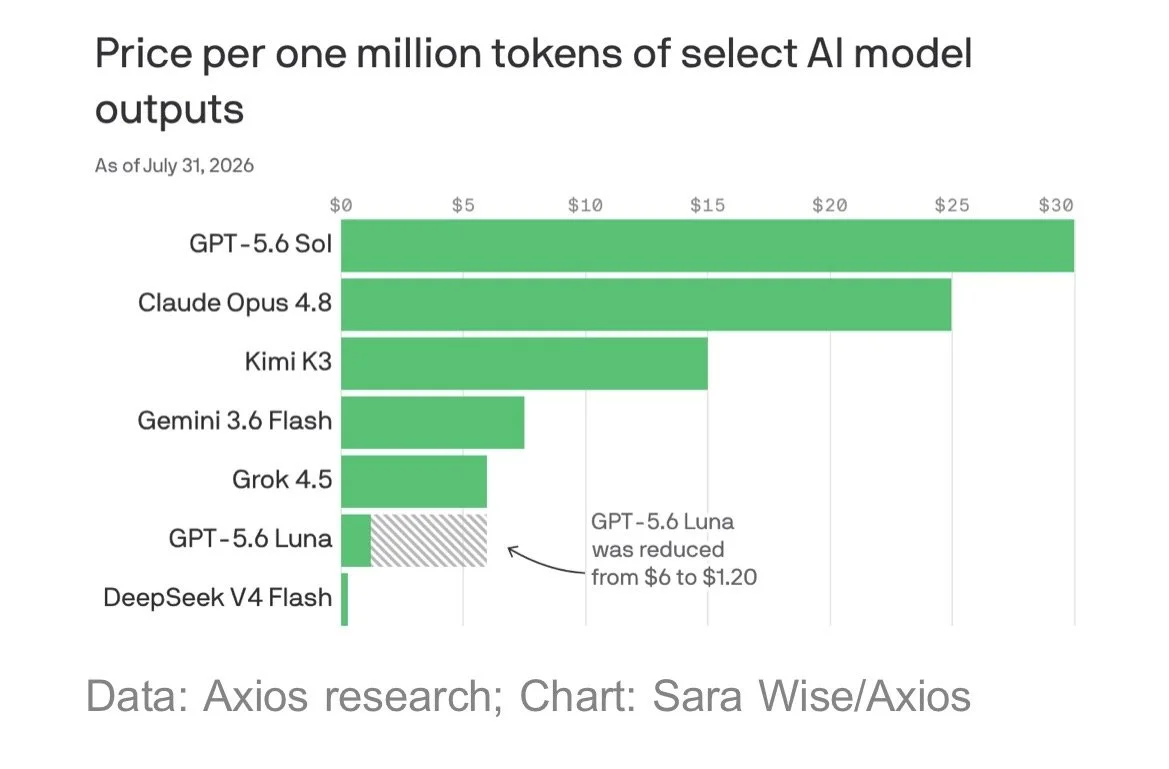
The world’s top four most used AI models last week were all Chinese open source, led by DeepSeek V4 Flash 0423. They aren’t quite as good as US proprietary models, but they come at a fraction of the price. OpenAI slashed the price of its lowest price model by 80% last week — it’s still not as cheap as DeepSeek.
· What happens with margins?: As open source AI models enter the market, the price AI companies can charge for tokens is declining. Some AI companies may focus more attention on selling low-margin AI solutions to consumers, which will eliminate one sort of jobs and create others. Other AI companies will focus on developing ever-more-sophisticated higher margin tools for corporate clients. Which solutions the market buys will have a big effect on which jobs change most quickly.
· Can you prove productivity gains?: The speed with which AI rolls out could change. So far major corporations have been enthusiastic early adopters. On calls with shareholders last year, 54% of S&P 500 companies last year announced that they expected productivity gains from their investments in AI. But so far only 11% of companies have been able to quantify those gains. If companies can’t show results soon, AI implementation will slow.
My takeaway from all this: AI is not going to replace as many jobs as quickly as we believed a year ago, but it is not turning around. About 55% of us report using AI “in some form” “regularly” — most of us at home in search or with small work tasks. It’s time for those 55% to broaden our use to understand how we can use it to enhance our work. And it’s time for the other 45% of us to stop standing on the sidelines and start paying attention.
Next time: AI reminds us to take agency over our careers.
-Leslie
Notes:
Goldman Sachs report: https://www.goldmansachs.com/pdfs/insights/goldman-sachs-research/an-ai-job-apocalypse/report.pdf
IMF on the jobs tsunami: https://www.imf.org/-/media/files/news/seminars/2024/12th-statistical-forum/p1sessioniiinov20generative-ai-and-jobs-a-global-analysis-of-potential-effects-on-job-quantity-and-q.pdf?utm_source=chatgpt.com
A pretty comprehensive review of AI job loss vs. gain reports: https://aimultiple.com/ai-job-loss
Electrician shortage: https://www.youtube.com/shorts/YNxBUp8cM88
AI construction sector needs more broadly: https://www.irecruit.co/insights/data-center-construction-labor-market-report