AI Update Part 2: AI and Personal Agency
Growing up, most Sundays after church, my sisters and cousins and I would go to our family’s architecture office and doodle on the drawing boards while our fathers squeezed in a couple of hours of work.

In our family, the family business was the path of least resistance.
I was about twelve when I finally asked the question I’d been worrying about: “Dad, do you want me to be an architect?”
It was a logical question. My grandfather had been an architect. My father and his two brothers were both architects. Already one of my cousins was heading toward architecture. But I couldn’t draw worth a lick and I worried what my father would say.
My recollection was that he said this: “I want you to do whatever makes you happy.” And what I remember is that I took that as this: he knew I had no talent and was gently steering me away from architecture. So at age 12 I remember concluding I was going to have to find something else to do with my life (years later, I asked him about this seminal conversation: he had zero memory of it and said he thought I could have been a good architect — careful what you say to your kids).
Many years later I’ve come to realize that what happened to me at that age was rare, and is probably getting rarer. Over the years, I’ve heard dozens of people describe how they chose their job in a very different way. They grew up following a script. Showed up for school. Graduated. Then…
· They went to work in the factory because that’s where their dad or mom or cousin worked.
· Or they joined the family business because someone expected them to.
· Or they firehosed applications to a bunch of jobs and took the first one they were offered.
· Or they went to business school because they couldn’t quite figure out what to do and it seemed like it would buy them some time.
· Or they did what “everybody else” was doing: 58% of Harvard’s class of 2024 went to work in either finance, tech or consulting.
· Or they did what looked like fun when other people were doing it: 57% of GenZers say they’d like to be an influencer.
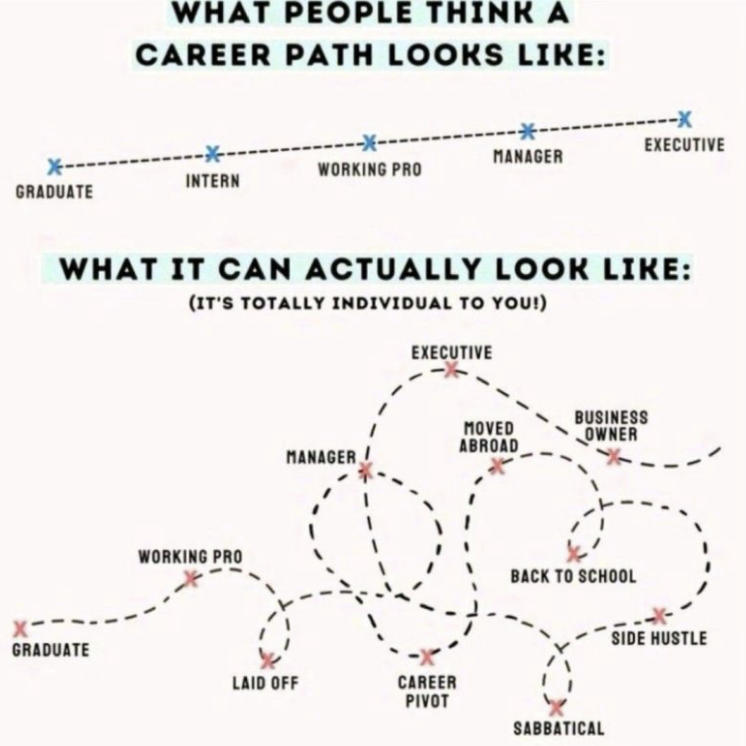
Our AI future means career paths are much more likely to be nonlinear. We need to recognize we can shape our future. (Illustration from Tshepo Ramaselwana)
Cate Hall, the author of a new book called You Can Just Do Things, confesses that she was on the straight-line career path, unconsciously following the script of what was “expected” of her. She worked hard in school, graduated, went to law school, took a corporate law job. But as Steven Covey noted in The Seven Habits of Highly Effective People, if our life ladder “is not leaning against the right wall, every step we take just gets us to the wrong place faster." One day Hall realized she was climbing the wrong ladder: she hated her job and had no clue what to do next. Her book is about how hard it was for her to jump off her assembly line career and determine what to do next, and what we can do to avoid that.
It’s a pivot millions of us are going to need to make over the next decade as AI changes the world of work.
To do that, we need to rediscover our agency, our ability to shape what happens to us.
AI gives us an excuse, an opportunity and an impetus to do that.
"Between the idea / And the reality / Between the motion / And the act / Falls the Shadow"
T.S. Eliot, “The Hollow Man,” 1925
Americans talk a big game when it comes to entrepreneurship. The 2023 Small Business Trends Survey by Incfile of 2000 Americans found that 68% believe they have an “entrepreneurial mindset.” About 74% said they had come up with a business idea. And 90% of those surveyed said they would prefer to be their own boss. A separate study by GOBankingRates found that 42% of Americans have actively considered starting a business. But up until now, most people just don’t follow through: only 16.5% of adults age 18-64 actually run a small business of any size.
AI could change that number. The technology isn’t just permitting Americans to be more entrepreneurial. Over the next decade it will force us to be more entrepreneurial.
As existing workplaces implement AI team by team -- purchasing, HR, legal, accounting, sales, marketing -- the people interested in remaining employed will need to become intrapreneurs, figuring out what they can still do that AI can’t, then making the case for doing their work in a new way (see Part 1 of the series).
Others will find themselves unable to adapt quickly enough in their current work. They’ll lose their jobs and will have to think entrepreneurially, forced to assess their skills and abilities and interests and reimagine what value they can bring to a new or different organization, accessing their creativity in a way they may never have before.
Some groups may be better prepared for this transition than others.
· Immigrants have historically been more entrepreneurial than native-borns – perhaps because they have found fewer opportunities in the traditional workplace. Last year, a study by Gusto found that immigrants started 37% of new businesses.

Those who have struggled in the existing job market are more likely to start their own businesses (Image generated using Chat GPT).
· Young people, perhaps because entry level jobs are shrinking, are more likely to be open to starting new businesses (38% consider themselves “entrepreneurial”). According to the Global Entrepreneurship Monitor (GEM) USA report, in 2025, 23.6% of 18-24 years olds were engaged in entrepreneurial activity, more than any other age group.
· Blacks are particularly open to starting new businesses. According to the GEM report, nearly 1/3 (32%) of blacks describe themselves as “entrepreneurs,” 2.5 times the rate of whites. Gusto’s survey found that 69% of black-owned businesses were launched by women.
· And researchers at the Kellogg School have found that formerly incarcerated individuals are 40% more likely to start businesses than those with no history of incarceration.
What these groups have in common is that they have learned not to assume a job is waiting for them and have already made the pivot into an entrepreneurial mindset.
The GOBankingRates study asked potential entrepreneurs what was holding them back from taking the step. AI could ease each of the barriers they highlighted.
· Money: About 44% of those surveyed said they couldn’t start a company because they didn’t have “enough money.” There are multiple pathways to funding a new business beyond personal assets, including loans, grants, crowdsourcing and bootstrapping, but AI LLM’s offer dramatically cheaper tools that can (with human adult supervision) handle many parts of revenue projections, accounting, marketing, and code development, making it possible for much of the early work on a company to be done with few or no employees (more on this in Part 3).
· Focus: Sixteen percent of potential entrepreneurs say they don’t know what type of business they should get into. Any number of AI tools have the ability to identify gaps and potential business opportunities.
· Time: Thirteen percent said they didn’t have enough free time to start a new business. AI agents, properly directed and managed, can do some of that work while the potential entrepreneur is at work in an existing job and can speed that person’s work in the evening.
As Mark Zuckerberg put it in his “AI manifesto” earlier this week:
“Everyone will soon have invention superpowers.”
“Everyone will have powerful tools to create new businesses and the economy will become more entrepreneurial. People are starting to be able to manifest ideas themselves without having to raise money or build large teams. Many ideas that would have been too hard or expensive to try before will now be possible.”

AI enthusiasts want us to see their products as Swiss Army knives for our entrepreneurial dreams (Image generated using Chat GPT).
Possible, yes, but not certain. Tools alone don’t build companies.
In her book, Cate Hall identifies one other barrier I think may be more important than any of the others.
In our lives, Hall believes, a lot of us take “the path of least embarrassment.”
We are so worried someone might see us doing something we are not proficient at, (see this piece on why we are so resistant to change and how we might “do” it better) so eager to avoid the perception that someone might see us doing something imperfectly and put us in the “mode of low status” that we just keep doing the things we know we can do, and avoid learning new things. We avoid asking questions. We avoid taking chances. We only ask for things we are confident we can get.
But, she notes, you can’t start anything new unless you are willing to open yourself to the possibility of failure, to admit you can’t do it on your own. If we are willing “to test the limits of what is reasonable, sometimes reality cracks open.”
Artificial intelligence may transform our current work to the point we can no longer do it or don’t want to. But it can also, perhaps, if we are open to it, help us figure out a new reality that could be even better.
-Leslie
Notes:
Harvard Class of 2024 job choices: https://features.thecrimson.com/2024/senior-survey/after-harvard/
Overview of You Can Just Do Things: https://www.harpercollins.com/products/you-can-just-do-things-cate-hallsasha-chapin?variant=44287888719906
Cate Hall on “The Next Big Idea podcast”: https://podcasts.apple.com/us/podcast/the-next-big-idea/id1482067226?i=1000779077002
Story on Incfile small business survey: https://www.businesswire.com/news/home/20230420005377/en/2023-Incfile-Small-Business-Trends-Survey-Reveals-68-of-Americans-Believe-They-Have-an-Entrepreneurial-Mindset
GOBankingRates study on intent to start business: https://www.gobankingrates.com/money/business/nearly-half-of-americans-have-considered-starting-a-business-heres-whats-stopping-them/
Small business startup spike 2026: https://www.inc.com/georgia-fearn/america-startup-boom-just-hit-record-high-criticis-say-not-what-it-seems/91381351
Role of AI in startup growth: https://www.nytimes.com/2026/07/17/business/economy/american-small-business-boom.html
Global Entrepreneurship Monitor USA report 2025: https://www.gemconsortium.org/news/new-gem-usa-report-highlights-increases-in-entrepreneurship-and-startup-intentions
Kellogg School study on entrepreneurship among formerly incarcerated individuals: https://insight.kellogg.northwestern.edu/article/after-prison-opportunities-are-hard-to-come-by-enter-entrepreneurship
Zuckerberg’s AI manifesto: https://www.meta.com/thefutureisforeveryone/?srsltid=AfmBOopmGGIzPziUujEFaLcocN7q6Vdf7wTNAi22yS64cCTpmJsdJ96W