Oodles of Whistling Tips: Lip Licking, Labial Stops, Hikifuki and Kissing
Note: If you’re looking for the story of my trip to the World Whistlers Convention in 2026, you can find it here and here.
Thinking about competing at the World Whistlers Convention in 2028,? Here are the preparation techniques and lingo you need to know to start getting ready.
In his 2017 book Find Your Whistle and in an interview this spring, here are some tips 4-time international whistling champion shared.
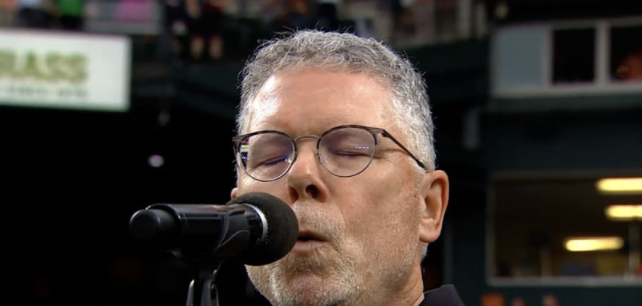
Chris Ullman whistling the national anthem at a Baltimore Orioles game this spring. He’s whistled for President George W. Bush, with symphonies and at basketball games, and is still waiting for an invitation to do an NFL game. Along the way he’s learned a lot.
Getting Ready to Compete
The Lips
Lip balm is essential. It serves two purposes, says Ullman: providing the moistness and smoothness and then preventing the loss of the moisture. He always carries a tube in his pocket.
Don’t overhydrate: Water will actually remove the natural oils and saliva from your mouth, he believes. Saliva has more viscosity. You want viscosity.
No lip licking: It does not make them moist, he says. Instead, it removes the natural oils on your lips.
No kissing: For 24 hours in advance of a competition. Kissing, he says, makes your lips too pliable. There has to be this interesting balance between firmness and softness. Kissing impacts firmness.
2. Song Selection
Start big: Ullman begins with 20 or so candidate songs, then narrows it down.
Mix it up: Songs should have a diversity of tempos and instruments. One favorite for Ullman was “Go Daddy O” by Big Bad Voodoo Daddy, which had him replicating sax, piano and trumpet runs.
Show your stuff: If you are good at fast whistling, or long runs of notes, or have good breath control, choose a song that highlights those things. One year, he chose “This Nightlife” by Clint Black, a song no other whistler could possibly keep up with.
“Familiarity” or “first date”?: Choose a song that is too familiar and the judges may have a set notion of how it “should” go; choose one they don’t know and they may not “get” it. This advice helped me decide on the Aretha Franklin version of “My Way”–judges would know the song but not the arrangement.
Pick a song you won’t hate by the time you perform it: Ask yourself – “can it be practiced incessantly without your going insane?” Ullman discovered a new classical piece by Amy Beach called “Invocation for the Violin” for one competition that fit the bill perfectly, a mixture of beautiful melody and complexity.
3. Mental Preparation:
Visualize yourself in action: See the entire performance in your mind before you get out there: Ullman says you want to be able to step up there and immediately perform your song. No hands in pockets; no closing your eyes and looking down.
Be courageous (in both whistling and in life): Don’t let your fear of being rejected or laughed at get in the way of executing. Ullman’s 2017 book, Find Your Whistle, has much more to say on this subject.
Whistling Lingo - An Abbreviated Guide
Like any discipline, whistling has its own jargon. Here are a few key terms you need to know (to hear some of the whistling techniques, try this YouTube tutorial from Yuki Takeda):

You can learn a lot about whistling from Yuki Takeda’s YouTube channel (image yukitakeda.com)
A Capella: Whistling with no accompaniment. A new category in this year’s World Whistlers Convention. Formerly the central competition was among competitors whistling over an accompaniment track.
Allied arts: Mouth whistling accompanied by some other performance technique. Examples might include hand whistling, ventriloquism, whistling with someone else playing an instrument, or dance.
Glissando: Sliding smoothly from one note to another.
Growl: A form of two-toned, or polyphonic, whistling with a deep bass note as the lower tone.
Hikifuki: (Japanese: literally “playing an instrument” + “blowing”) self-accompanied whistling. Contestants whistle while playing the piano, guitar or ukelele.
In ‘n out: As Yuki Takeda puts it in his YouTube tutorial, ”Imagine an over-heated dog in summer, but do it faster than them.”
Inhale whistling: What it sounds like: whistling while breathing in.
Labial stops: (Hey, I didn’t invent these terms. Chill!) This is not whatever you may be thinking. It’s just a term that describes slowly closing the lips (labia) at the end of a note to end the sound.
Oodles: Whistling produced by a double tongue (“oodleu-oodle”)movement
Polyphonic whistling: Getting tones out through your mouth, typically at a high pitch; a “growl” is ia polyphonic whistle in a lower tone.
Pre-recorded: Live whistling the melody of a song over an accompanied backing track.
Pucker whistling: The classic – whistling by blowing air out through “O’-shaped lips.
Siffleur: (French) A professional whistler.
Vibrato: Whistling a tone that wavers slightly around either side of a central note.
Warbling: Whistle technique that imitates a bird sound. Approachable only by elite whistlers.
Notes:
Yuki Takeda’s website: https://yukitakeda.comHis YouTube channel is a rich source of insight into the whistling world: https://www.youtube.com/YukiTakeda
You can order a copy of Find Your Whistle here: https://www.amazon.com/dp/1684010209?lv=shuf&channelId=500&plpRedirect=mhFallback