AI Update Part 3: Entrepreneurship In the AI Age
Darrell DeBrew has a dream he thinks he can turn into a $288 million reality. He envisions a full-scale social media company serving black businesses, black content providers and black entrepreneurs. “Think of it,” he tells me, “As a combination of black Yelp, black Tiktok and black Shark Tank, all on the same platform.”
It’s a big dream. And he can tell you, step by step, exactly how he wants it to unfold. But right now the dream is hung up by a technical problem with Lil Reggie’s Cookies.
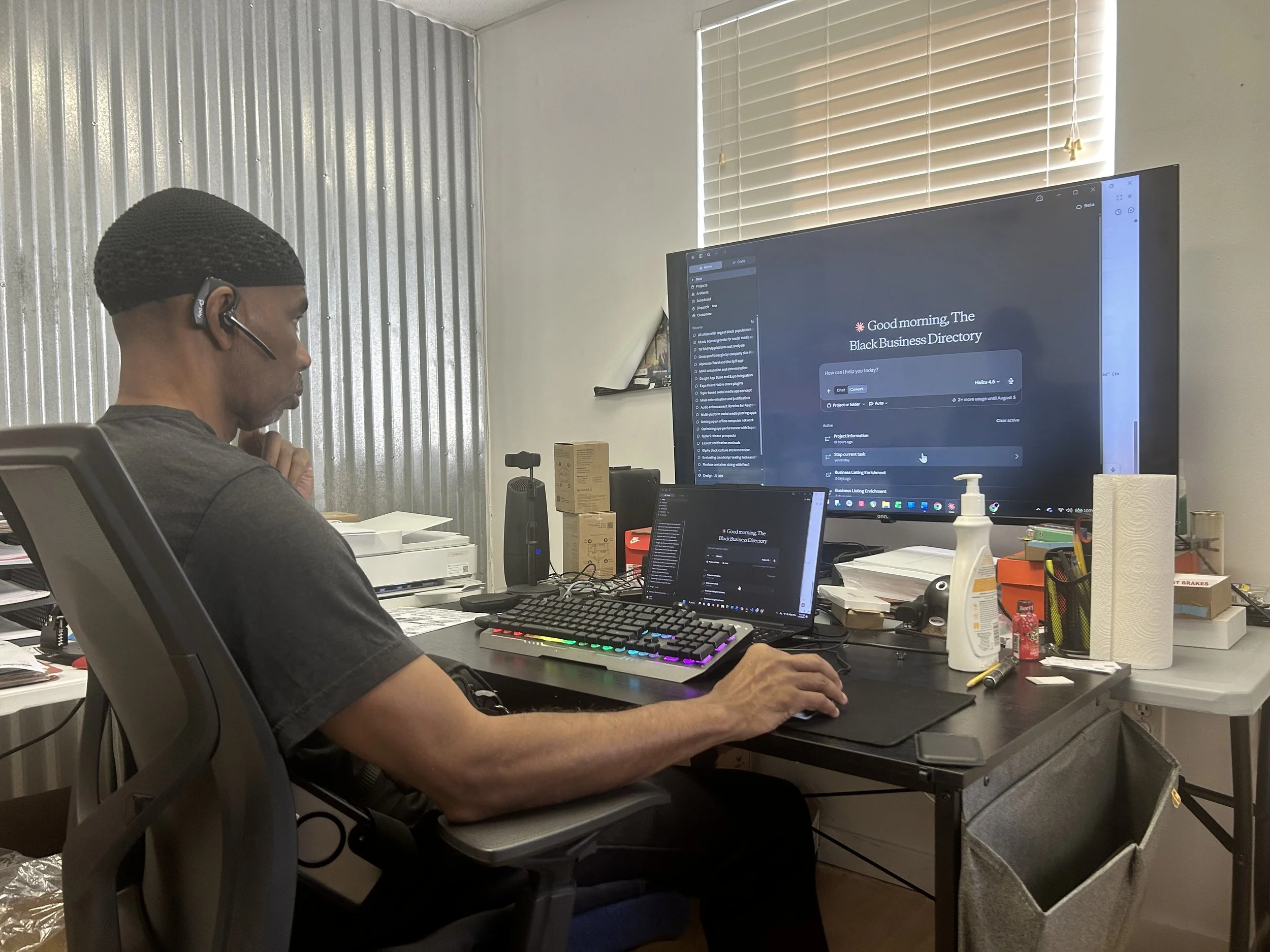
Darrell has to keep a close eye on his team of AI agents, but they do work at a volume no human could.
We’re sitting in his office off a garage in North Raleigh where Darrell has a laptop running Claude Code and Claude Coworker and a giant monitor keeping track of their work. He’s asked the two AI tools to work together to build listings for the 250,000 businesses that will make up what he calls the Black Business Directory, the first product in the new company he is creating. He’s tasked Co-Worker with helping him develop his business plan, project potential revenue and organize his implementation. He’s asked Claude Code to help extract information from the websites of existing businesses and put them in a common format for the Black Business Directory.
“The tools are very very useful,” says Darrell. “One will do certain things very well. One will do other things well. But they don’t always talk to each other very well and they don’t understand real life.”
Both tools are doing things he would otherwise have to pay humans to do.
“I could not build a directory at this scale without AI tools,” says Darrell. “What I have done so far would have cost me $1 million — which I don’t have — if I had to pay people.”
But because Darrell is the only human involved, he’s also completely responsible for instructing his AI agents, resolving disputes when they work at cross purposes, noticing when they make mistakes or faulty assumptions and ensuring they execute his vision.
Case in point: the listing for Lil Reggie’s Cookies, a Clayton, NC-based bakery. His AI agents are supposed to search the web, create a description of the business, find its website, discover a profile picture, then move on to the next listing.
“OK now Claude’s going to pull pictures from Reggie’s site,” says Darrell, “And put them into the profile. Nope — that’s not a good picture.” Darrell taps in feedback. Claude Code goes back to the task. While the AI works in the background, it sends him a new gerund at the bottom of his screen every five seconds to assure him it is hard at work:
“Cogitating….Improving…Vibing….”
According to the US Census Bureau, between the beginning of January and the end of June, 2026, Americans filed more new business applications than in any previous six month period, 3.23 million – a 12% increase over the first half of 2025. At the same time, the percentage of companies announcing plans to pay employees declined by 18.6%.
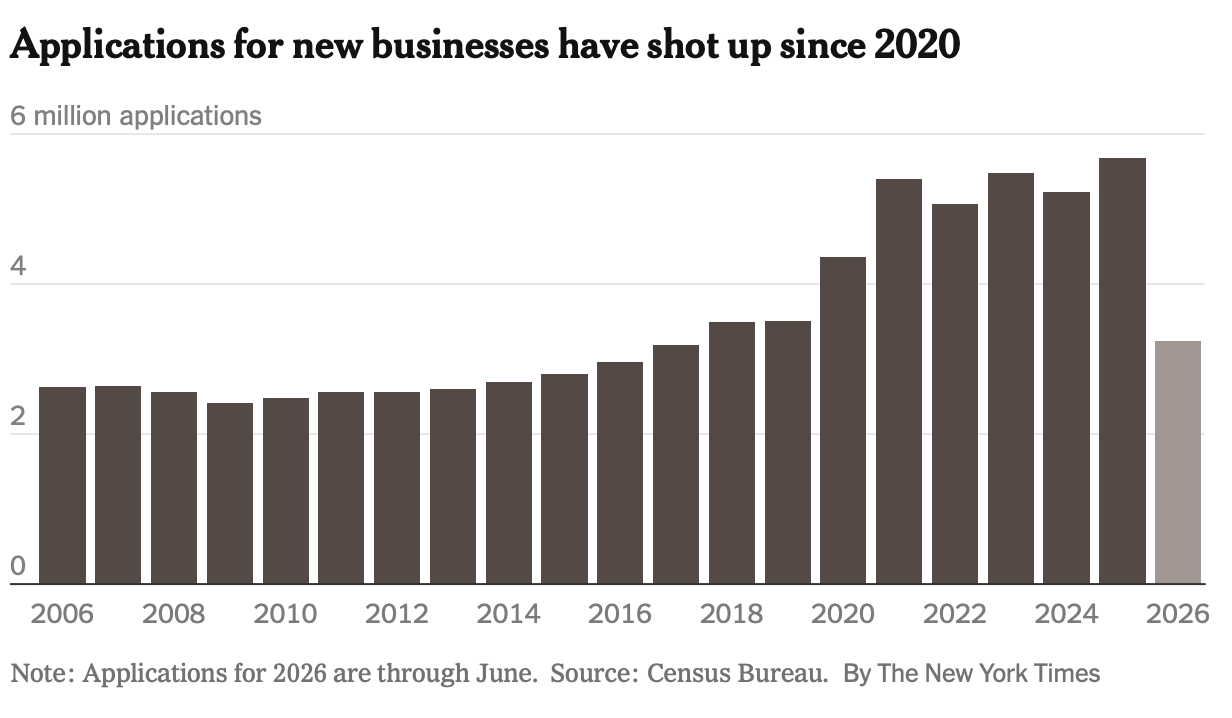
Small business applications have shot up post-pandemic. AI is part of the reason.
Experts say AI explains part of this development. The same tech that is driving some people out of existing jobs and is standing in the way of others getting their first jobs is also providing them the tools to create new work.
Earlier this year, the 2026 Gusto New Business Formation Report released a surprising finding. It found that 60% of new business founders had used AI to help start their businesses.
AI tools are making it possible for entrepreneurs like Darrell to think bigger than ever. Then they make it possible for them to refine, develop and even begin executing business plans with very little investment – and often no other employees.
***
This is Darrell’s second startup. Released from prison in 2016, he immediately began looking to create a business of his own. For his first startup, he used his existing knowledge of cars, and the knowledge of technology he taught himself, to build a new model for an auto repair business. He performs only one service – changing brakes. For marketing, he optimizes his site on search engines so that people see his business first when they search for “brakes.” For back office, he uses AI to do the scheduling, asks customers to purchase their own hardware and keeps overhead low – he pays only for the garage, power and a wi-fi connection. “I simplified the process,” he says. It’s working: the business, justbrakes.xyz, makes him $100,000 a year, he says.
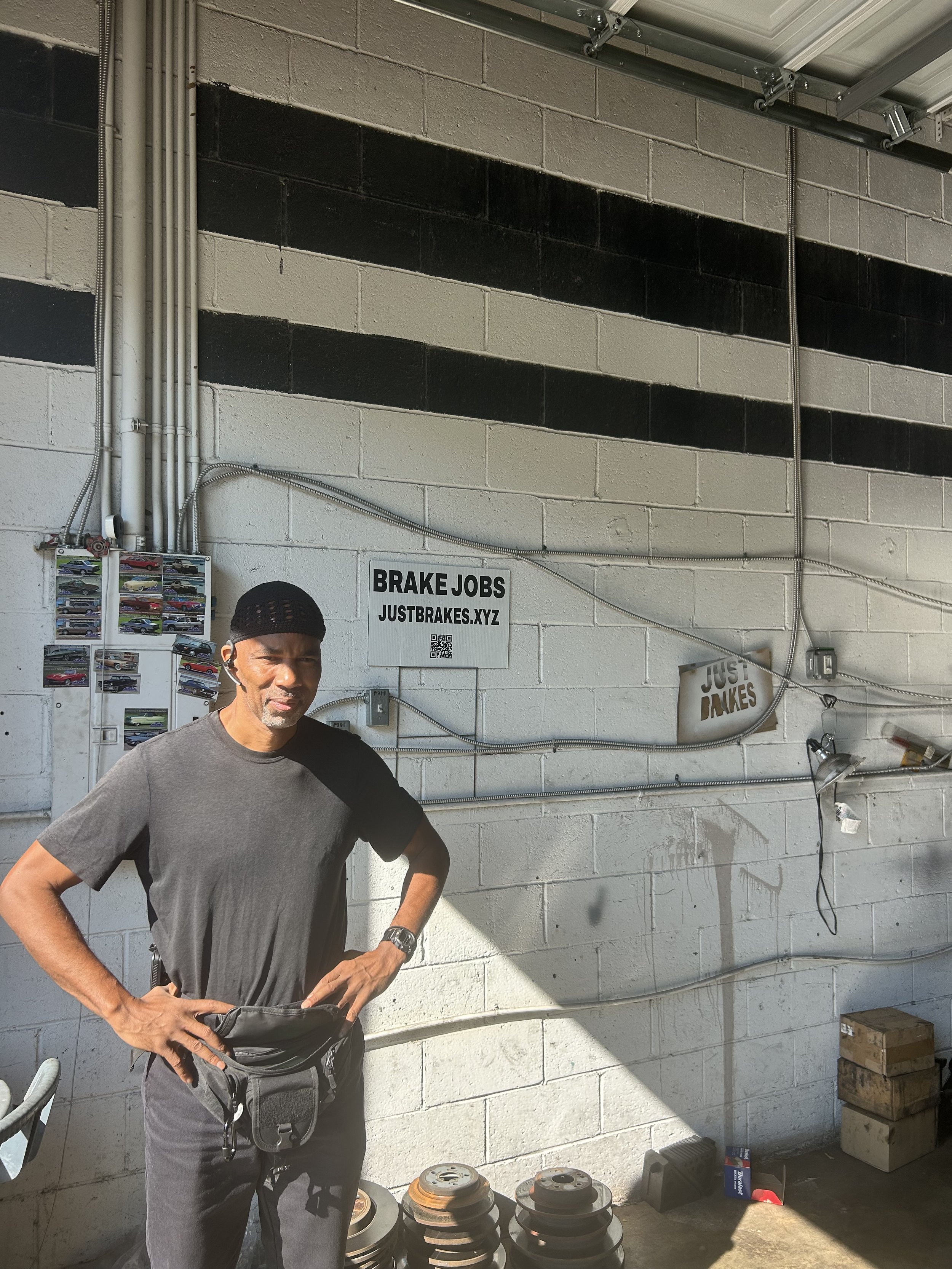
Darrell’s first startup pays the bills while he creates his big dream.
And now, AI is helping him build an even bigger dream. Next to the rented garage in a small office, between brake jobs, he’s managing a team of AI agents, slowly correcting and perfecting their work to build what could be a very different, life-changing business.
“Wibbling… shimmying… contemplating….”
“That’s much better,” he says as he looks at the listing for Lil Reggie’s Cookies on the BBD. Claude has already moved on. The next 100 listings will go more quickly. Then the next 1000 and the next 10,000.
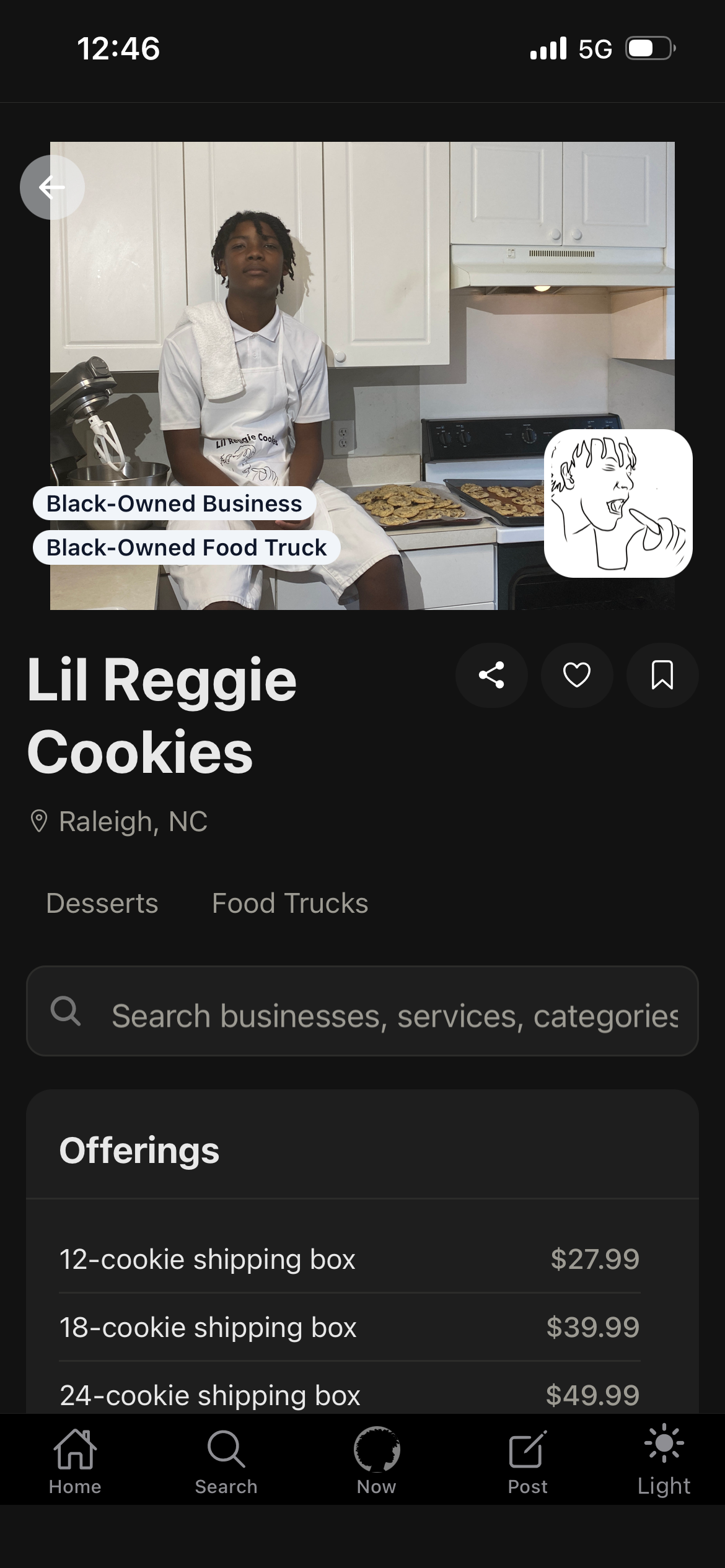
It took some human coaching, but eventually Lil Reggie Cookies listing was ready for the BBD.
AI visionaries tell us that the technology will be able to accurately predict years of sales, discover new markets, tell us which advertising works and how we could do it better and reduce waste in manufacturing processes. They say it will help us end drudgery, cure diseases, discover new energy sources, and bridge inequality. And they say it will give millions of us the ideas and capacity to create our own future. Darrell will tell you that right now it can’t do any of that without humans taking time to learn how to effectively use it and then carefully checking its work.
“Yeah, you can build some software. But you can’t build a company,” Darrell says, then pauses.
“Listen, the AI people are doing what they’re supposed to do. They’re supposed to sell a dream. They’re doing that. But I’ve gotta figure out how to make that dream work for myself.”
“Frolicking… simmering… wandering…”
Darrell is figuring it out, with a sometimes rogue, occasionally brilliant, always diligent, but sometimes “wandering” virtual team. The question for the rest of us is: are we ready to reimagine our own dreams – and make the investment of time to turn them into reality? For that, AI may be necessary, but it won’t be sufficient.
Notes:
Small business startup spike 2026: https://www.inc.com/georgia-fearn/america-startup-boom-just-hit-record-high-criticis-say-not-what-it-seems/91381351
Role of AI in startup growth: https://www.nytimes.com/2026/07/17/business/economy/american-small-business-boom.html
Gusto report: https://res.cloudinary.com/dja3z8nt6/image/upload/v1778711978/Gusto_The_AI_Advantage_PDF_V3_dgik5h.pdf
Generative AI spurring business activity: https://conference.nber.org/conf_papers/f238865.pdf