The Four Work Spirit Animals
Every year in the US, right around this time, about 3.3 million people graduate from high school; another 2.1 million get four-year degrees. A million people get associate degrees; another million get master’s or doctoral degrees.
And then something remarkable happens. Except for those who sign up for more education, most of these people end up with their first, real, full-on, full-time jobs (if you’re not quite there yet, I shared some ideas about that process here.)
This piece is about what happens when you start work.
I think there are four good choices of spirit animals to channel as you enter the workplace. You can be an ox, a penguin, a beaver or an eagle.
The Ox

Oxes “get ‘er done.” (Image generated by ChatGPT)
Folks just beginning at a company will mostly be given assignments by other people. That’s familiar to young folks; it’s how most of our early life and education has worked. New employees who want to make an impression need to make sure they know what the assignment is, then put on their harnesses like an ox and pull their load. That doesn’t mean working alone or not asking questions -- if you’re doing anything for the first time, you need to know where you are going and how to get there. But then you need to find a way to get the thing done. Marge Piercy celebrates the oxen in her poem “To Be of Use”:
I love people who harness themselves, an ox to a heavy cart,
who pull like water buffalo, with massive patience,
who strain in the mud and the muck to move things forward,
who do what has to be done, again and again.
Bosses love oxes too.
And being someone who can “get ‘er done,’ especially as a new employee, gets you noticed as “dependable,” or as a “go-to team member.” An ox is not a bad choice for a work spirit animal: you need to be able to plow to the end of the row, completing assigned work on time, with excellence.
The Penguin
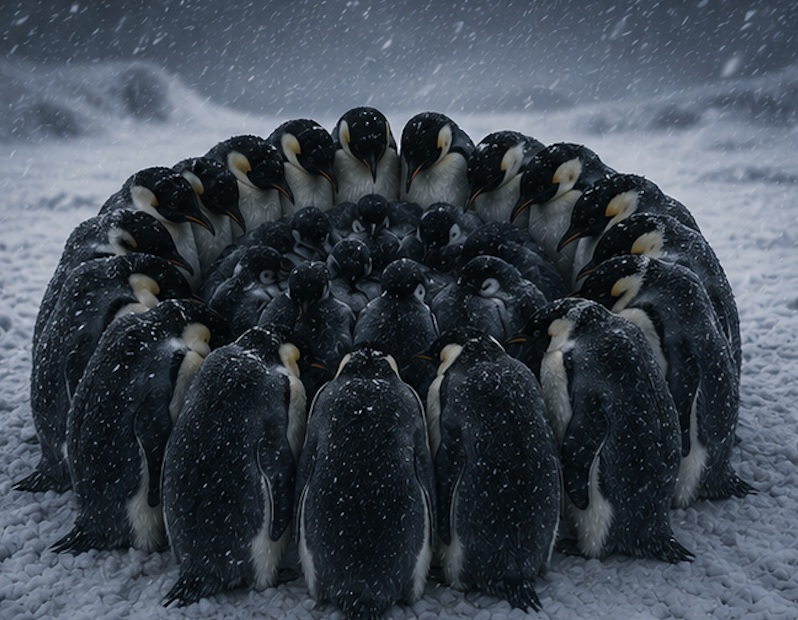
Penguins do what it takes to strengthen the colony. (Image generated by ChatGPT)
In nature, penguins volunteer to do the work their colonies and families need, even when that involves significant short-term sacrifice. They expose their backsides to the coldest weather to protect other penguins inside the huddle. Females go without food for months before laying eggs, then males go without food for months to incubate them.
There are all sorts of projects at work that nobody wants to do but somebody has to. A work “penguin” steps forward voluntarily and takes one of those on – writing the memo after the meeting, bailing out the struggling colleague, ordering the pizza for the team meeting, even unjamming the copier. If you do this, there’s a chance some of your work colleagues will call you a “sucker” or a “suck-up,” but over time those names will change to “trusted work buddy,” “culture carrier,” and “valued team member.”
The secret bonuses of volunteering? It is not nearly as time consuming as it appears from the outside; it earns social capital; and it makes you feel like you are doing a good thing.
It also inspires others to do the same thing: penguins ultimately learn to take turns exposing their butts to the cold weather.
The Beaver

By working and thinking upstream, beavers can fix a host of downstream problems. (Image generated by ChatGPT)
A few years ago, high school teacher Karl Fisch summarized in a single line the challenges we face in the workplace. We need workers, he said, in his viral video “Shift Happens,” who can “solve problems we don’t even know are problems yet.”
This week in his newsletter, “Methods of the Masters,” Stanford professor and artificial intelligence zealot Jeremy Utley updated the language a bit for the AI age:
“The world increasingly belongs to people who can determine what should be done before someone tells them what to do.”
In the wild, beavers face two big problems in the world they are given: bears can catch beavers and beavers can’t catch fish. In order to survive, they have to think upstream. By chewing down trees and damming up streams, they change their environment: the slower water enables them to catch fish and the dens they build on the underside of the dams keeps them safe from bears.
A “beaver” at work learns to get upstream on problems the organization has, to be the one who asks “What can I do to make this project that I am working on/situation that I find myself in/place that I work in… go better?” Or put another way, “What can I do upstream that will change the environment downstream?”
The Eagle

Eagles see opportunities others can’t. (Image generated by ChatGPT)
Workers who get in the habit of seeing themselves as potential changemakers, not perpetual victims, may eventually embrace a new spirit animal. They may learn that they can be not just a trusted ox, or a team player penguin, or even an upstream otter: they may learn to see the world like an eagle.
Work “eagles” learn to adjust their perspective to see “problems we don’t even know are problems yet” – to find opportunities nobody else has thought of. They see not just what is missing in their current work environment, but across the valley.
There is precious value to becoming excellent at completing projects with excellence, chipping in for the good of the whole and imagining new solutions. Be an ox. Be a penguin. Be an otter. Your colleagues will love you and your bosses will value you.
But stopping there still leaves you dependent on the creativity of others to find work for you.
To maximize your chances of success, start channeling your inner eagle now.
You need to learn how to become the person both identifying the problems that need to be solved and the person with ideas on how to solve them.
How do you get started doing that?
Utley suggests starting small.
Notice
Start noticing things in your life – at work, in your personal life, in the world – that annoy you, that you wish were different. Write them down for a week.
In an earlier post, I described my version of this kind of list as “T3PMO” (Ten Things That Piss Me Off). Bob McKim, the founder of Stanford’s famous d.school, called it a “bug list,” urging his students to write down what “bugged” them.
Describe
For each thing you write down, ask these questions:
· Why is this a problem?
· Why do we keep doing it this way?
· Why is fixing it so hard?
· How could it be done better?
Brainstorm
Then, after a week, go in depth on one of them. Ask around or search around to make sure you understand the problem. Utley suggests giving AI a crack at it, telling it the problem, asking it for three different approaches to fixing it, the first step for each and how he will know if he is going in the right direction. That may give you some additional ideas you hadn’t thought of.
Act
Finally, says Utley, start building out the solution: “Draft the email, mock the form, build the spreadsheet, record the Loom, create the bot. Test it with one person."
The point of the list is not to amass a list of complaints; it’s to identify a set of opportunities – if something is bothering you, chances are it is bothering someone else. If it is bothering enough people, it’s probably worth figuring out how to fix. And it puts you in an otter/eagle posture: Instead of dwelling on how bad the problem is and how somebody should fix it, you’re thinking about how YOU would fix it.
As Utley explains it: “The bug list isn’t only for startups. It’s for work, for teams, for families, for classrooms – for anyone who wants to stop waiting for the world to hand them a perfectly formatted assignment.”
The truth is you don’t need to choose a single spirit animal. To be successful, you’ll need the determination of an ox, the generosity of a penguin and the proactivity of a beaver. But you also need to take every opportunity to train yourself with the vision of an eagle. Eagles can always find their own food.
Notes:
Graduation data: https://educationdata.org/number-of-college-graduates
“To Be of Use,” originally published 1973: https://www.poetryfoundation.org/poems/57673/to-be-of-use
“Shift Happens” presentation: https://teachingandlearninginhighered.org/2013/07/15/preparing-students-for-what-we-cant-prepare-them-for/
Jeremy Utley on “the bug”: https://www.jeremyutley.com/blog/the-bug-is-the-brief
Recording a Loom: https://www.loom.com/community/how-to-record-your-first-video