Eating Alone Part 3: Getting Out of Neutral
I have a deeply-ingrained tendency to be a neutral figure in the world. That’s been a good thing in some of my jobs. Reporters don’t get far if they can’t present both sides of a story; if you’re trying to bring Republicans and Democrats together to agree on some aspect of public policy, you’d better treat their arguments fairly.
But neutrality has its limits.
In his “Letter from Birmingham Jail,” Rev. Dr. Martin Luther King decried the “white moderate,” sitting on the sideline of the fight for civil rights, “more devoted to ‘order’ than justice.”
In the New Testament book of Matthew, Jesus called for us to be salt (to have a positive moral influence that restrains corruption and making life better through our presence) and light (giving folks an example to follow).
In the book of Revelation, Jesus counseled the church in Laodicea: “Because you are neither hot, nor cold, but lukewarm (about your faith), I will spit you out of my mouth.” There are some issues we must not be indifferent on.
The Torah tradition from Deuteronomy to “do what is good and right in the eyes of the Lord” calls on us to be proactive and positive in our interactions with the world, not neutral.
When we are unwilling to bring friends into our homes (Part 1 of this series) and to interact with organizations outside of our homes (Part 2), we deny ourselves opportunities to be a positive force in the world, to be salt and light to our family and friends and colleagues.
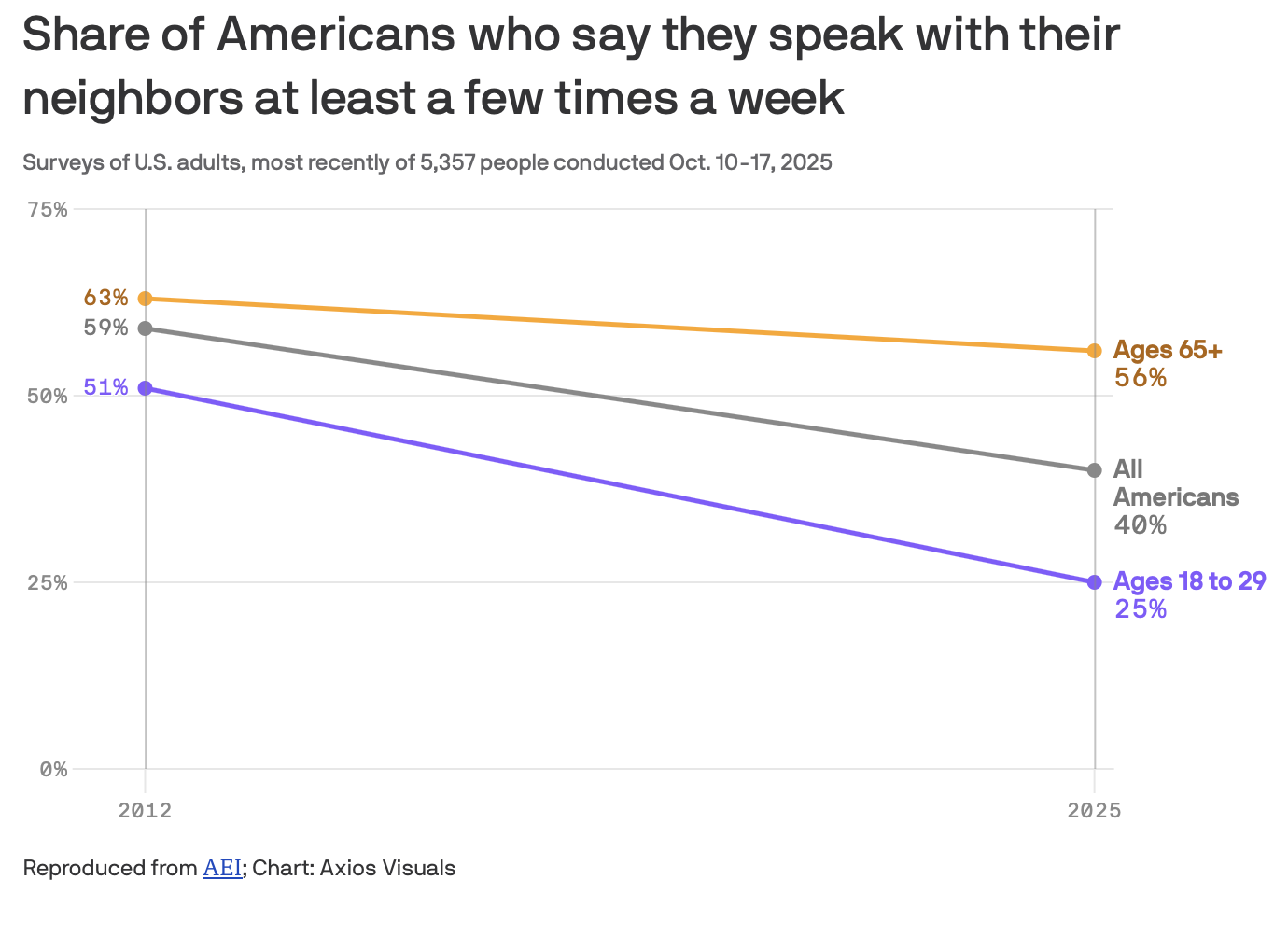
We’re pretty bad about talking with people we actually know; we’re worse talking to strangers.
But there’s another opportunity we are missing out on. Every day we pass on dozens of opportunities to make a positive impact on others through our interactions with strangers.
I know I do.
When I run into people I don’t know, I almost always find myself going for interactions that are “neutral.”
I assume they are busy and don’t particularly want to have anything to do with me. I want to be responsive when someone asks me a question. I want to be polite. But I don’t want to put the person out. So in almost every situation, I try to be vaguely pleasant, then move on.
I’m not alone. A recent survey of Gen Z’ers in college finds that only 37% of them “always” or “often” talk to people they don’t know. Some 42% of Gen X’ers say the same; 49% of Boomers. The reasons we give vary: we lack confidence to speak to strangers; we have trouble reading body language; we’re too busy to actively listen.
It doesn’t have to be that way. “We actually know from research that something like social conversation can be trained… it’s not a personality trait,” Laura Berssenbrugge, a therapist who works with Gen Z and Gen Alpha clients, told Axios in a recent article.
Not surprisingly, there’s a company trying to monetize that kind of training. RiseGuide has developed an app to enable clients to improve their social conversation with strangers. Their “Small Talk Simulator” puts you into hypothetical social settings and asks you to type in what you would say. Their “Speech Analyzer” tool presents you with a situation, listens to a thirty-second recorded response from you, then gives you advice on how to improve your tone and content. To get publicity, the company is currently hiring three “Chief Small Talk Officers” (to make clear they are serious, they changed the original job title from “Head of Hanging Out”), who will be paid to test out the apps’ instructions in real-life situations, sending the CSTO’s into gyms, restaurants and parks to try to improve their conversational game.
Since there are only three of those positions, though, I have a better suggestion. Spend a few days hanging out with a gifted conversationalist.
I spent the past week in New Orleans, officially to play in a tennis tournament. But since my tennis was meh, I was left with plenty of time and brain space to witness a communication master at work.
Because we were playing doubles together, my friend Geoff and I spent three and a half intense days together at the tournament. We stayed at the same hotel, rode together, ate together, sightsaw together, watched and played tennis together. I got to see how he interacted with dozens of people along the way.
Blindingly obvious conclusion: he is nothing like me.
Geoff saw every interaction with every person he ran into as an opportunity to learn something, to make someone’s day by asking them questions, complimenting them on something. Neutral didn’t cut it; he wanted EVERY interaction to be a positive one.

White is neutral; red is positive. That’s Geoff in red.
Here’s what I think I learned from him.
Talking to strangers
Lead with curiosity: If I have down time in a social situation, I assume I can best fill that moment by reading something on my phone. That, of course, signals to others that I don’t want to engage and decreases the chances that I’ll meet somebody interesting. During our time together, it was clear Geoff believed the people around him were more interesting than his phone, and that he could learn something interesting from everyone we ran into.
Start by just saying anything: Geoff would start some conversations by commenting on a shared situation – waiting in line, the weather, the traffic. In other cases he’d find something to compliment about the person. Or he’d ask the person for a simple bit of advice – on a menu or how to pronounce someone’s name or where to find the best barbecue. Realizing that you don’t need to have a fascinating opening line makes the bar for starting a conversation lower. A recent headline in Psychology Today makes the same point: “You Don’t Need to Be Interesting, Just Interested.”
Expect the other person will be into it: I worry when I say something to strangers that they won’t want to respond. Geoff approached everyone with the expectation that of course they will want to talk to him, Then they seemed to pick up on that – he was so earnest, they almost felt obligated to start talking. And once that first barrier is crossed, it was easier to keep talking.
Followup: Geoff is really good at listening – he gets people’s names the first time; he picks up on the side comment and references it; he follows up to get more information. I worry they might think I’m prying.
Good deed-doing
Geoff has one other habit I need to learn from as I try to move from neutral to positive. He commits to doing a “good deed” every day. The deed cannot be something that he is required to do as part of his job. It can’t be something that is just polite. Instead, it has to be an active good deed that requires him to make a sacrifice of time or effort or money. It doesn’t need to be elaborate; it could be letting someone cut in front of him in traffic, helping someone with their bags on a plane, cleaning up a spill for someone.
But committing to doing one good deed invariably leads to doing more than one good deed in a day, and that commitment can’t help but remind you that you are not put here on this earth to be just a consumer or a neutral; you have a daily opportunity to be a positive force.
You can be someone who leaves the people you encounter with a smile on their face.
A Resolution
Here are two things I’m going to do after my week with Geoff:
Shoot for a 50% “positive” rate in my encounters with strangers: I’m not ready for a Geoffian 100%, but I can try a lot harder than I have been to move out of neutral and in to drive. Doing that will definitely require me to lower my phone when I am in public. And it probably means I will need to spend a little more time at the store or at the table or at the gym – having a positive encounter with someone is not something you do with a stopwatch. The payoff: a chance to make someone’s day a little better and mine a lot more interesting.
Try doing one actively good deed a day: I think I am going to define a good deed as something that makes another person feel good and requires some level of sacrifice by me. I haven’t previously tracked “deeds,” so I don’t know what my baseline is, but I think having to account to myself for my behavior at the end of every day will inevitably increase my net positivity in the world.

It’s time to shift my interactions with strangers out of neutral and into drive.
I’m already beta-testing and I like how it makes me feel.
I’ve known for a long time that every person in the world can be interesting, but I’ve reserved my curiosity for my official work. Turns out they are also interesting when I am not working. What a concept!
I generally don’t engage much with my seatmates on the plane; on my flight back from New Orleans, I made an effort and found I was sitting beside an expert on Medicare insurance. She loved talking about her work; I learned something; and she picked up a client who heard us talking. Instead of just checking email while giving blood this week, I instead had a long conversation with my phlebotomist. I learned nuance about Mississippi football and accents and schools I could never get from my phone. She got to talk about something other than platelets; she got to talk about a place she loved.
If you are among the 49% of Boomers or 42% of X’ers or 37% of Z’s already actively engaging with strangers, and if you’re doing it in a way that is not just neutral but positive, I’d love to hear how about how those interactions have changed your life or the lives of others. If not, wanna join me?
Notes:
Paying people to make small talk: https://www.axios.com/2026/10/18/small-talk-officer-job-social-skills
Conversation starters: https://www.cosmopolitan.com/relationships/a45002972/nerdy-pickup-lines/
RiseGuide hiring ‘chief small talk officers’: https://www.yahoo.com/lifestyle/articles/wanted-chief-small-talk-officers-110509287.html?guccounter=1&guce_referrer=aHR0cHM6Ly93d3cuZ29vZ2xlLmNvbS8&guce_referrer_sig=AQAAAA-8G555iym9_nRFPipYsObOe2O3d7WMd6gSc8m5KBCdyGjIHEpZvnfZSRM1kbRWV-CD9CXc9VQx7U4mlwgCNfiuB4b8LVQM-KonprNO2TYaYa5h5Bkp0xGR7NUUUyavfuSZAvR9jZgiRT-1p9hsihJR7SlH-gBPP6UM-aP4vsue
More on RiseGuide: https://riseguide.com/blog/how-to-make-small-talk
What different generations say about talking with strangers: https://www.surveymonkey.com/curiosity/cnbc-social-skills-pulse-survey/
More on conversation starters: https://www.menshealth.com/health/a38003675/how-to-talk-to-people-again/
The power of “mitzvah”: https://www.chabad.org/library/article_cdo/aid/1438516/jewish/Mitzvah.htm
Doing community vs. talking about community: https://www.carolinajournal.com/opinion/when-it-comes-to-community-maybe-im-the-problem/