Why We’re ‘Choosing Country’ These Days
Here’s a quiz for you.:What song has spent more weeks at #1 on the Billboard chart of Hot 100 records than any in history?
Before you make your best guess (you’ll be wrong), I’ll go ahead and limit your choices.
A. Bing Crosby singing (and whistling) “White Christmas”
B. Whitney Houston singing “I Will Always Love You”
C. Elton John’s “Candle in the Wind”
D. Aretha Franklin singing “Respect”
E. Xiao Zhan’s performing “Spotlight”
F. Mariah Carey’s performance of “All I Want for Christmas”
G. Ella Langley singing “Choosing Texas”
These are all plausible choices. “White Christmas” has sold an estimated 50 million copies since Bing Crosby recorded it in 1942. “I Will Always Love You,” written by Dolly Parton, became the biggest selling single in history performed by a woman when Whitney Houston recorded it in 1992. Elton John’s “Candle in the Wind” is the biggest selling single since official records have existed. Aretha Franklin’s “Respect” was named the #1 “rock” song of all time by Rolling Stonemagazine in 2024. Xiao Zhan, a Chinese “idol” winner and film star, has the most downloads in history for his song “Spotlight.”
But the question was about time at the top of the charts. Until last week Mariah Carey’s “All I Want for Christmas” was the record holder for most weeks as a number one record. Then came “Choosing Texas.”
Released in October 2025, the song slowly climbed the charts before it hit #1 earlier this year. Since then there have been a few weeks where another song slipped in at #1. But then “Choosing Texas” went back to the top. This was its 23rd week at number 1 – nearly a year after its initial release, about 25 million people are still listening to it every week.
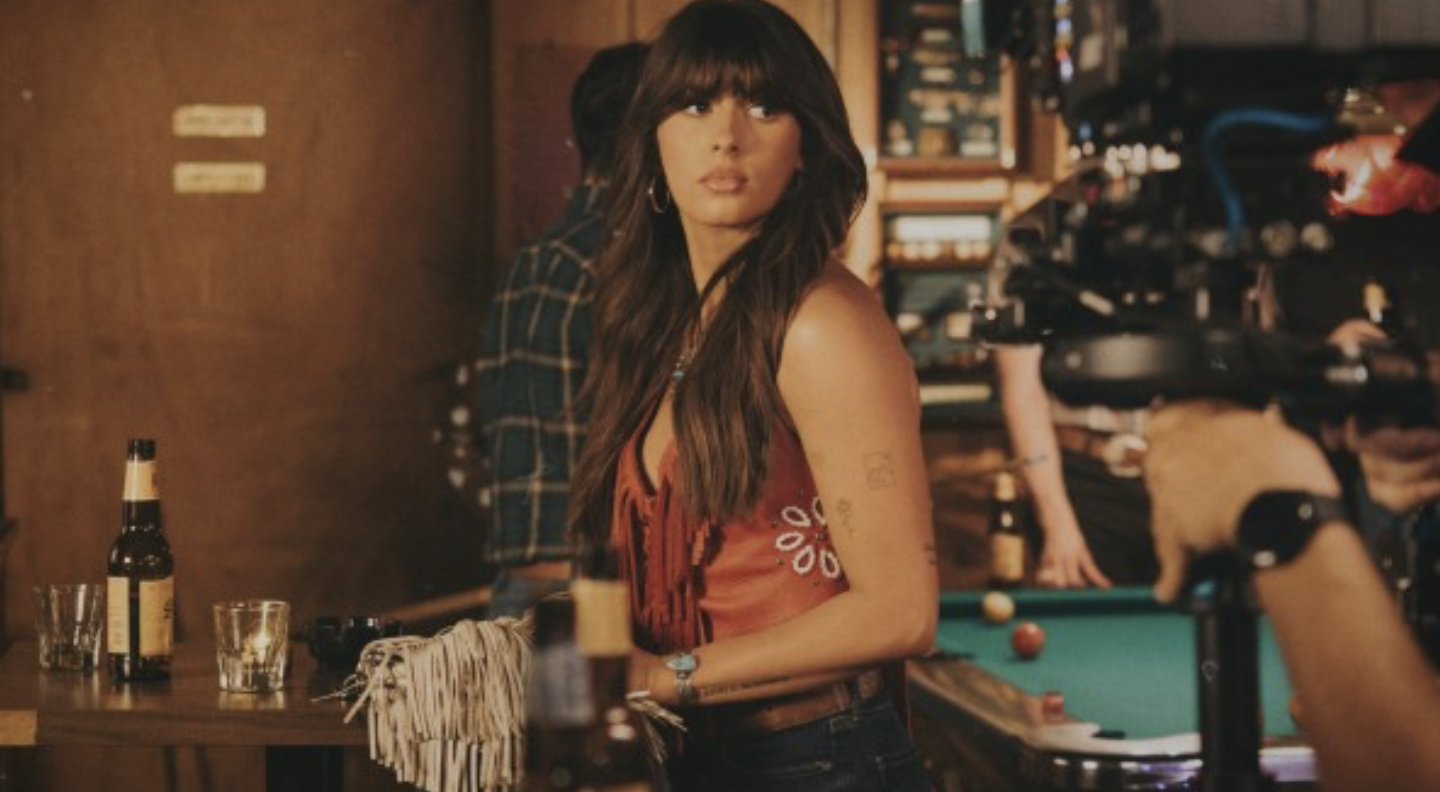
Both the song and the music video for “Choosing Texas” are great storytelling.
And that’s a shock. Because “Choosing Texas” is unabashedly, unmistakenly what we in the US call a “country” song (if you haven’t heard it yet, take a few minutes to watch the music video in the notes below). It’s about a couple on the rocks; a woman who wants to stay in Tennessee and her man who’s “choosing Texas.” Ella Langley sings it with a southern accent and it’s played at a honky tonk rhythm. There’s dancing. There’s drinking. There’s a mandolin.
For a while I’ve been looking for an excuse to write about the power and appeal of country music. “Choosing Texas” gives me the excuse to explore why it’s been such an enduring genre and why it may be having its moment/month/year right now at the top of the charts.
Pop is vague; country music gets specific. The top pop songs are maddeningly and intentionally generic; country songs aren’t afraid to be specific. In the case of “Choosing Texas” the singer makes it not just about two specific states, Tennessee and Texas, but subareas within those states: she loves the Smoky Mountains; he wants Abilene. She’s not just driving some unnamed highway; she’s on I-40. He’s not just dancing with another woman; he’s two-stepping. She’s not drinking alcohol to drown her sorrows, she’s drinking Jack Daniels. And he’s not singing a generic sad song, he’s singing “Amarillo By Morning.”
Pop creates situations that aspire to be vague, average, inoffensive, asking us to just sing along, maybe fill in our own specifics; country gives us specific images of real people. That gives us a chance to empathize with them.
Pop songs go for hooks; country songs tell stories: A study by Colin Morris in the online magazine The Pudding analyzed 15,000 songs put out since 2000, looking for the amount of repeated content the songs had. He found that pop and rock tunes repeat about 60% of their material over the course of a song. Country and hip hop songs average about 40% repeated material. His conclusion: while pop and rock tunes are looking for a single musical hook, country and rap are more word intensive.
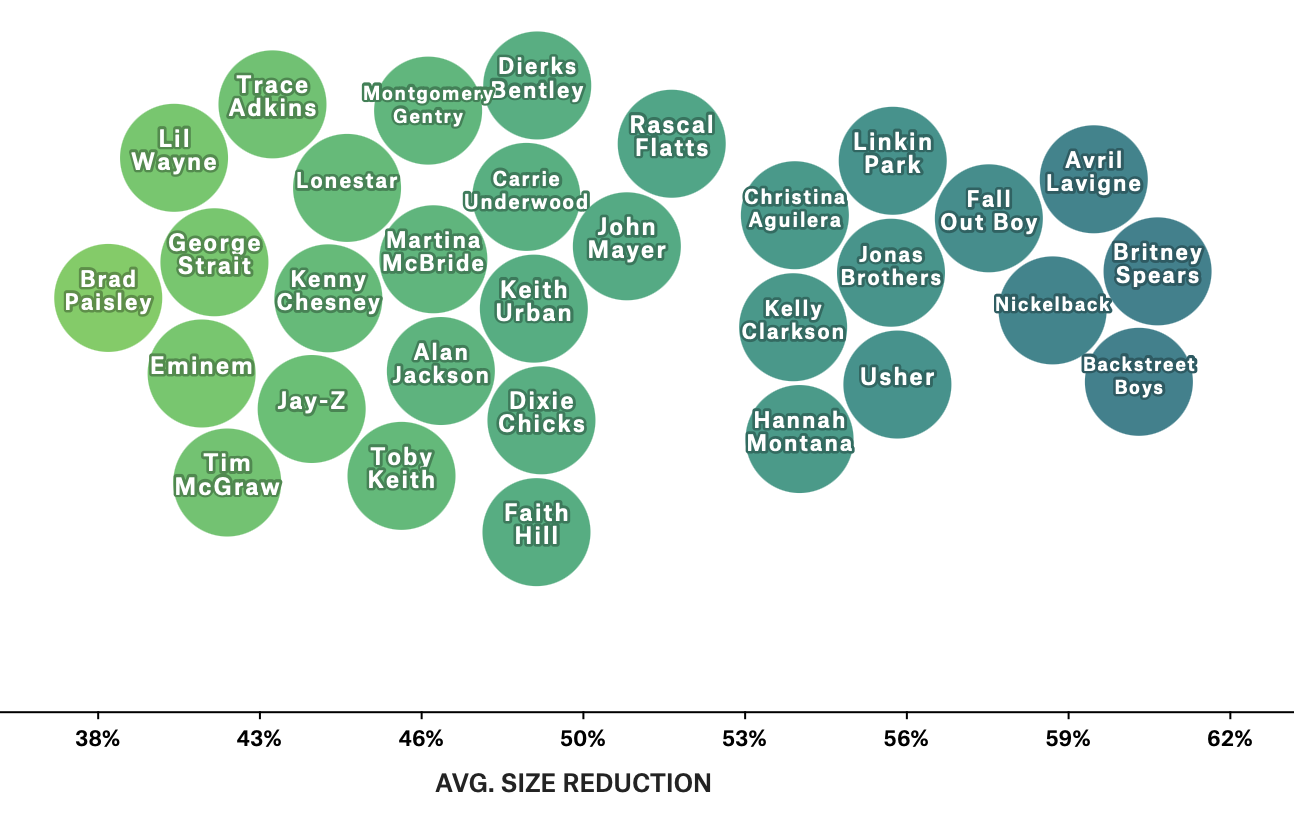
These bubbles are from Colin Morris’ analysis of the amount of repetition in the songs of various artists since the year 2000. Country and hip hop artists have all the low amounts of repetition; pop and rock artists are clustered on the right.
Country artists love a hook too, but they’d rather tell you a story. Even if you are not a country music fan, think of these crossover hits:
· Garth Brooks’ “I’ve Got Friends in Low Places” tells a story about an ex crashing his lost love’s wedding.
· Charlie Daniels’ “Devil Went Down to Georgia” is a long story about a man betting his soul with the devil.
· “King of the Road” by Roger Miller gives us a snapshot of the life of a hobo.
· Carrie Underwood’s “Before He Cheats” tells us a very specific, bitter revenge story.
“Choosing Texas” is not a classic country “story song,” but it still gives us an arc – a couple goes to Texas; he steps out on her; she drives back home, devastated.
Country songs are by a specific demographic, for a specific demographic: In a podcast a couple of years ago, Malcolm Gladwell compared the birthplaces of top country music stars and top pop and rock stars. The pop and rock stars were from all over the English-speaking world; country artists were overwhelmingly white, southern and Protestant.
That relative homogeneity allows country artists to make assumptions about what their listeners know (in “Choosing Texas,” it’s assumed that we know what “Jack” is, where I-40 runs; that you’re more likely to two step in Texas than Tennessee, etc.). Once again, that shared world view and language makes country artists more similar to hip hop stars, who are overwhelmingly Black and urban: in both genres, the artists can make assumptions about what their audiences know in ways that pop stars can’t.
Country songs will take on any topic: I couldn’t find a comprehensive analysis of the topics rock and pop music most often takes on, so I’ll make a guess: 90% of the songs are about sex, drugs and love. Country music takes on all those topics, but you can find big country songs about much weightier topics, the kind that “don’t rock the boat” rock and pop producers flee from or fuzz up: abortion, addiction, cancer, cheating, divorce, drug overdoses, the IRS, murder, revenge, sex trouble, suicide.
Country music gets personal: When rock stars write about personal experience, they intentionally omit the details. Country artists grovel in them. The saddest country song of all time may be “He Stopped Loving Her Today.” If you haven’t heard it, stop before reading further and take a listen (link in the notes).
It’s the story of a man who vows to never stop loving the love of his life, even after she dumps him. For most of the song it’s not clear why “he stopped loving her today,” but then it hits with a gut punch: he only stopped loving her today because he died. Bobby Braddock wrote the song after losing the love of his life. Then he asked George Jones to record it, who admitted he recorded it thinking about the love of his life, Tammy Wynette (the link in the notes is to a YouTube video of Alan Jackson singing it at George Jones’ funeral). It became Jones’ biggest hit, but it was only a little bit bigger than his 1976 hit, “Golden Ring,” a story about a marriage falling apart that he and Tammy recorded the year after they got divorced. If it sounds like there is real emotion in that song, well, there is.
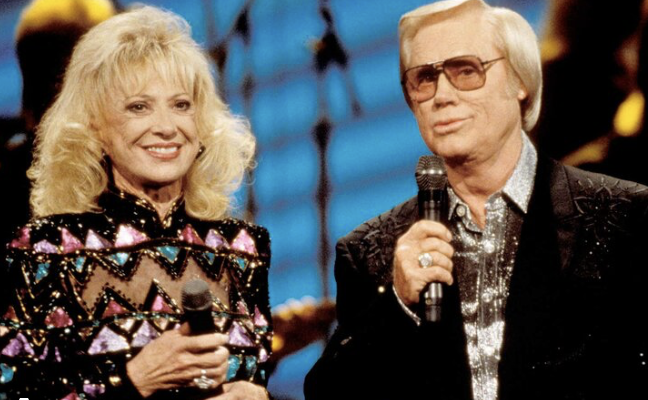
Tammy and George could both sing about the most painful heartache, especially after their divorce.
And maybe that’s why another country song – a catchy tune with a specific story, performed with real instruments, sung in a fresh voice, about a woman who’s been dumped – is taking over the charts at this specific moment (and not just in America – “Choosing Texas” has also hit #1 in Australia, Canada, Ireland, New Zealand and the UK).
We live in a world where chatbots have replaced customer service agents, where our friends are more often digital and distant than nearby, where everything from sweeteners to counselors to even intelligence is artificial. Country music, whether it’s telling a story about the joys of small town life or a new love or an old dog or the pain of addiction or a disease or a breakup, feels authentic – like there’s a real person on the other side of the microphone.
Given all that, why wouldn’t we be choosing country?
Notes:
Music video for “Choosing Texas”: https://youtu.be/nUsrYVxrDwI
Rolling Stone’s Top 100 “rock” songs: https://en.wikipedia.org/wiki/Rolling_Stone%27s_500_Greatest_Songs_of_All_Time#Top_10_songs
Xiao Zhan wiki: https://en.wikipedia.org/wiki/Xiao_Zhan
Malcolm Gladwell podcast on the King of Tears: https://www.pushkin.fm/podcasts/revisionist-history/the-king-of-tears
Pop and rock are more repetitive than country and rap: https://pudding.cool/2017/05/song-repetition/
Pop music goes for easy, repetitive and average: https://www.alexmurrell.co.uk/articles/the-age-of-average-encore
Alan Jackson performs “He Stopped Loving Her Today” at George Jones’ funeral: https://youtu.be/UiM42bGUFbg?si=MSiPBnPoP5g4ER5P