Lions vs. Gladiators: Who Ya Got?
For centuries, historians debated whether gladiators of the Roman Empire ever actually fought lions. Last year, archaeologists finally settled the matter, when they unearthed the hip bone of a known gladiator with clear evidence of a lion-sized bite mark in it. After extensive analysis, they concluded that the lion and gladiator must have fought and (spoiler alert) the lion won.
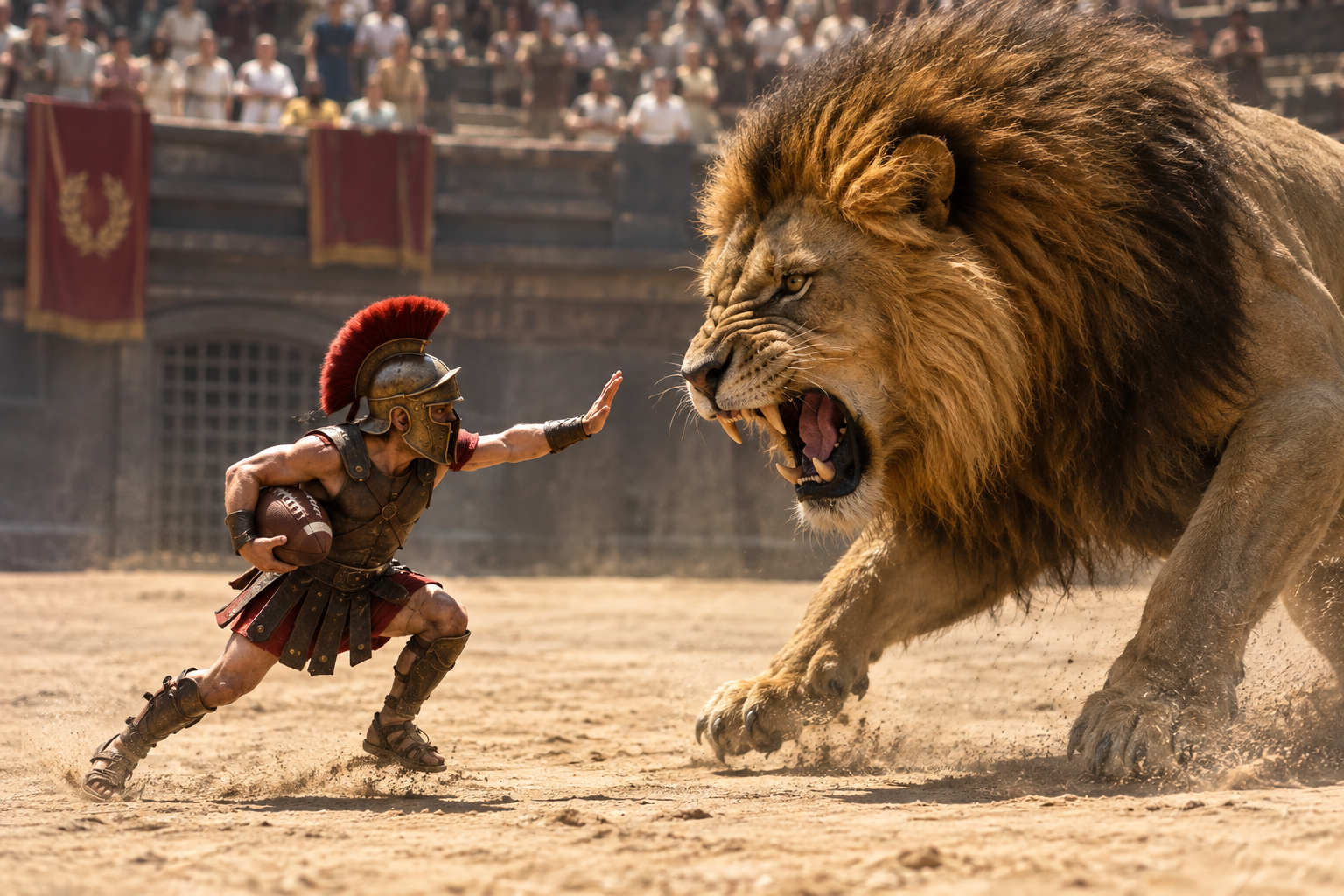
Sure. BC might beat Miami this season (Image generated with ChatGPT).
There will be a rematch of sorts when Miami hosts Boston College on November 28 in an ACC college football matchup.
A new analysis by The Athletic of the football player payroll of the 68 teams in the four biggest conferences (the“Power 4”), calculates (teams would not share official data, but this analysis is a breakthrough; last year we didn’t have any payroll information approaching this) that Miami will pay its lions/Hurricanes about $47 million in weapons; Boston College will pay its gladiators/Eagles with $8 million. And while there are no statistics on the overall success rate when gladiators took on lions, oddsmakers are giving Boston College a 3% chance of winning.
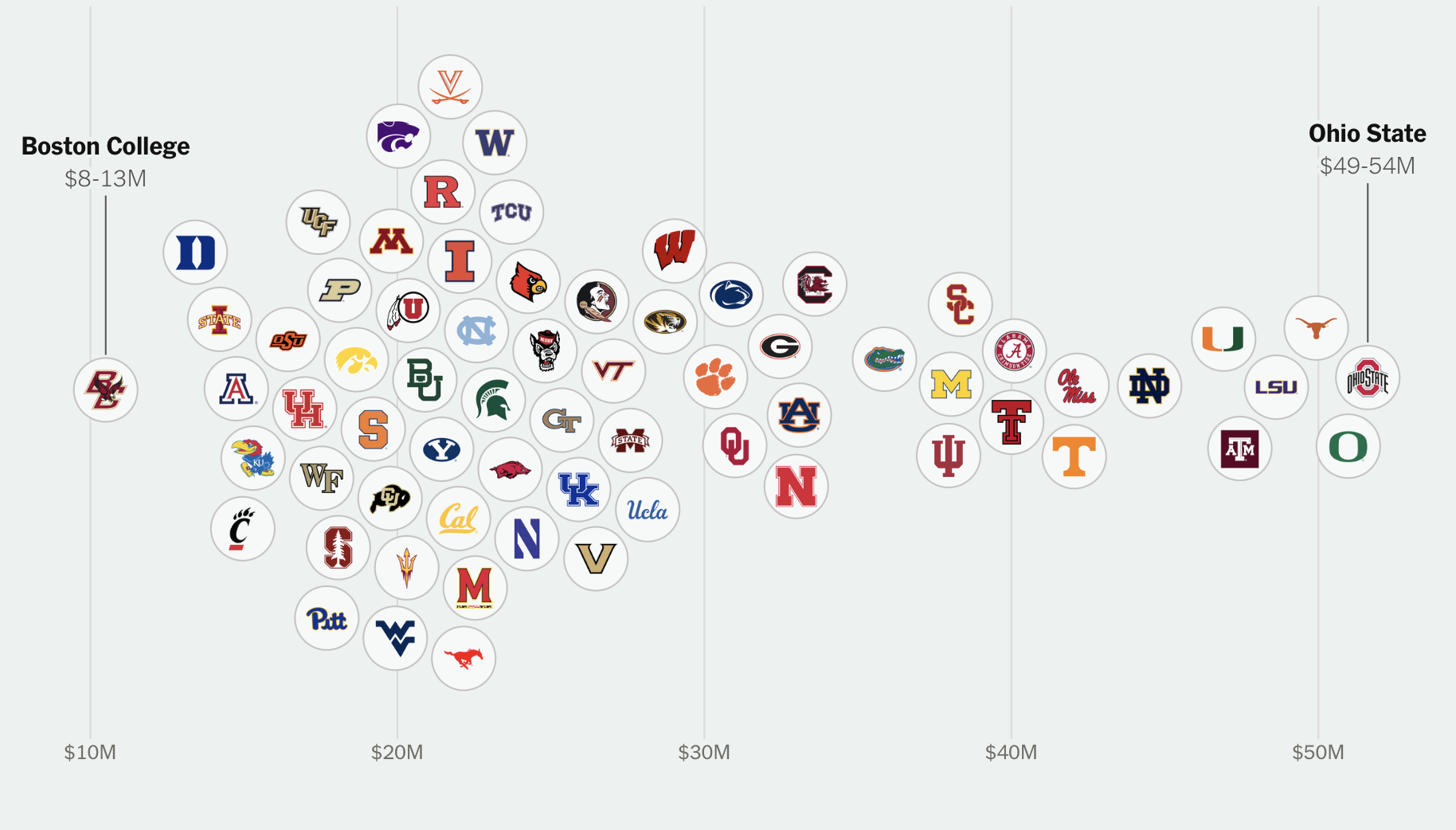
That’s BC on the far left of the player payroll list. Miami is the “U” on the far right. If you’re looking for your team, you can find it in the story, linked in the Notes at the bottom of the post (Graphic from The Athletic).
I’m not saying money is the only reason Miami is favored in the game. The biggest of “big football schools” have stayed big over time for a variety of reasons.
· The best players want to come to those schools because those teams appear on high-profile TV broadcasts more often.
· Because those schools appear more often on more TV, they’ve been able to hire great coaches, pack huge stadiums, jack up ticket prices, plop their players in sumptuous athletic dorms, build high-tech training rooms and load up amazing training table buffets.
· Big football schools have traditionally been more willing than other programs to overlook bad grades, low scores or questionable off-field behavior, as long as the player excels on-field.
· And, historically, the foot-ballsiest teams have been a little more willing than other schools to shovel prospects pizza money under the table.
But the new math of college football turns those historically mostly intangible elements into hard currency. Here’s how it looks for Miami vs. BC. Division I college football teams are allowed to have 105 players on their roster. That means the average wage for a player at Miami this year will be $447,619. At BC it works out to $76,190. The “average” wage is a bit misleading because top players skew the scale – Darian Mensah, the Miami QB, will be making a reported $6.5 million this year (a 62.5% increase over the $4 million he received last year from Duke), but the roughly 6:1 pay disparity persists at every position – BC quarterback Mason McKenzie is reportedly making about $1 million for his services this year.
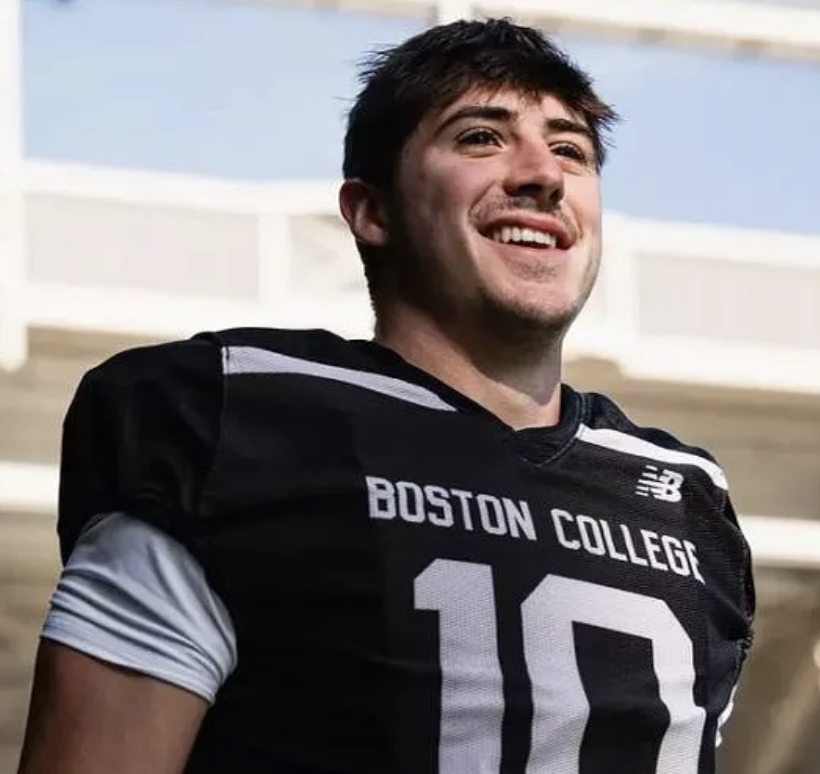
Good news: Mason McKenzie is making a boatload more at BC than he did for Saginaw Valley State last year. Bad news: his opponent November 28 is getting paid 6.5x more (Image Boston College Athletics)
The Athletic‘s survey shows a predictable correlation between the biggest spending schools and the most successful schools. The seven teams given a 50%+ chance of college football’s season-ending playoffs (Miami is on this list) are spending an average of $43 million on their players this season; the 34 teams with less than a 5% chance (BC is on that list) of making the playoffs are spending an average of about $21 million.
So who wins and who loses in this brave new world of mega-college football?
Players
Assessment: Net winners
This one would seem obvious. After years of working 80 hour weeks (most get free tuition, room and board, but have little time to take advantage of actual college life with the full-time job as players), players are now getting paid. Hallelujah.
That pay, though comes with additional responsibilities. Now in addition to their jobs as competitors on the field, players are having to take on challenges previous generations never had to. Here’s what Mensah’s path so far has looked like:
· During his freshman year at Tulane, Darian Mensah had a college football scholarship, but was paid no wage. He was a third-string afterthought. With determination and talent, he clawed his way up the depth chart to become the starting quarterback.
· Then the NCAA changed its rules, permitting players to get paid for the use of their “name, image and likeness” and permitting players to basically transfer wherever they wanted, whenever they wanted. With almost no warning, Mensah suddenly had to figure out how to weigh offers from across the country.
· He negotiated a two-year, $8 million contract to play for Duke.
· Another great season, so good that after one year he decided he wanted to leave. Duke sued him for breach of contract and he and his attorneys had to negotiate a settlement agreement to get out of his contract.
· Meanwhile, he was separately negotiating a new deal at a new school.
· Now he’s in Miami, a 21-year-old “junior” making enough money to transform the rest of his life.
Not your typical undergraduate experience.
Mensah’s story is a bit of an outlier, but it’s not uncommon for players to make stops at 3, 4 or 5 different college programs during their careers.
Where does all this shake out? Players are finally making money and they have the freedom to shop their services to the highest bidder, so we have to call that a win. But wow, this new job description is a lot more complex than the old one – hiring agents, firing teams, dealing with lawyers, pleasing sponsors, resisting sports gambling in addition to their 80-hour work week. How could there possibly be any time left to take classes and make friends?
Coaches
Assessment: Net winners
You might think that as schools spend more and more on players, they would have less to spend on coaches. You’d be wrong.
An analysis by The Athletic of football coaches at the biggest schools shows that between 2005 and 2023, salaries increased by 370% (about 7 times the rate of inflation) at 16 top schools. Top head coaches now routinely make more than $10 million a year, with some assistant coaches making more than $3 million a year. Compared to 2005, big football schools are also finding ways to spend 322% more on player recruitment, 300% more on equipment and 200% more on travel.
Why don’t college teams see budgets as zero sum? A West Virginia University study found that schools view coaches as an essential part of their “arms race.” Here’s how the researchers put it: “They generate wins, so athletes who play for high-quality coaches get to experience more victories, more championships,” they wrote. “We found the bigger a head coach’s salary, the higher that coach’s quality and profile, and the more successful their team’s recruitment efforts.” And to make the coaches happy, more money to recruit players, better weight rooms and swankier travel.
There is no zero sum. Both/and, not either/or.
Institutions
Assessment: Net losers
There are some studies that show universities get an in student applications after a particularly noteworthy football season (Boston College saw a 30% bump in applications after its famous “Hail Mary” victory over, ahem, Miami, in 1984).
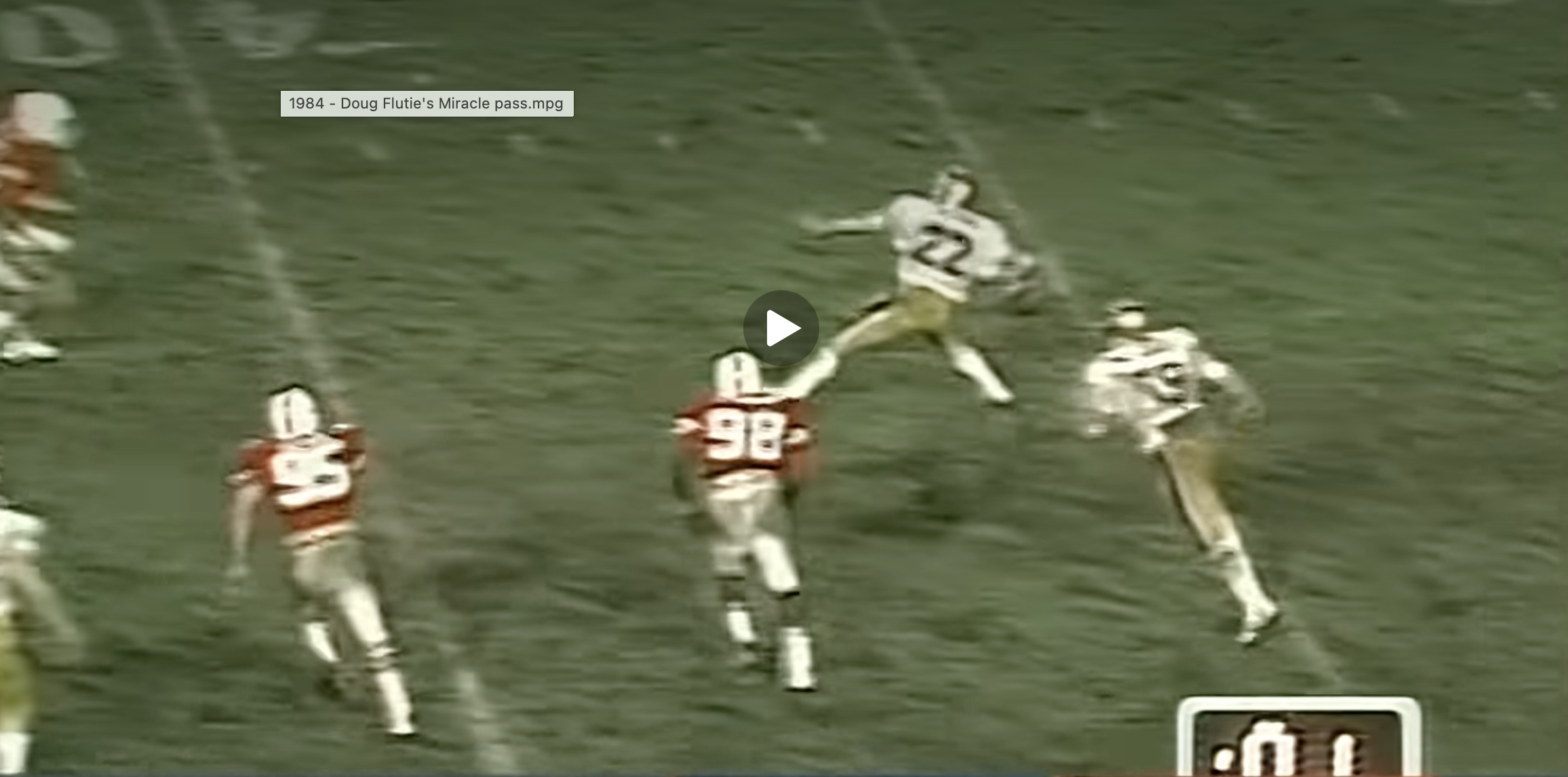
Miami is 25-6-1 in its series of games against Boston College. But this game-winning last-minute pass by BC’s Doug Flutie against Miami in 1984 was epic.
At halftime of football games, universities are allowed to run free ads promoting themselves, and you could argue that having your school’s name on the bottom of the screen for three hours during a game is good free publicity too. And football games are a great excuse to get alums to come back to your university, where you can invite the wealthiest of them to join the president or chancellor in a suite to talk about the university’s needs.
There’s also some “spillover” from athletic giving to academic giving. Generally speaking, when athletic giving goes up a lot, academic giving goes up a little.
But here’s where it’s useful to look at where universities are getting the money for their football arms race. Football revenues come from four kinds of sources.
Media Rights: The total amount of money that comes from TV contracts has exploded over the past decade, and the percentage of the athletic budget that funding supports varies widely by conference. In the Big 10, for example, 40% of athletic revenues come from TV contracts. In the ACC it’s 28% and, in smaller conferences like the SunBelt, about 7%.
Private donors: Private donations to athletics have increased at all schools, but at the biggest football schools, they have exploded. In 2015, for example, Clemson and Virginia Tech raised about the same amount from private donors. By 2025, Virginia Tech’s donations were up 131.5%, but Clemson’s were up 181.3%. That means Clemson has $17.4 million more to spend this year than Virginia Tech. A decade ago, Florida State outraised NC State by 34%; last year it outraised NC State by 50%.
Ticket/concessions/parking prices/merch: Over the past decade a lot of big football schools have actually been downsizing their stadiums to make sure they can put in more super premium seats. Miami downsized its stadium by 11,000 seats to make room for more suites and, counterintuitively, made more off ticket sales because they were able to charge more for tickets. Football programs also make money off concessions, parking and merch.
Institutional support and student fees: The biggest of big football schools typically report spending zero institutional funds and only limited student funds on football – they’re getting all the money they need from skyrocketing media payouts, checkbook-opening private donors and jacked-up ticket prices. But middle of the pack schools in the big conferences and all the schools in “mid-major” conferences are having to take money that could be spent on other things to pay for football and other athletics.
A decade ago, Virginia Tech spend about $100,000 in “institutional support” for its athletic programs. Last year it spent $8.4 million in institutional funds and added another $15.7 million in student fees. Together those two sources made up 15% of its athletic budget.
It’s even more extreme at some other schools. The University of Cincinnati gets 44% of its athletic budget from institutional or student fees; the University of Houston 45%. And among mid-majors, Old Dominion gets 59% and James Madison 77% from institutional funds and student fees.
What else might those schools be using those kinds of funds for if they didn’t have to use them to balance their athletic budget?
Fans
Assessment: Net losers
Fans at the big football schools “win” when they get to see their lions devour the gladiators in person.
But they’re paying an ever-bigger price for the privilege. As schools try to figure out how to finance their exploding football budgets, they have to charge more for tickets at their downsized stadiums. The average football ticket price has doubled over the past decade – from $59 to $125 a pop. “Dynamic pricing” and the outrageous resale market drive ticket prices up still further and AI is helping hotels learn how to extract the maximum from fans looking for a place to stay. Parking, concession and merch prices are rising as well.
For fans watching at home, there’s a different kind of loss. One of the joys of watching college sports historically has been the opportunity they provide to watch a player and a team develop over time.
No more.
· Tulane fans got to see Darian Mensah develop from a nonplaying freshman to a third stringer to a starter over his first two years. And then he was gone.
· Duke fans were excited they would get to see him for two years – until he broke his contract and left.
· Miami fans can get excited to see their $6.5 million man this season – but then he’ll be off to the NFL.
In this era of Wild West free agency, it’s not unusual to hear stories of football teams bringing in 85 completely new players each year. The new players may be wearing the team colors, but it’s hard work for fans to figure out who they are. And it’s got to be depressing to pay $150 for a Duke “Mensah 10” jersey, then have him leave after just six home games.
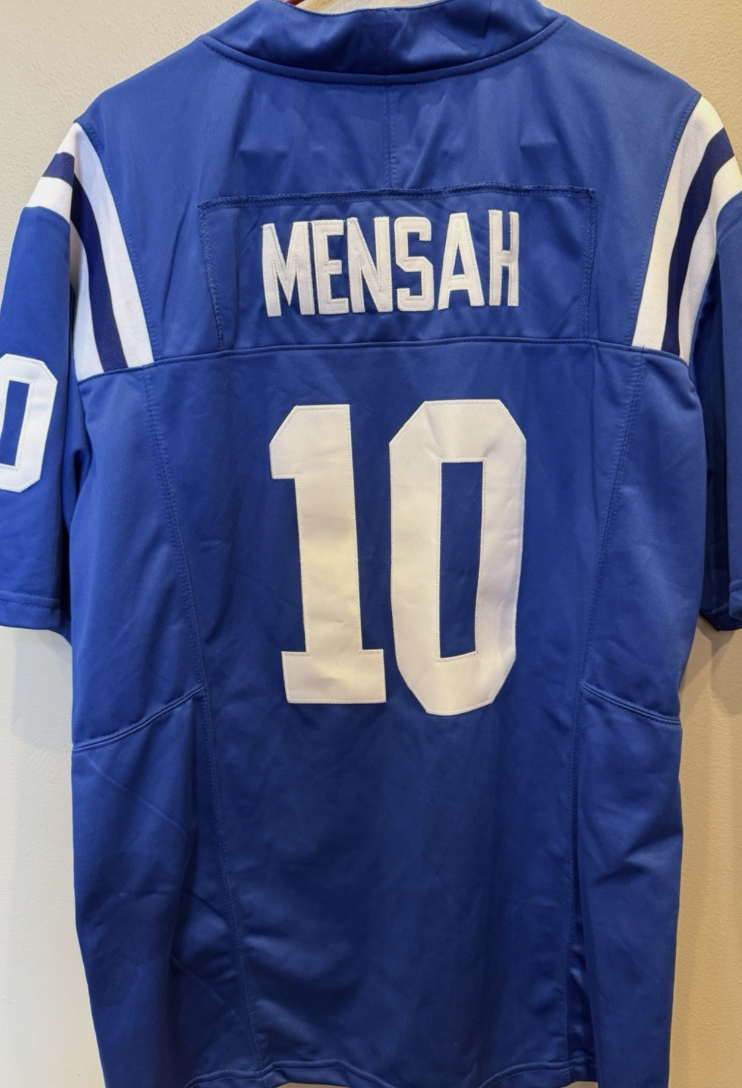
The official Duke jersey for Darian Mensah went for $149 last year; this year a fan is trying to unload it on eBay for $25. (Image on eBay)
Let’s face it. All of us fans always knew college football was a sport of haves and have-nots, well-armed lions with fangs and pretenders with nerf guns. But we could always squint with one eye and imagine one of the gladiators had a shot. Now that the receipts are available for all of us to review, we can quantify just how unlikely that victory would be. So unless archaeologists find a lion skeleton somewhere with a deadly human bite mark on it, and Boston College can Hail Mary and Joseph, Peter and Paul, I’m betting on Miami.
Notes:
Analysis of gladiator bones shows bite consistent with lion: https://www.nytimes.com/2025/04/23/science/lion-gladiator-romans-bones.html
247 betting line on Miami/ Boston College game: https://247sports.com/college/boston-college/longformarticle/evaluating-espns-game-by-game-projections-for-boston-college-football-for-the-2026-season-288493646/
Story on 2026-27 college football payrolls: https://www.nytimes.com/athletic/interactive/college-football-nil-spending-budgets/?unlocked_article_code=1.BlE.xaCJ.8vRC8skAxXHP&source=athletic_user_shared_gift_interactive_email&smid=em-share-ta
University presidents do not perceive athletic giving vs. academic as a zero-sum game: https://www.insidehighered.com/news/2012/04/27/athletic-giving-crowds-out-academic-donations-research-finds
Review of benefits/costs of athletic donations to success, giving: https://findingequilibriumfuturehighered.substack.com/p/do-universities-actually-benefit
Where universities find funding for college sports: https://cardinalnews.org/2026/09/10/to-keep-up-with-rising-athletic-budgets-colleges-are-increasingly-turning-to-school-funds-and-mandatory-student-fees/
Coach salary increases 2005-2023: https://www.nytimes.com/athletic/6567247/2025/08/24/college-sports-athletic-department-spending-buyouts/
The price of college football coach buyouts: https://www.nytimes.com/athletic/6764800/2025/10/31/college-football-university-presidents-coaching-carousel-salaries-buyouts/
Why don’t college football coach salaries go down?: https://www.mybuckhannon.com/wvu-researchers-reveal-rising-college-football-coach-salaries-tied-to-recruiting-success/
Ticket price changes: https://www.axios.com/local/kansas-city/2026/02/05/sports-ticket-prices-soar-as-teams-chase-premium-demand
Stadium redesigns: https://www.nytimes.com/athletic/6799381/2025/11/14/college-football-game-prices-fans/