The Trill of the Chase Part 2: Joining the Flock
Note: This is Part 2 of a story that first ran in The Assembly, an online journal featuring long-form articles about North Carolina news and culture (subscribe!) You can read that version here.
My wife, Ret, and I arrived in Japan, in mid-June, a week before this year’s World Whistlers Convention. I hoped to settle into the 13-hour time difference, get my lips accustomed to higher humidity, and put in at least an hour a day of practice.
The practice part proved problematic. On day three of our time there, during my daily session in our hotel’s 13th floor stairwell (whistlers love the echoes that come off of hard surfaces), I was in the middle of my take on Gershwin’s “Rhapsody in Blue” (this tricky section required imitating a clarinet, trilling a note, then slowly sliding up an octave without running out of breath) when a security guard burst through the door. He informed me, through hand signals (crossing both arms across his chest), that I couldn’t practice there. He glared silently until I packed up my things and left.
I asked a Japanese friend to call the front desk and clarify where I could practice. “Not in the stairwell,” he said. “Not in the room. Not anywhere in the hotel.”
For the remainder of the week, I rented private rooms by the hour at nearby Rainbow Karaoke. Between whistle songs, Ret and I threw down, singing new versions of karaoke classics like “Ain’t No Mountain (even Fuji) High Enough” and “Summer Lovin’ (in Kawasaki).”
On Friday, the first day of the competition, we rounded a corner a mile or so from the Kawasaki train station to find a four-story beige building called, for reasons nobody seems to know, “Scrum 21.” That’s the home of the Kawasaki Gender Equality Center and, for three days every two years, the World Whistlers Convention.
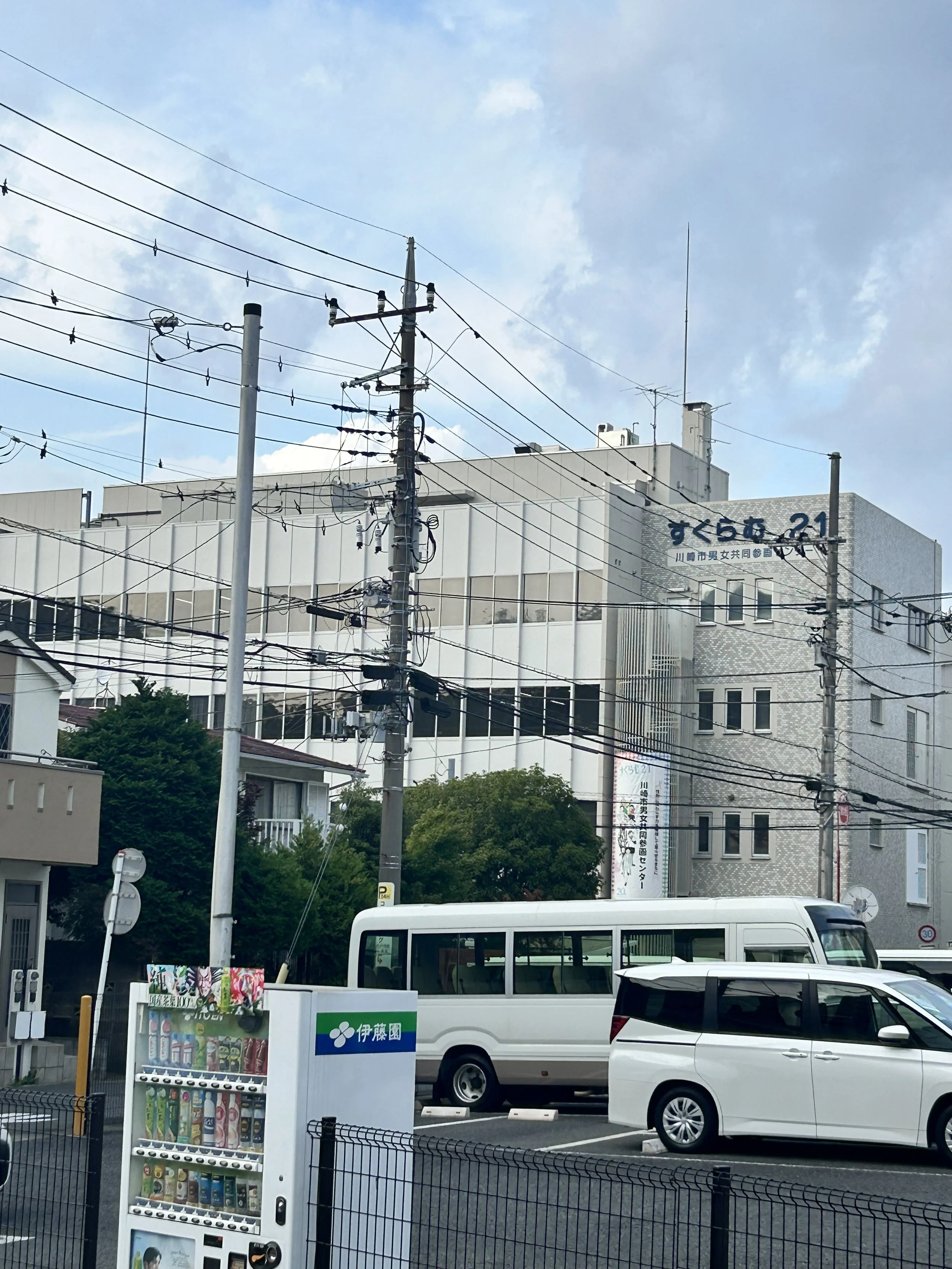
For three days every two years, Scrum 21 in Kawasaki is the center of the whistling world
Inside the building a team of volunteers welcomed us. In the lobby was a table where you could buy CD’s and books by top whistlers and another table with Convention merch – t-shirts and stickers. And in one corner was a giant event display – gold balloons spelling out “WWC2026,” green and white balloons flanking a giant pair of red balloon lips.
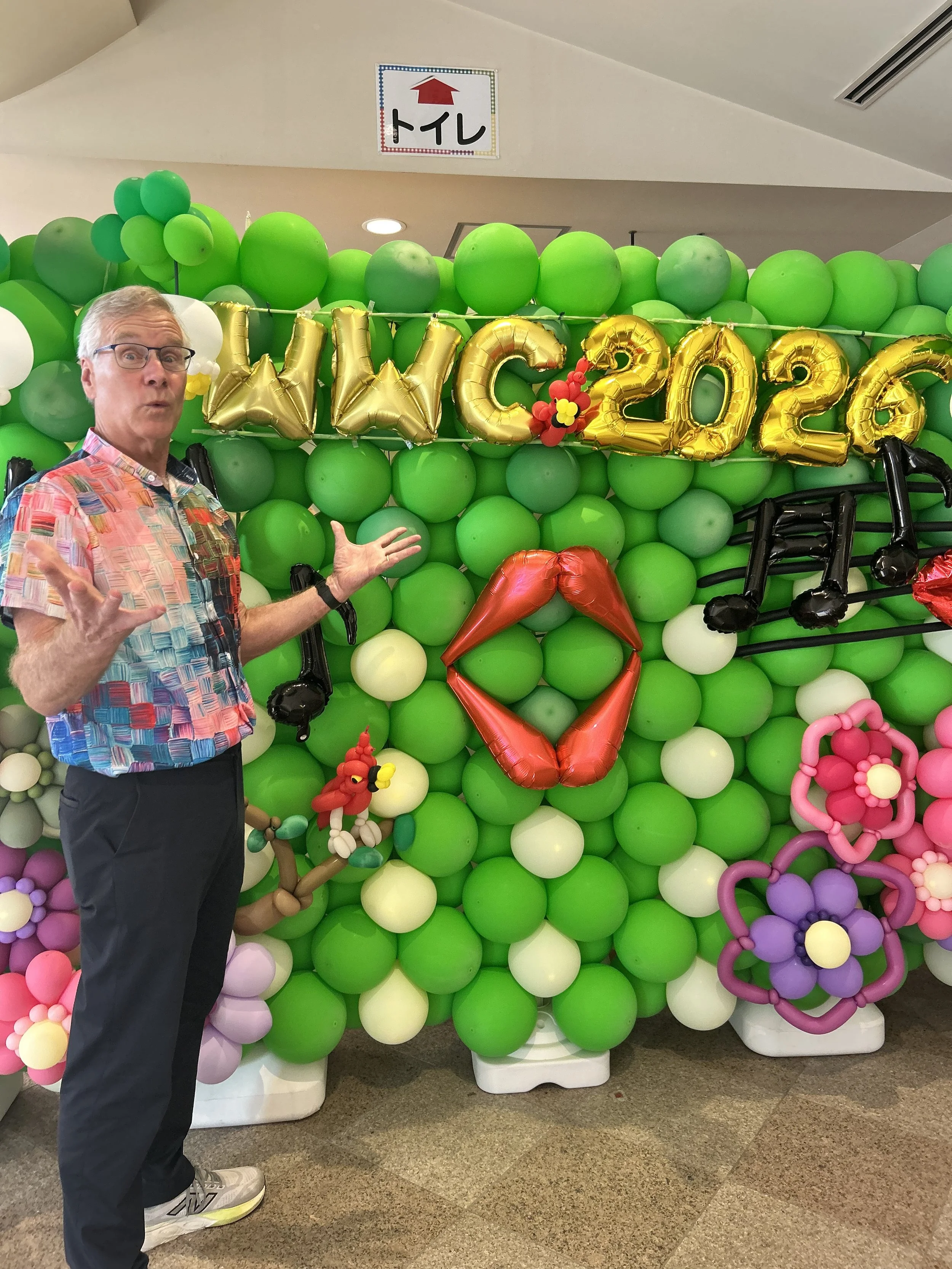
The most-photographed spot of the Convention (photo Ret Boney).
Ryosuke Takeuchi, a six-time Louisburg whistling competitor, brought the competition here in 2014, after DeHart passed the torch. Takeuchi felt he had to do it. “When Allen looked around the world, I was probably the only person who could take on the responsibility,” Takeuchi told me. “It’s such an interesting idea I wanted it to continue.”
It may have been interesting, but it wasn’t easy. The “International Whistlers Convention” name was protected by US copyright, so Takeuchi had to change it to the “World Whistlers Convention.” And he faced many of the same problems as the founder—finding volunteers, overcoming contestants’ language barriers, and recruiting judges, all on a razor-thin budget.
In Kawasaki, an overlooked industrial center south of Tokyo, Takeuchi found a town not unlike Louisburg, in some ways: happy for some good publicity and willing to rent out an auditorium for an affordable price.
***
As I watched the contest’s early rounds, I was impressed by the range of people: young, old and in between, from eight different countries. Besides a capella whistlers, there was a “hikifuki” division, where competitors accompany themselves on a guitar, piano, or ukelele (in one case, a woman whistled while playing a xylophone and an accordion – kids, don’t try that at home) and “allied arts,” where whistlers can perform in groups, or with dancers or visual artists.
I remembered something Ullman, the former champion, had told me. There are three types of competitive whistlers: tourists (those who are just happy to be there, but have no chance of winning); local hotshots (who may be the best in their neighborhood or zipcode or state, but are about to be humbled); and then a small few who have a legitimate chance to win. I mentally slotted myself into the zip-code-champion tier.
That summary tracked pretty well with what I saw. Some folks changed keys in the middle of their songs; others blew directly into the microphone (whistlers have to blow across it to avoid distortion); many got nervous in front of the judges.
But two or three performed gobsmacking, pyrotechnic, acrobatic, virtuosic whistling gymnastics like I’d never heard –and never done -- in my life.
They whistled exhaling, then—with no change of tone—whistled equally well inhaling. Then they did both, alternating inhales and exhales at a frantic pace, like dogs panting musically. They “oodled” (moving their tongue back and forth quickly to get two tones out at almost the same time). They chirped and warbled like birds, going up a couple of octaves for 15-second arias. Some performances came off almost like a cross between bird calls and bebop jazz: I admired the skill, but sometimes I had trouble hearing the melody.
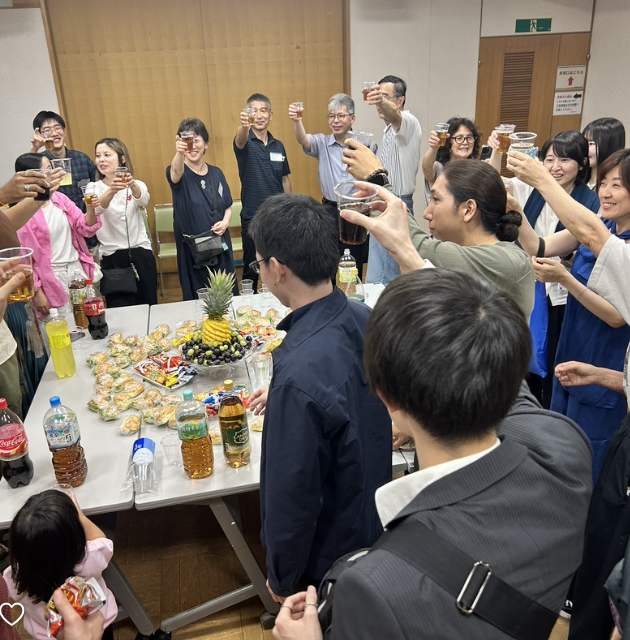
Contestants raise glasses of barley tea at the end of the first day of competition.
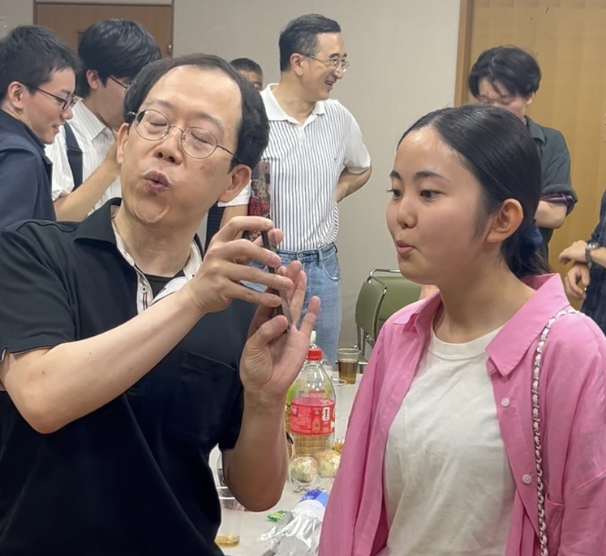
The Convention tries to build a sense of community among generations of whistlers.
***
I wouldn't be competing until Sunday, in the “senior a capella” division, and I was the only American in my group. The two obvious favorites in my category had placed second and third in 2024, so I tried to figure out some sort of competitive advantage. Maybe, I told myself, what I lacked in experience I could make up for with pluck and enthusiasm. My mantra would be “I am energetic and emotional.” Plus I had a brilliant strategy: for my second song, I’d be whistling one of Japan’s most popular oyagi (“old man”) karaoke songs, “My Way.” But not the way Frank Sinatra did it; I’d also be doing it in a style I bet the judges hadn’t heard—the Aretha Franklin version.
Shock and awe? Maybe. Confusion? Also maybe.
***
Over the course of the Convention’s three days, I got to see and meet undeniable stars. Yuki Takeda, 34, who had won eight times in international competition in multiple categories, gave a lecture on the history of Western whistling before he competed in the adult a capella and hikifuki categories. Yuseke Matsumura, the 33-year-old 2024 overall champion, wasn’t competing this year, but he gave a demonstration.
Both men showcased their three-octave ranges, sophisticated whistling techniques, and deep musical knowledge, all while delivering stellar performances of both classical and popular pieces.
Takeda and Matsumura are key parts of an ever-expanding competitive whistle world. In 2020, Takeda co-founded the International Whistlers Guild, which now hosts the Global Whistling Championship, an annual online-only event designed to attract more competitors worldwide. Matsumura, a former tuba player who is now a bass opera singer in Germany, won the global online title in 2021.
There’s also another international whistling competition now, bringing the total to three. A new documentary, Whistle, focuses on the Masters of Musical Whistling competition (held every other year in Hollywood), and features Takeda prominently. The buzz that documentary has created is, in turn, spurring talk in the community of even more championships, including one in South Korea, another in India and a third in Italy. But not in Louisburg.
***
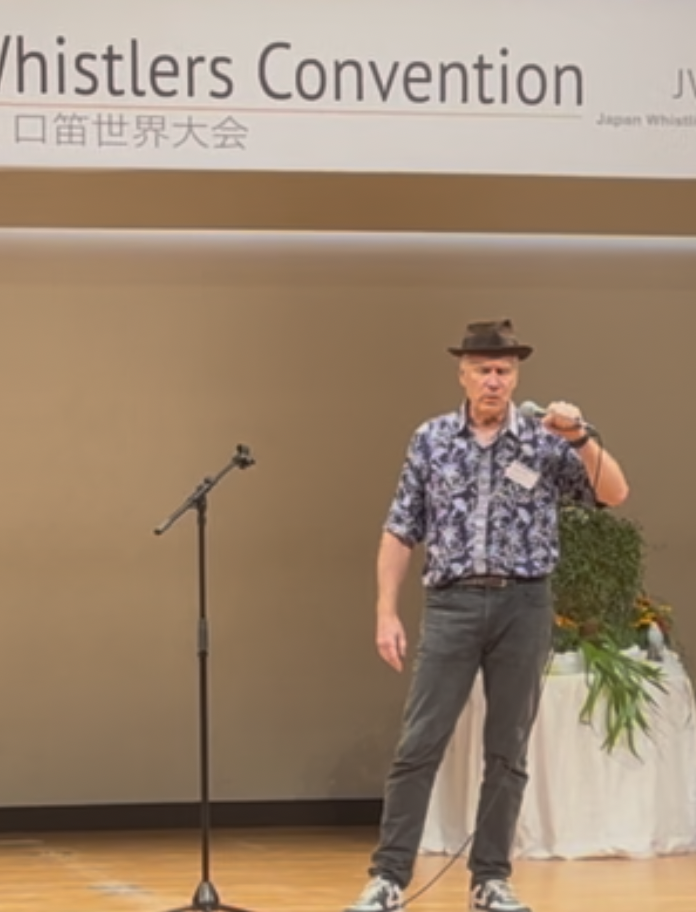
My moment of truth.
When it’s finally my turn at the microphone on the final day of the convention, I’m surprisingly nervous.
I’ve sung in plays and concerts for decades, but performing alone, with no words and no other instruments, trying to squeeze an entire performance through a one millimeter aperture suddenly feels like a naked bungee jump.
I forget to change octaves in one section of my Mozart piece and have to take a breath in a weird place. I forget to bow afterward and am still beating myself up about it as I launch into “My Way,” the tune I am hoping will be just weird enough to captivate.
The audience does not, apparently, fall under the sway of my jazz-blues approach. Even so, I stay on pitch, make no major mistakes, and keep my promise to myself: I am energetic and emotional.
After my performance, I exit through the lobby of Scrum 21 and am stopped by a Japanese man who has just watched me.
“Your whistling…” he says—I wait, hopefully—“Was very…interesting. Very…enthusiastic.” Hmm.
I return to my seat to watch the others. “I have you third… so far,” says my ever-honest wife. Then the elegant Noriko Ikenoya, delivers a different version of “my” Mozart melody. A better version. She takes her time, hits every note with precision, breathes perfectly, looks supremely confident. Ret leans over and whispers, simply: “Okay, now maybe you’re fourth?”
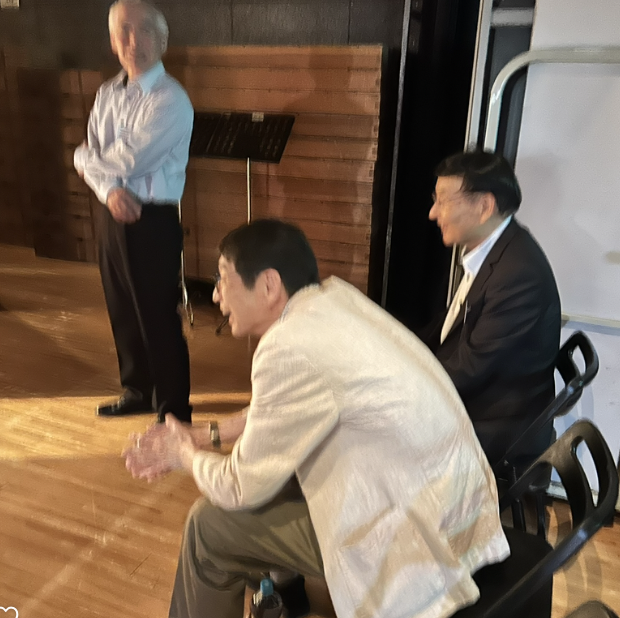
Contestants in the senior a capella division wait backstage for their chance to impress the judges.
Sure enough, Japan sweeps the podium in my division. Though I’m not exactly where I finished, I know my pitchpipe dream of somehow reclaiming North Carolina’s lost whistling glory has fallen flat.
The subtle nods to the event’s Louisburg heritage are still there, though. The event’s official logo features a cardinal, the North Carolina state bird and there’s a cardinal in the balloon display too. DeHart is prominently featured on the back of the program, and the convention’s website shows a letter he wrote just before his death in 2016, officially conveying the event to his Japanese successors.
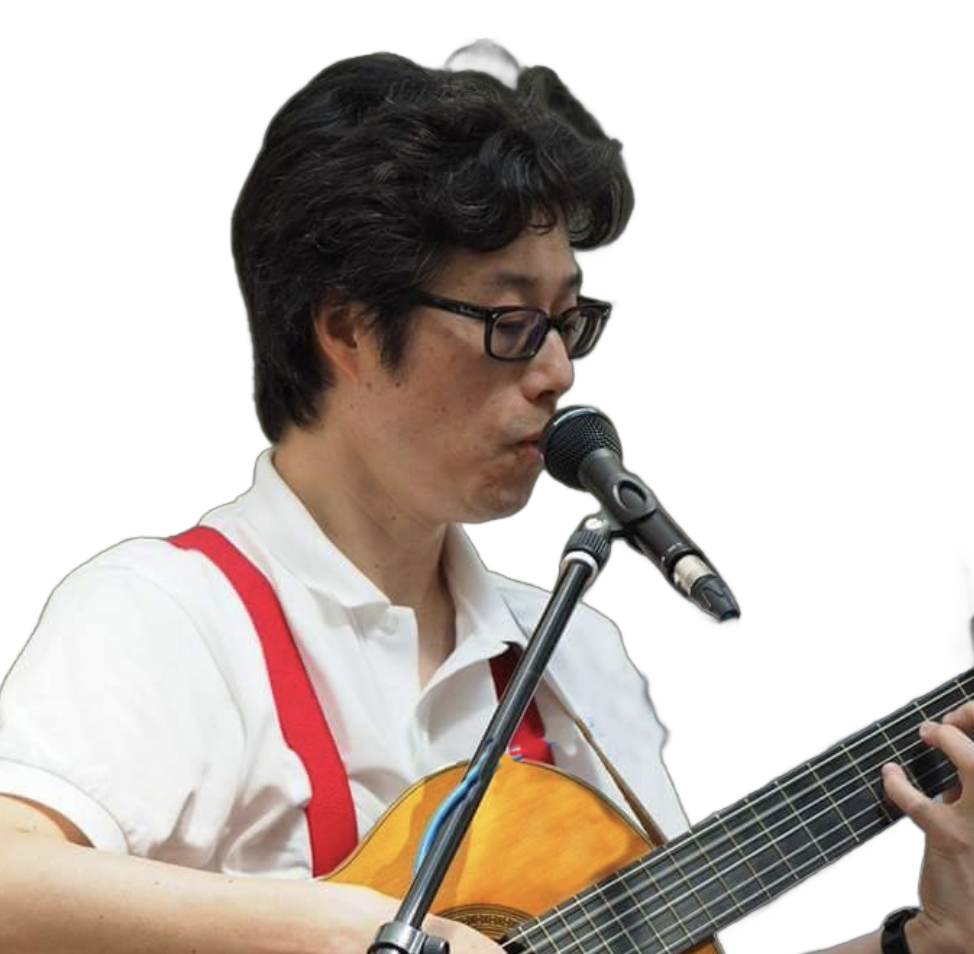
Expert whistler, judge and event organizer Ryosuke Takeuchi has picked up the torch from event founder Allen DeHart.
The major players in whistling have traces of North Carolina DNA as well. Organizer and head judge Takeuchi, the former Louisburg competitor, was the recipient of the first international Allen DeHart Award, given annually to the person who has contributed most to the cause of whistling in the world. Cristina Toyohashi, who helped manage this year’s event, was with Takeuchi when DeHart first asked Japan to host the Convention. Kamiko Wakiyama, now a competition judge, was the 2007 Female Grand Champion in Louisburg. And Carole Kaufman (aka “The Whistling Diva”) who runs the Masters of Musical Whistling event every other year in Hollywood, launched her career after winning the Female Grand Championship in Louisburg in 2009.
The influence of Louisburg will continue into the next generation as well. David Eberius, a 34-year-old from Knoxville, Tennessee and a co-founder of the International Whistlers Guild, got his start in competitive whistling after watching Pucker Up, the documentary about the 2004 competition in Louisburg, on YouTube. And Takeda traces his entry to this world to a television interview he watched that featured two Japanese teenagers just back from winning in Louisburg. He won the teen category the following year, launching the career of the most-decorated whistler in history.
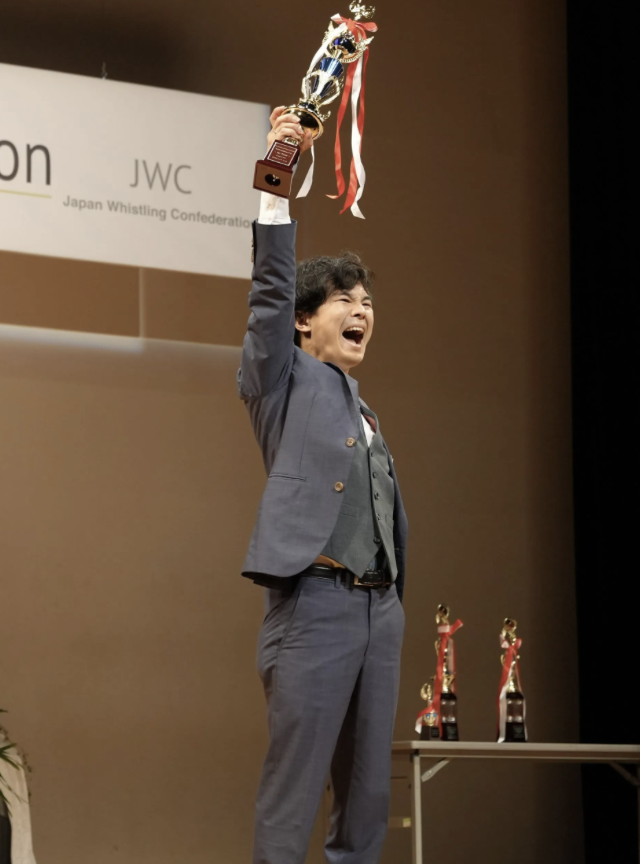
At 34, Yuki Takeda may already be the GOAT of whistling….
This year, Takeda adds two more awards to that legacy, winning both the adult a capella and hikifuki divisions. On Sunday evening, the hundred or so remaining competitors are called on stage to join him for the close of the 47th World Whistlers Convention. Just like Louisburg – but with a different accent.
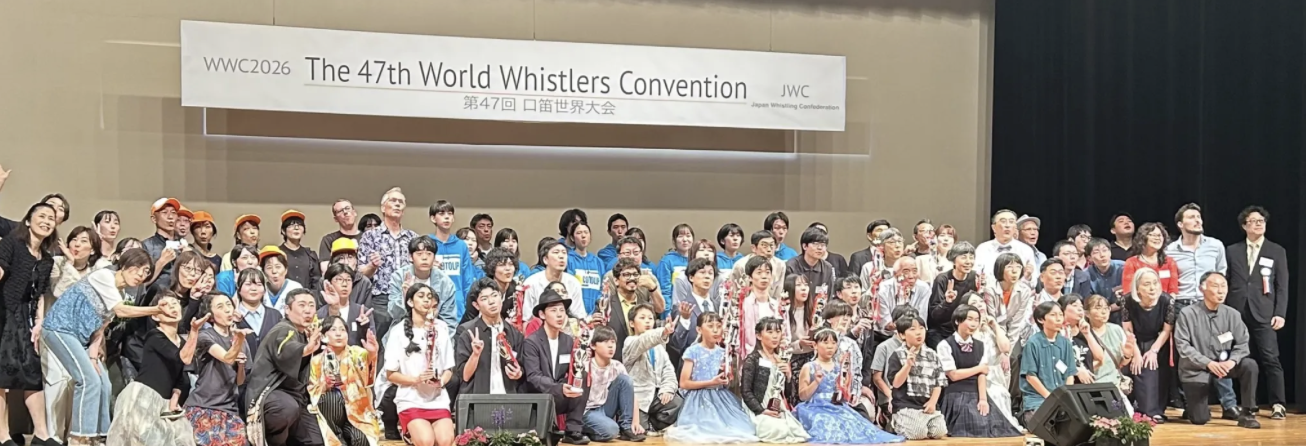
The competition in Kawasaki ended, as did those in Louisburg, with a final group photo (photo Ret Boney).
I’m back home in Raleigh three weeks later, when out of the blue, I receive an email with an unexpected set of comments on my performance. The panel thought I had a “beautiful tone” in my performance of “Eine Kleine Nachtmusik,” but said I strayed too far from the original song. They found my arrangement of “My Way” to be “heartwarming,” with “groove and mood,” even if they also thought my sound was too “husky.”
Still, I performed, they thought, with “manly coolness.” It’s a phrase I’m not sure will ever again be applied to a whistling performance—and, Ret is quick to add, probably not to me, either.
Unless, maybe, I return to Kawasaki in 2028. Because there was one more tantalizing bit of information in the email. I was, in fact, the fourth-best old person.
-Leslie
Missed Part 1? You can find it here. Want to know more about the wonderful world of whistling from top experts? You can find that here.
Notes:
Masters of Musical Whistling: https://www.mastersofwhistling.com
Global Whistling Championships: https://whistlersguild.org
Whistle documentary: https://www.whistlemovie.com
Kamiko Wakiyama’s YouTube channel: https://www.youtube.com/user/whistle794