I can’t help thinking that the policy world might be different if I hadn’t said no to Mr. Beast. Back in 2021, I was working with NC State’s Institute for Emerging Issues. Our communications director, Greg Hedgepeth, knew somebody who knew somebody who knew Mr. Beast (the brand name for Jimmy Donaldson, then a 23-year old content creator from Greenville NC). Greg suggested Mr. Beast might be just the person to dramatically increase interest in a big meeting we were having focused on bringing people together across the various geographic, economic, educational and political divides that were breaking out in the US.
At the time, “Mr. Beast” was a rising superstar of YouTube. Beginning at the age of 13, “MrBeast6000” had begun making videos on how to beat the game Minecraft. Year after year, Donaldson slowly discovered how to grab more and more (and more) viewers’ attention for longer and longer periods of time. He livestreamed himself counting to 100 thousand. For reasons I can’t imagine, that went viral, but he discovered his superpower: making videos involving big spectacle and big numbers. He sent a tank to pick up folks who called for an Uber – shock value. He filled a friend’s home with 10,000,000 legos – and delighted in emptying the bags into every nook and cranny. He got people to volunteer to go to a “prison” he made, filmed them and rewarded them for every day they survived it. He gave away millions of dollars to charities, to homeless folks and to winners of his “challenges.” By 2021 his video channel on YouTube had 100 million subscribers.
Hence the attraction to me as head of a sometimes-boring public policy thinktank. What if we could get him, we wondered, to figure out some stunt that would illustrate the interdependence of big cities and small towns?
After a lot of hand-wringing, I went along with the argument that working with Mr. Beast might obscure the seriousness of the issue (God forbid we should make a policy debate fun). He’d had a couple of problematic tweets. He’d had complaints from some of his employees. We passed. And I’ve second-guessed that decision ever since.
A lot of people have underestimated Mr. Beast for a long time. He’s proven them wrong.
In the past four years, Jimmy Donaldson/Mr. Beast has shot past superstar status to the kind of fame that didn’t exist for anyone 20 years ago.
· By 2023, Time Magazine had named him one of the world’s 100 most-influential people.
· Today, he has the biggest channel on YouTube, with 457 million subscribers, and is its highest-paid creator, clearing more than $500 million a year, most of which he puts back in to producing videos and giving to charity.
· His videos have been viewed more than 105 billion (yes, billion) times around the world. He continues to grow those numbers by hiring voice actors to dub videos into multiple languages (and he’s started a company designed to help other creators do the same) – only 37% of his views come from the US.
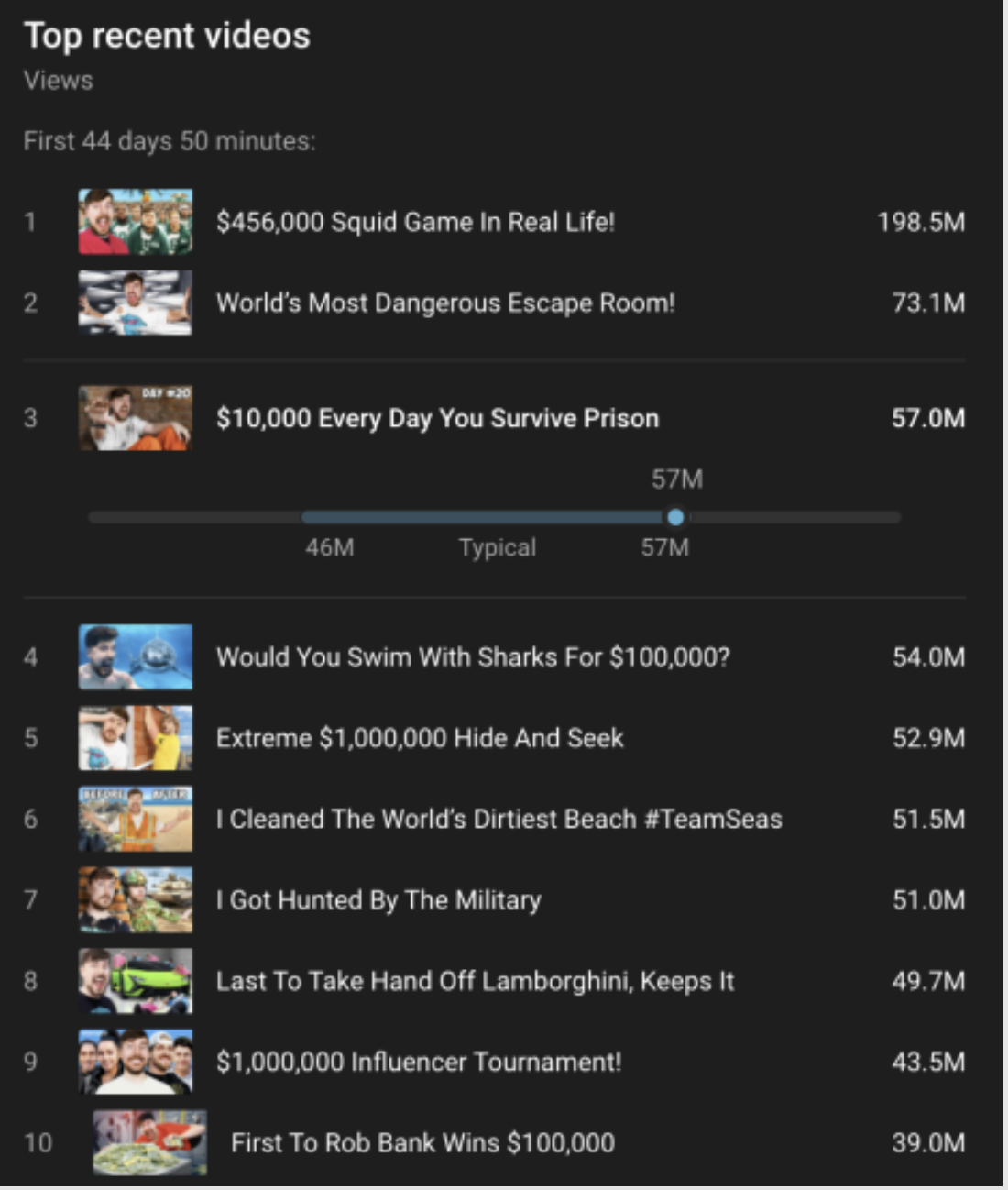
The number of views for Mr. Beast videos is absurd.
· Through Beast Philanthropy, he has given away 10 million meals to the hungry, gotten clean water to 500,000 people in Africa, planted 23 million trees, removed 33 million pounds of trash from oceans, built 100 homes for the homeless and given away 100 cars, supported Ukrainian refugees, helped with disaster relief and through GiveDirectly, given millions in cash to families in extreme poverty.
· He’s started the food companies MrBeast Burger, Feastables (a chocolate bar company) and Lunchly (a competitor of Lunchables). He’s co-writing a thriller with James Patterson (set for release this year; reportedly an eight-figure publishing deal).
His Amazon series, “Beast Games,” became the platform’s most popular unscripted series ever, with 50 million viewers in its first 25 days. In the process he gave away the largest TV cash prize ever ($10 million) to the winner, as well as millions more in smaller prizes.

The surprise of Season 1 of Beast Games was that he actually awarded $10 million to the winner. This season the prizes will total $15 million — and a private island.
· He’s become the 8th youngest billionaire ever (and by one estimate the youngest self-made billionaire), with an estimated net worth of $2.6 billion.
So why isn’t Jimmy Donaldson talked about in business circles like other big CEO’s? In part it is because he’s only moved beyond YouTube relatively recently. But I think there are at least three other reasons.
· Education/location/age bias: Donaldson is a community college dropout from the rural South. We like our business heroes to be from the “right” place with the “right” education. And it helps if they have a little grey hair.
· Unfamiliarity with the industry: If you’re older, like I am, you’re less likely to spend your screentime on YouTube, Instagram or Tik Tok, and don’t appreciate the analytics and creativity it takes to create a viral video. About 87% of Mr. Beast viewers are under 45, with an average viewer he describes as “a teenage memer who likes video games.”
· Annoyance with the distraction economy: If older Americans spend any time thinking about the online video world, it’s spent aiming the rocks we want to throw at it.
Lately I’ve been studying Mr. Beast to figure out how the brand became so successful and what I can learn from it.
First a disclaimer. Jimmy Donaldson has admitted to making racist and sexist comments online as a teenager. A lawsuit filed in 2024 by 5 of the 1000 participants in his Amazon show Beast Games, alleging exploitation, unsafe working conditions and sexual harassment has not been resolved (though the show has been renewed for another season; it went live this week). There are similar allegations, easily discoverable, of racism, sexism and unsafe working conditions against Jeff Bezos, Elon Musk and Bill Gates. Let’s be clear: we don’t want to learn that kind of behavior from anyone.
So what can we learn from this strange, manic, data-savvy, creative genius? I think he has a lot to teach us about Gen Z, leadership, and building a business in this new strange attention-scarce economy.
Beyond cracking the code on the YouTube algorithm (more on that later), there’s a business brain that deeply understands how to motivate the people who work for him and how to ensure that his customers keep “buying” his products.
One great set of clues to his success can be found in a (leaked) 36-page memo Donaldson shared with his employees last year called “HOW TO SUCCEED IN MR. BEAST PRODUCTION.” If you are in sales, it is worth reading. If you are trying to figure out how to manage Gen Z employees, it’s worth reading. If you are a young person starting out in any job, it’s worth reading (I’ve put a link to the full memo in the notes).
There are a number of really important tips in the memo about how to work in any setting.
1. Work smart> work long: Donaldson makes clear that people working for him won’t be judged on how many hours they worked, but on how successfully they worked. “At the end of the day,” he writes, “The amounts of hours you work is irrelevant…You will be judged on results, not hours. We are a results based company. Get s*** done and move the goalpost!” For a generation that consistently expresses an interest in greater work-life balance, this would be really good news.
2. Commit to excellence: With great latitude comes great responsibility. Donaldson sets the bar high for his employees, describing the characteristics of what he calls “A,” “B,” and “C” employees. He wants only A’s: “A-Players are obsessive, learn from mistakes, coachable, intelligent, don’t make excuses, believe in Youtube, see the value of this company, and are the best in the g**d*** world at their job.”
3. Analog communication produces better digital communication: Donaldson reminds his employees that face-to-face conversations are always better than texts or emails. “The worst thing you could ever do when you need something for your critical component is email someone at the company. The best is to talk to them in real life. It’s very important you know when to call people for stuff, grab them in real life, and when to text them.” Obvious? Probably not to someone who’s grown up online.
4. Own your responsibilities, but don’t be afraid to ask for help: Employees, especially younger employees, sometimes worry so much about screwing up that when they do they either blame their failures on others or try to cover it up. Donaldson makes it clear: “I hate excuses and I despise with my entire soul when people just try to save face instead of learn from how they messed up. Mistakes are okay! Genuinely they are and I expect you to make a lot. That’s perfectly fine. Every veteran here has cost me a million dollars at one point or another, and you can go ask them yourself if I ever held it over their heads. The reason i’m okay with f*** ups is because I know that’s how you learn.” But admit it quickly so it can be fixed. He’s also a huge fan of consultants: why would you not take advantage of people who have already solved a problem you are trying to figure out?
5. Know your product: It’s always amazed me to discover that a number of people working in organizations don’t read what the company is writing, watch what the company is producing, or take time to understand the core mission of the organization. Donaldson reminds everyone that his products have a distinct style and vibe and the people producing and marketing them need to be deeply familiar with the brand. They also need to understand the platform the videos are shown on: “Whether it be production, creative, camera, or editing I want you to be obsessed with Youtube. Get rid of Netflix and Hulu and watch tons of Youtube, it will without a doubt in my mind make you more successful here… If you’re a writer or director you really need to monitor and perfect your information diet. If your diet is not correct, you won’t have a good pulse on culture.”
6. Ignore analytics at your peril: Everything Beast productions does is built around the key analytics that determine success on YouTube. For YouTube, the more people watch the more seconds of a video, the more ads the platform can sell, and the more the platform pays Mr. Beast Productions. That means carefully crafting every second of every video to keep viewers engaged. Great headlines increase the number of people who decide to click on and start watching a video – the Click Through Rate (CTR). An off-the-charts interesting first 60 seconds hooks someone for a longer Average View Duration (AVD) and consistent surprises stoke the percentage of the video that people watch, the Average View Percentage (AVP). “If you want to know if the contents of a video are good, just look at the AVD and AVP of a video after we upload it.” For his company CTR+AVD+AVP=YouTube $. Do your employees know your metrics?
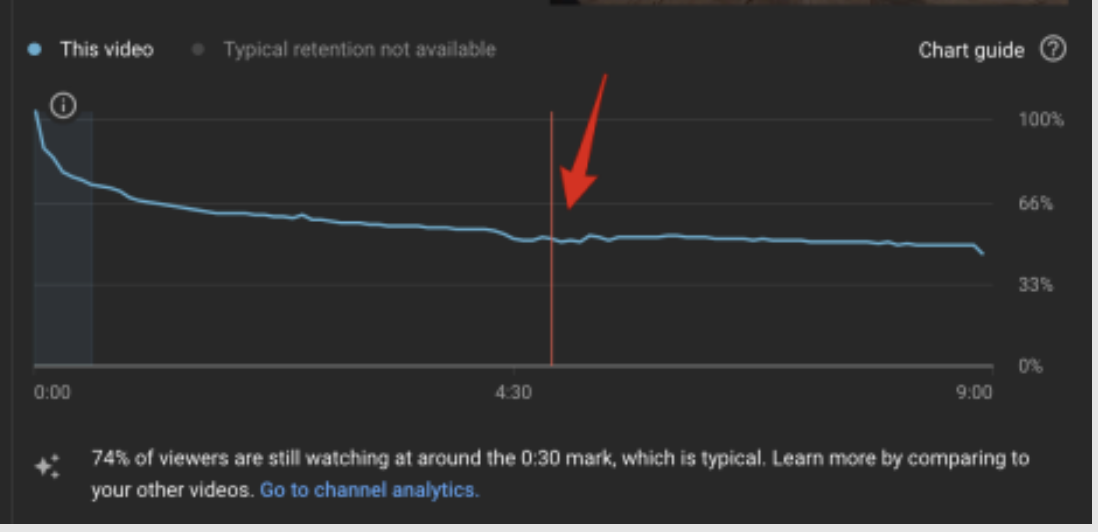
Mr. Beast knows exactly what keeps people watching, and when and why they turn away.
7. Give employees a clear vision of success: You can argue about whether it is a good thing for our society to have more people watching silly videos for longer periods of time, and you can argue that he could be creating art instead of viral videos (to which he says this: “Pardon the bluntness but this is not Hollywood and I do not want to be Hollywood. And if that sentence is a turn off to you then you’re probably at the wrong job.”), but you can’t argue that Donaldson isn’t telling his employees what success in his company looks like.
8. Bring yourself to work: Donaldson actively encourages his employees to bring their outside knowledge into the workplace. Granted, he’s not expecting Shakespeare or Aristotle; he holds up as an example an employee who has encyclopedic knowledge of every Spongebob Squarepants episode. As a result, the employee is “able to draw from so much stupid s*** in his head as inspiration to make jokes and be quirky.” Which makes for better videos for Mr. Beast’s principal audience (70% male, 54% 18-34 years old). I never especially wanted my employees to bring Spongebob Squarepants to work, but I wasn’t in Mr. Beast’s business.
9. Offer options, not problems: Donaldson reminds workers that as CEO he’s got a lot of different projects going on. So “when you need something from me you have to understand that i’m probably not as knowledgeable about a video as you. Whatever you don’t tell me, I don’t know. When getting an answer from me it’s ideal you do the research and come to me with context and options.” In other words, don’t just dump your problem on your boss: come in having thought through options, with an opinion about how to go forward. Any busy boss appreciates that.
10. Flat management structure; vertical opportunities: Donaldson makes clear that the videos his company produces will always star him, but he also encourages speaking up when you disagree or have an idea, and he seems determined to minimize bureaucracy. The memo also lays out an attractive (and based on past growth, not ridiculous) vision for the future: “There is infinite room to grow here… And those of you that help build this will be rewarded…. I want nothing more th(a)n for you to go all in, obsessive all day everyday, and become so g**d*** valuable this company can’t operate without you. And in return for becoming so valuable I hope to give you incredible experiences, a fun place to work, and of course, more money th(a)n you could ever dream of making at any other company. I see a world where this company is worth billions and one day 10s of billions. And those of you that help build this will be rewarded.”
In summary, in the memo, a precocious CEO very clearly lays out a succinct set of expectations for a bunch of young employees, most of whom have never previously had a full-time adult job. He offers them a chance to work in a fast-paced, game-oriented environment, one that offers nearly-unlimited advancement potential in an ever-expanding company and doesn’t micromanage your schedule. He offers sound advice on managing up, and he sets a hyper clear goal.
If the CEO’s name were Steve Jobs or Elon Musk or Jeff Bezos, business professors would be teaching courses about him or writing books about him. But a 27-year-old rural Southern dropout? He doesn’t fit our mold. Maybe we need to rethink the mold.
After passing on Mr. Beast in 2021, we held our conference on finding ways to “reconnect” people across divides – rural and urban, digital, racial, political, educational. Using our traditional marketing strategies, we felt excited that 500 people participated during the pandemic. People wrote good reviews of the conference; they vowed to take action; we declared victory.

Yes it was during a pandemic. But what if we had brought a Mr. Beast-inspired approach to a public policy discussion? How many people would have been talking about it?
I have no idea what Mr. Beast would have come up with if we had ended up asking him to get involved. I was imagining he would have convinced a young farmer to deal with a cramped city apartment and traffic and a young urbanite get up at 5 am to milk cows or shovel hog slop for 100 days, but he would have come up with something better. And even though I surely would have cringed at some of the content, instead of having 500 people talking about our issues, we would have had 500,000. Or 5 million. The man knows eyeballs. That, whether we like it or not, is the beauty of the Beast.
Notes:
Mr. Beast overview: https://en.wikipedia.org/wiki/MrBeast
The Mr. Beast memo: https://www.alexanderjarvis.com/memo-how-to-succeed-in-mrbeast-production/
Amazon Beast Games Season 1: https://www.primevideo.com/detail/Beast-Games/0TC47K49HUJK01R9FA42BAO22A
Mr. Beast philanthropy: https://economictimes.indiatimes.com/magazines/panache/mrbeast-drops-long-list-of-philanthropic-deeds-funded-by-youtube-earnings-reveals-how-he-made-it-happen-while-still-in-his-20s/articleshow/122341960.cms?from=mdr
Mr. Beast discusses his foreign language dub strategy: https://www.youtube.com/watch?v=8bDRVP9xSfc
Lawsuit against Mr. Beast: https://www.youtube.com/watch?v=z1cOBobRmGE&feature=youtu.be