How to Get the “Right Things” Done
“What the hell does Smart Start have to do with paving highways?” It was North Carolina Transportation Secretary Sam Hunt on the phone, calling me. He was ticked. And it was a legit question. I’d told his assistant that the Governor’s Press Office needed to rework his planned remarks to the Carolina Asphalt Pavement Association (yes, that’s a real thing). The problem? In his speech draft, Sam Hunt wasn’t talking enough about Smart Start, the early childhood initiative our boss, Gov. Jim Hunt (no relation), was pushing.
By this point, two months in to Gov. Hunt’s third term, the folks in our office had gotten used to these kinds of calls. The previous week there had been another one from the head of the Department of Crime Control and Public Safety. Another from the communications director of the Department of Environment and Natural Resources.
So why were we rewriting every speech by every member of the administration to find a connection between early childhood education and… asphalt? Incarceration? Pollution?
The answer, according to Jim Hunt? Smart Start was “the right thing to do” ! There was no more important time in a child’s life than the first three years and North Carolina wasn’t doing enough to help children during that time! Smart Start would fix that!
Some people in the state opposed the proposal for religious reasons or self-interested reasons or political reasons or fiscal reasons. The Governor heard all that, he said, but they were “Just flat wrong.” This was war.
In situations like this, Gov. Hunt believed, it’s all hands on deck. To get tough legislative issues passed, he told me in a 2017 interview, you had to “talk about ‘em all the time, to the point where people get sick of you talking about ‘em, so people are just damned tired of hearing Hunt talking about Smart Start.”
But it couldn’t be just “Hunt talking about Smart Start” – EVERYbody needed to be talking. So we strong-armed cabinet secretaries and shoe-horned Smart Start into their speeches. We trotted out social scientists and brain scientists to cite the data. We found worthy mothers and adorable children and earnest day care operators and passionate pastors in the hometowns of wavering legislators and got them to tell compelling stories.
It was all fascinating political chess for me as a newbie in that world. I especially enjoyed doing the mental backflips to argue why, if you want better roads or fewer inmates or cleaner water, you need to pay attention to our most vulnerable children.
After a few months of allSmartStartallthetime, the campaign worked. The opposition capitulated. Smart Start passed and took root. It’s part of the landscape of our state now, as accepted as long leaf pine trees.
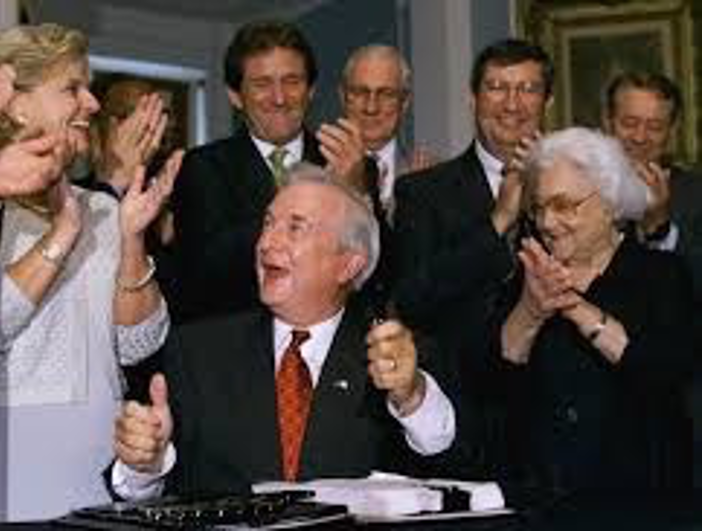
Victory! Gov. Hunt signs Smart Start legislation, 1993.
Some parts of Jim Hunt’s success can’t be duplicated.
· He was passionately committed to and deeply knowledgeable about one very particular place. Except for a couple of years in the 1960’s doing a kind of Peace Corps stint in Nepal, Gov. Hunt lived his entire 88 years in North Carolina. Over time, he built well-connected groups of supporters in every one of North Carolina’s 100 counties. He knew their names and their needs and every nook, cranny, dune or holler of the state.
· He had unmatchable experience of one particular kind of job – he served as either Governor or Lieutenant Governor for 20 years. By the time I joined up in 1993, he was in year 13 in an executive role. He knew which things could be done “top-down” by executive order, which ones needed to be built through a “bottom-up” groundswell, which ones needed to be carefully navigated through a fickle legislature. And he could do all three.
· He had a frighteningly intense, indefatigable, dog-with-a-bone sales ability. Gov. Hunt would grab you by the elbow, look you in the eye and refuse to let you go until you agreed with him. He could sell bacon to hog farmers – and early childhood to asphalt pavers.
The Smart Start sellathon strategy was not unique — Gov. Hunt was basically applying saturation advertising principles to politics — but it was groundbreaking at the time. Since then, over the past 30+ years, it’s become part of the standard political playbook. Elected officials now regularly have “theme weeks” where they and their surrogates relentlessly hammer home a central message about a single issue.
A couple of other keys to the success of Gov. Hunt, sadly, have not become part of the standard political playbook. It would serve politicians – and all of us well – to rediscover them.
Know who you are: There’s an old saying that if you don’t know where you are going any road will get you there. Gov. Hunt told me in the 2017 interview that before beginning any job, especially as a politician, you need to make sure you know what you care about and believe in, your core principles. For him, the early lessons he learned were acts of service in his family, his church, the Boy Scouts and Future Farmers of America. “Little things,” he called them. He helped his mamma put library books on the shelves; saw his dad help struggling farmers save their soil; helped his church bring food to poor neighbors. Learning the power of small acts, he said, can “evolve into bigger thoughts and bigger commitments that can change society.”
Having core principles also helps you figure what compromises you won’t make – your non-negotiables.
Real principles help shape what you take stands for. They enable people to understand who they are voting for. “One of the things we fail to do today is talk about our values and where they come from,” Hunt told me. “There are a lot of times where a certain issue is morally right.” And that means it is one worth fighting for.
Know what you want to do. So many politicians spend so much time and money telling us why the other candidate is an idiot or a hypocrite or a liar or a liberal/fascist/ communist that we never learn what the person running actually wants to do. Gov. Hunt told me that for him the ideas always came first.
“A lotta people just ran for the office,” he said. “I ran to get certain things done. I decided those things before I ran…. A candidate ought to have a positive program.”
“Tell them what it is,” he continued. “Get them excited about it. Get them to want to vote for you to get those things done… And if they (don’t) want it, to vote against me. And I told them that.”
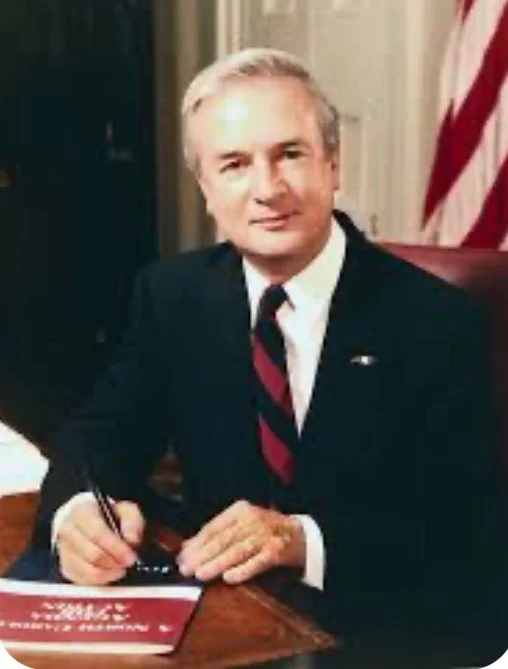
Campaign photo from 1992. Whether you voted for Gov. Hunt or not, you knew what he was going to do. It’s all in that red and blue document at the bottom left of the photo, his “Agenda for Action.”
Once Gov. Hunt got elected… and elected… and elected, and it came time to turn his ideas into policy or law or appropriations, he could legitimately say to legislators that he had wide public support for his ideas. 1972? He ran on implementing statewide kindergarten. 1976? Getting the veto and succession for North Carolina governors. 1980? Growing the biotech and microelectronics sectors. 1992? Early childhood education. 1996? Dramatically increasing teacher pay. The election votes were his proof.
But he didn’t want to just play the “mandate” card. Once he became convinced an idea was worth fighting for, he wanted to convince everyone it was right. One of my then-soon-to-be-bride’s jobs as Deputy Policy Director was lobbying legislators from the opposing party to vote for the Governor’s bills. It was thankless work — she had to listen to every complaint they had about anything the Governor was doing — but the Governor didn’t want to just 61 out of 120 legislative votes; he wanted to win 90-30. Or bigger. After all, this was “the right thing to do!”
I went to Gov. Hunt’s funeral in Wilson, NC yesterday. Our current governor, Josh Stein, and his predecessor, Roy Cooper, both described Gov. Hunt, flatly, as “North Carolina’s greatest governor.” High praise, and hard to argue with. It’s easy to put Gov. Hunt on a mountain far apart from us.
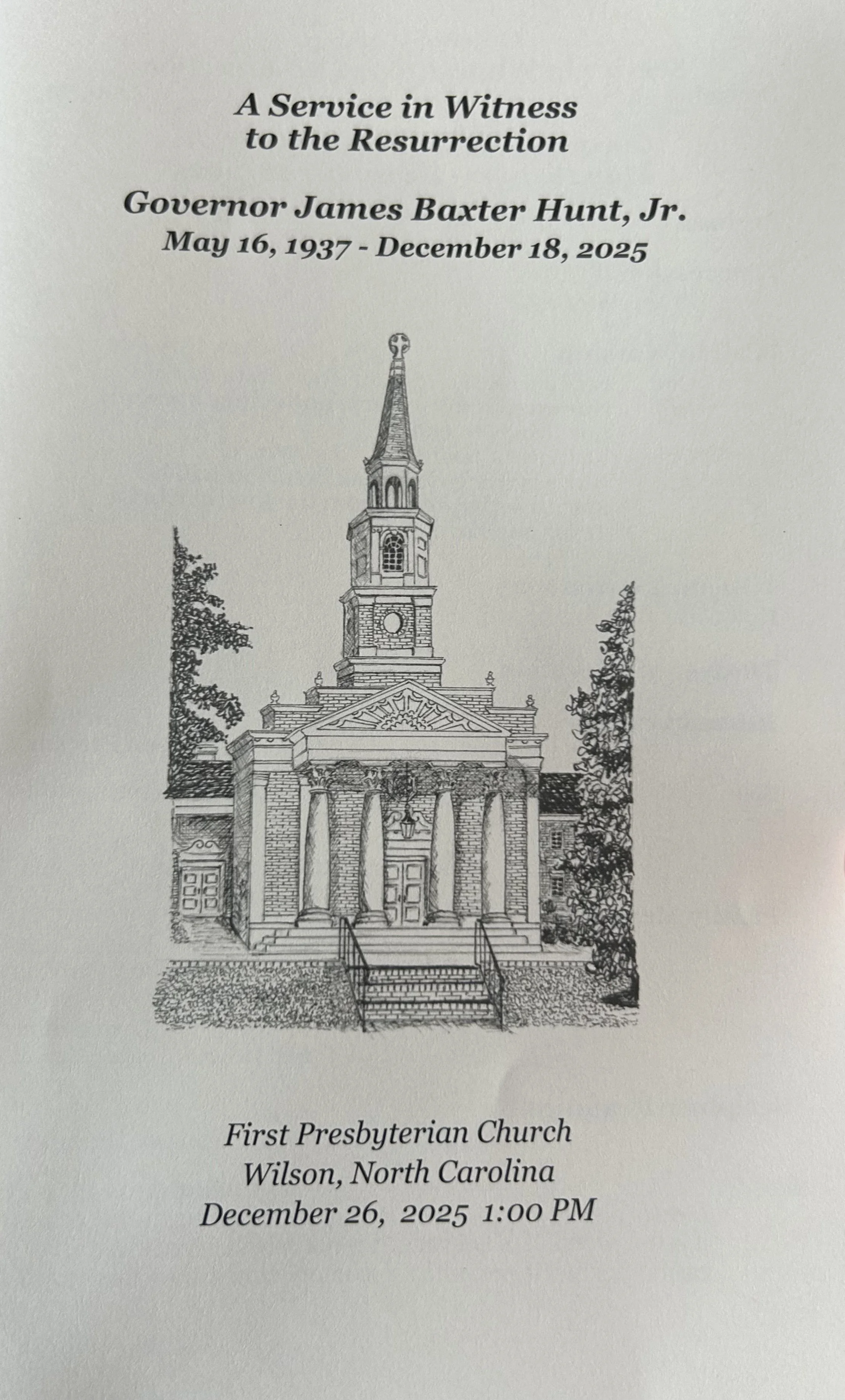
All six living North Carolina governors — and about 1000 others — attended Gov. Jim Hunt’s funeral.
But then the pastor at First Presbyterian Church in Wilson stood up and talked about Jim Hunt, his church member. Rev. Nick Demuynck shared the question he said the Governor asked himself and others in the congregation. It’s one we can all ask ourselves.
“How is God asking you to live your life THIS day?” Chances are the answer to that is probably going to turn out to be the “right thing to do.”
-Leslie
Notes:
Here’s the interview with Gov. Hunt from 2017: https://iei.ncsu.edu/2018/01/02/firstinfuture48/
The funeral: https://www.newsobserver.com/news/politics-government/article313979857.html