The Power of One
With his death this week, there’s going to be a lot written about the life of long-time North Carolina Governor James B. Hunt Jr. There should be. For those of you not from NC, he was the state’s only four-time governor, an unstoppable force in politics, a zealot for public education and the critical importance of early childhood learning, a national figure with a relentless mind that understood the importance of microelectronics, biotechnology and international business recruitment before anyone else. He changed the trajectory of the state I live in and places beyond.
According to President Clinton: “There’s nobody in my adult lifetime in the United States who has served as a governor who has done more for education, children’s health or the long-term economic interests of a state than Jim Hunt.”
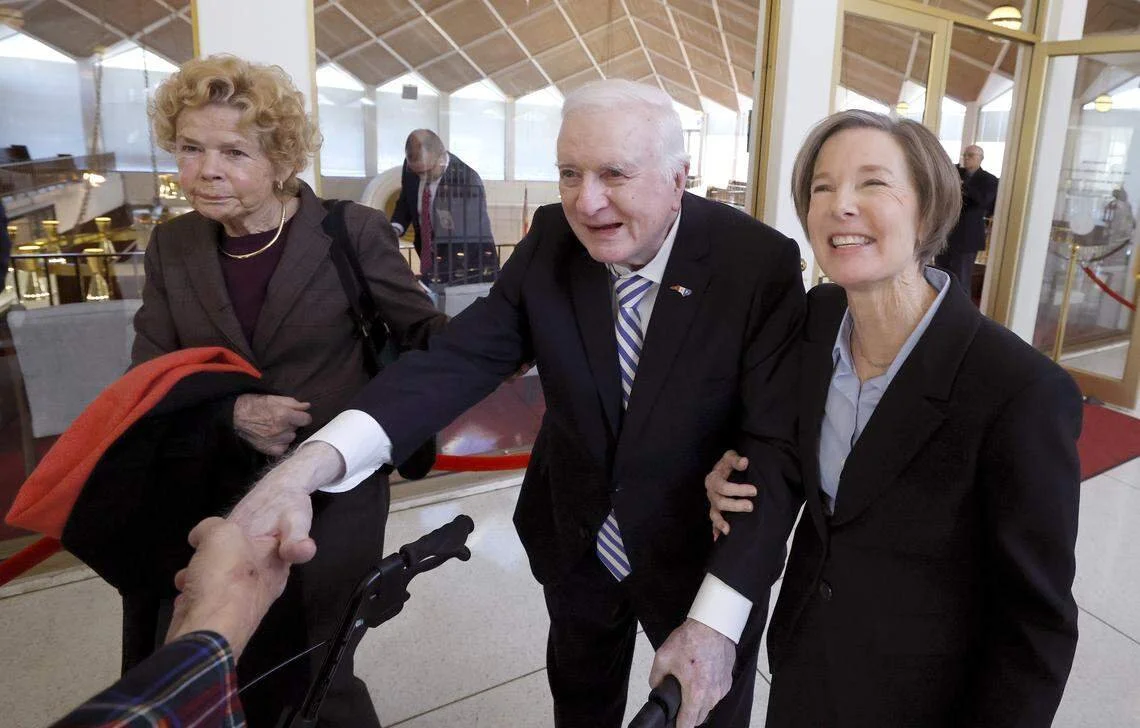
Jim Hunt (center) in one of his last public appearances earlier this year — with wife Carolyn (left) celebrating the first day of daughter Rachel (right) serving as the state’s Lieutenant Governor (photo Ethan Hyman).
But this piece is not going to be about any of that. I want to share how he changed the trajectory of one person’s life – mine.
1992 was a tough year for me. I was 33 years old, just beginning to be disenchanted with my work as a reporter when I got a call from Rachel Perry, who’d just finished running the successful campaign to elect Jim Hunt governor for the third time. She asked if I’d consider working for the new administration as a speechwriter.
Nothing could have been further from my mind than working in government, but I gave the idea a chance. And as I started combing through information about the campaign and the Governor’s stands on the issues, I found that I agreed with him on roughly 80% of his ideas. I took the job.
My first assignment was an absurd one. I, a city boy, was supposed to draft, as my first policy speech ever, remarks (to a group of farmers) for Gov. Hunt, a man who had grown up on a farm, gotten an undergraduate and master’s degree in agricultural economics, was currently raising a herd of Simmenthal cattle and had given at least 200 speeches about agriculture.
Drafting the proposed remarks took me a week. I sifted through every report I could find on every crop grown in the state. I looked up crop projections, pest eradication strategies, subsidies, new harvesting techniques. Then I poured them into what I thought was a pretty darned good speech.
On the way to the event, Gov. Hunt read what I’d written. He underlined passages, asked me tough followup questions, then stuck the speech back in his jacket pocket. I was stoked.
Once he got up to speak, he dramatically pulled the speech from his pocket and… spent the next twenty minutes gesturing with the rolled-up sheets of paper, giving a much better speech than I could ever have imagined.
That set the stage for my remaining time in that job.
Being asked to be a “speechwriter” for Jim Hunt was sort of like being asked to be a motivational coach for Michael Jordan: you got the benefit of the access but realized you weren’t really needed.
I got to learn about state policy writing speeches; I got to see how he converted the words I’d written into thoughts that people could get excited about. And, from time to time, he’d actually speak some of the words I wrote. What he would never do, no matter how hard my colleague Tom Rosshirt and I worked to come up with something better, was abandon his favorite speech closing.
If we all worked “our heads off,” together, he said, every time, we could “make North Carolina all that it can be; all that it should be; all that it MUST be.”
Mostly my time working near Gov. Hunt was a master class on how government works and the power of one person to transform ideas into reality. On a personal level, I made a huge pivot. As a reporter, I’d mostly been focused on identifying what was wrong, who was screwing up. I’d gotten good at tearing things down. Working for Governor Hunt taught me to get excited about the process of finding what was right and working to build it up. He had infectious expectations. I asked him about that in a podcast interview in 2017 (link in the notes below):
“Growing up,” he said, “I heard ‘we want to be the best in the South.’ To heck with that. I want North Carolina to be the best in the country…THE best.
“Not just good — a little better than some place else,” he went on, “We wanted this state to be the best it could possibly be.”
Gov. Hunt converted my attitude.
He also helped me with my love life. My first week on the job as Deputy Press Secretary I met his new Deputy Policy Director, Ret Autry. We started working on speech and policy projects, then working on… well, non-speech and non-policy projects. Eighteen months later we were married. Gov. Hunt took total credit and there’s some merit to that. No Jim Hunt, no way I would have met the love of my life.
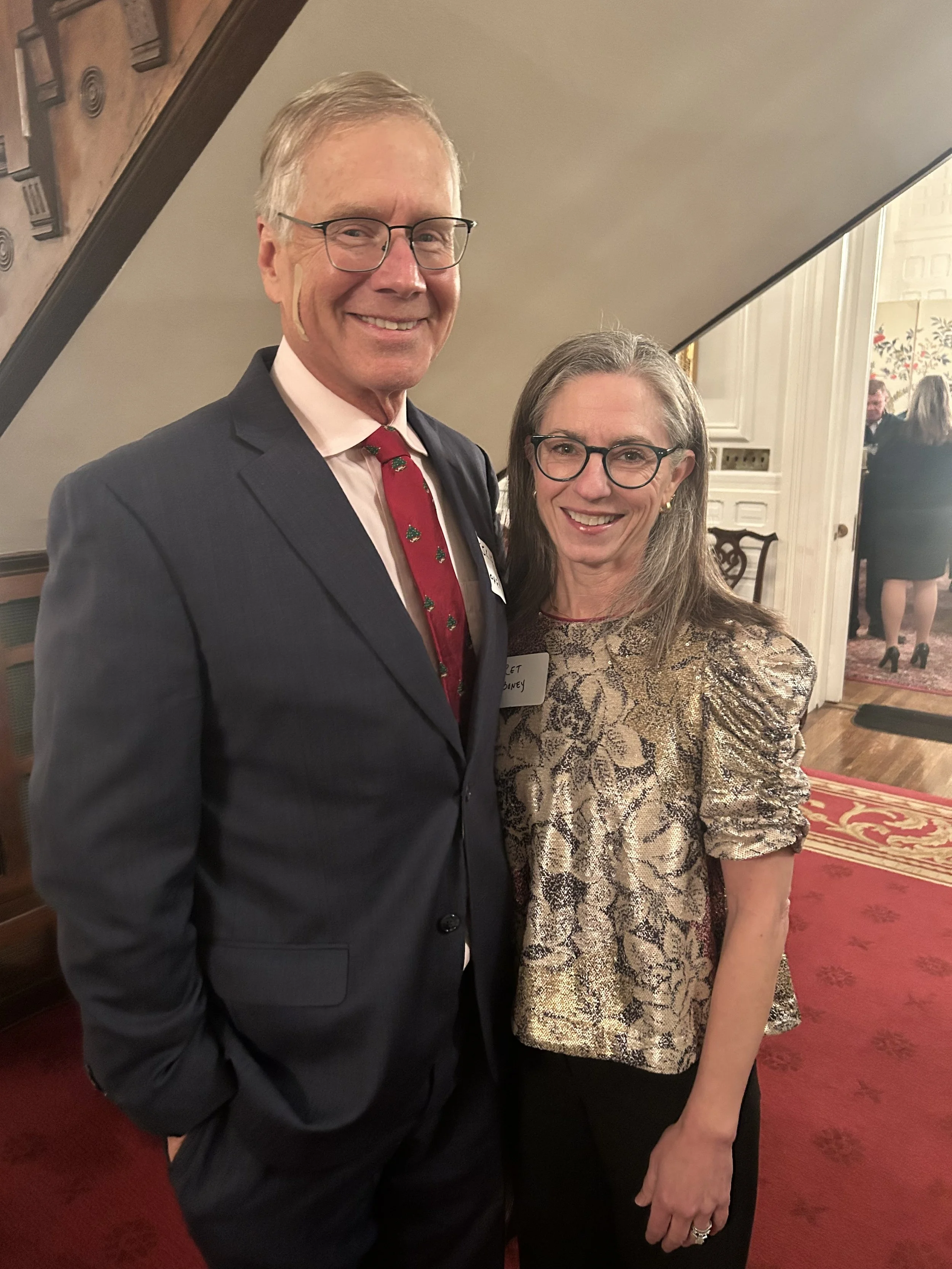
Earlier this month Ret and I found the exact spot in the Governor’s Mansion where we first met in 1993 — the first of many life-changing events that came about from my time working for Gov. Hunt.
One of the first pieces of advice I got from Gov. Hunt was a strange one. I asked him how he got so many ideas and he whispered, confessionally, “I always try to stay till the end when I go to a conference. By then most people are gone, but if you stay till the end, there’s a good chance you’ll hear something nobody else does.” He was an idea guy and his openness set me off on an my own idea-gathering odyssey. Over time I pitched three different job ideas that I thought would help make his priorities work. He greenlighted all three; the experience turned me loose on a completely new approach to work.
He was less excited about another thing I learned from him. Watching him work helped me to learn what I did not want to be: I realized I was not cut out to be a politician. I liked getting stuff done, but I didn’t have Gov. Hunt’s gift of gab, his art of the deal, his patience for compromise, his 18-hour-a-day passion or his ability to stare into people’s souls and get them to go to war for him.
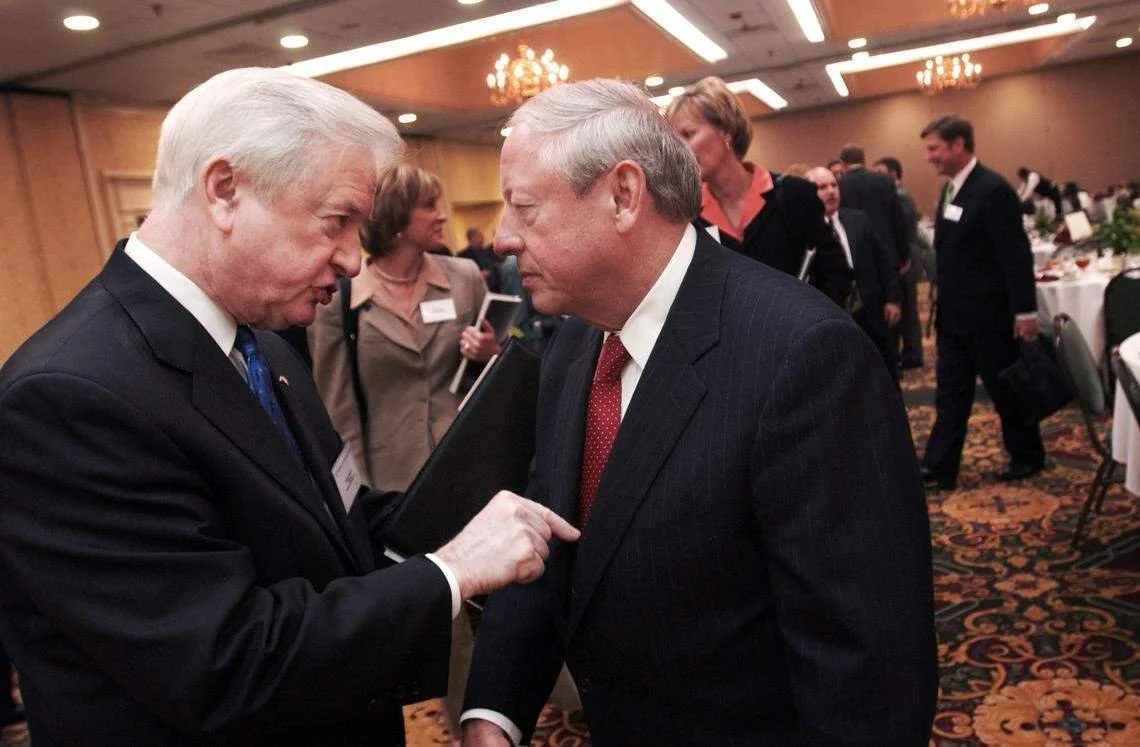
One of the most common opening lines for a speaker at the Emerging Issues Forum was this: “I actually was supposed to be doing three other things today. But then Gov. Hunt came to see me. You just don’t say ‘no’ to Jim Hunt.” Here he is with Merck CEO Raymond Gilmartin at the 2004 Forum (photo Ethan Hyman)..
Over the years, I thanked Gov. Hunt for what he had given me every time I got a chance. For helping convert me from a cynic to an optimist. For my bride. For demonstrating what a great politician can do and for helping me to understand I shouldn’t try to be one.
So that’s my story: the story of one person who was fundamentally shaped by the power of one man. But over time I’ve come to understand that there are dozens, probably hundreds, possibly thousands of versions of my story across the state. Here’s one more.
About three years ago when I was serving as director of the Institute for Emerging Issues (another one of his ideas!), I asked him to meet with a young NC State student who would become the first “James B. Hunt Jr. Scholar” – an undergraduate intern who would work with the Institute to learn how public policy is developed. As we waited for Shevani Mehta to arrive, it was clear he was weak from health issues – his voice was faltering; energy low.
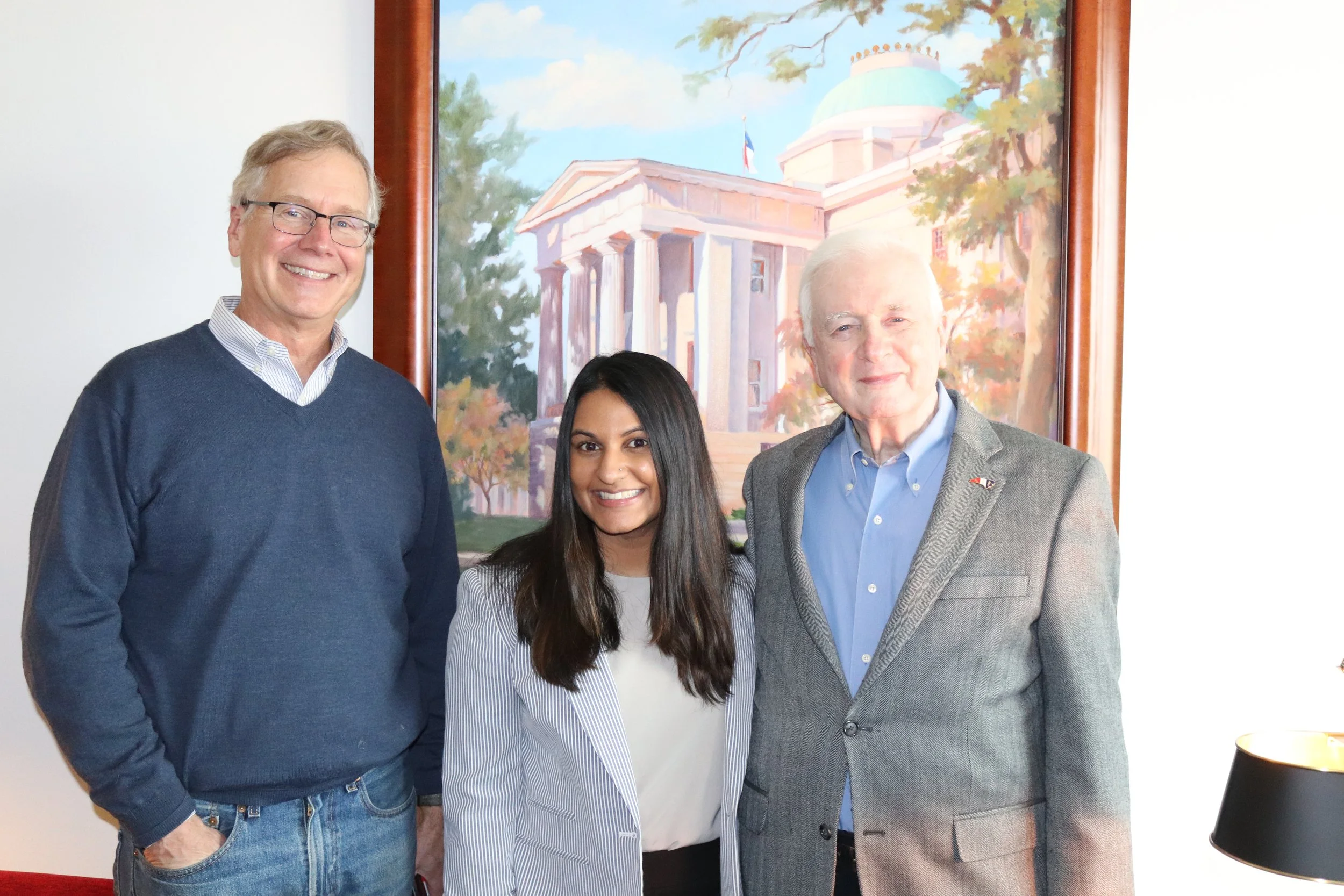
Shevani Mehta had no idea what was about to happen to her just after this photo was taken.
Then Shevani arrived. In seconds 85-year-old Jim Hunt became four-time Governor force of nature James B. Hunt Jr. again. We snapped a photo, then Gov. Hunt faced her, gripped her left tricep with his right hand, and, for the next twenty minutes, focused his entire being on this young person. He extracted her entire life story. Then he told her why her specific skills and background were so important. Why there was no better place to apply them than in North Carolina. And then he fixed his eyes on her and told her there was nothing more important she could do with her life than “work your head off” to make the world a better place. And I bet she will.
It made me want to be 20 again, or 33. Thinking back on that meeting reminds me that I should still be working my head off 33 years later.
There will only be one Jim Hunt. I was blessed to know him. The world is better because he was in it. But he’d be the first to say we have the power to help it keep getting better. It can be. It should be. It must be.
Notes:
Here’s a link to a two-part interview I did with Gov. Hunt for my podcast in 2017, when he was 80. The first one focuses on his creation of NC State’s Institute for Emerging Issues, which I served as director for five years: https://iei.ncsu.edu/2017/12/26/firstinfuture47/
This second episode gets into how he thought about leadership, and everyone’s obligation to serve: https://iei.ncsu.edu/2018/01/02/firstinfuture48/
Here’s an obituary that describes the political importance of Jim Hunt: https://www.newsobserver.com/news/politics-government/article313815210.html
This is a really nice documentary made by Clay Johnson at WRAL-TV about Gov. Hunt’s life: https://youtu.be/rz9k2zf5QR0
A great pithy summary of Gov. Hunt’s accomplishments: https://talkingaboutpolitics.com/jim-hunt/
Gov. Hunt’s inspirational interaction with the NC State intern reminded me of this scene from Man of La Mancha, one of my favorite moments in movies. Start about 3:30 in: https://youtu.be/oo7VlD66ISM?si=3sAGEkTzIBxXGNQv