Your Pathway to a 26 Hour, 36 Minutes Day
Smart phones are making us dumb. Distrustful. Lonely. Depressed.
In Megan Garber’s new book, Screen People: How We Entertained Ourselves Into a State of Emergency, she argues our phones have changed us into onscreen beings very different from our real-life selves, “screen people” — characters in our own lives, antisocial and heading in a bad direction.
You’ve heard some version of that before. More than 90% of Americans now own a smartphone, and surveys show that half of all smartphone users – and 80% of those under age 30 -- worry that we use our devices too much.
I don’t know. Is 4 hours, 37 minutes a day (that’s the average among all age groups*) too much? Is checking our phones 352 times a day (that’s our average,* up 4x since 2019) too much?
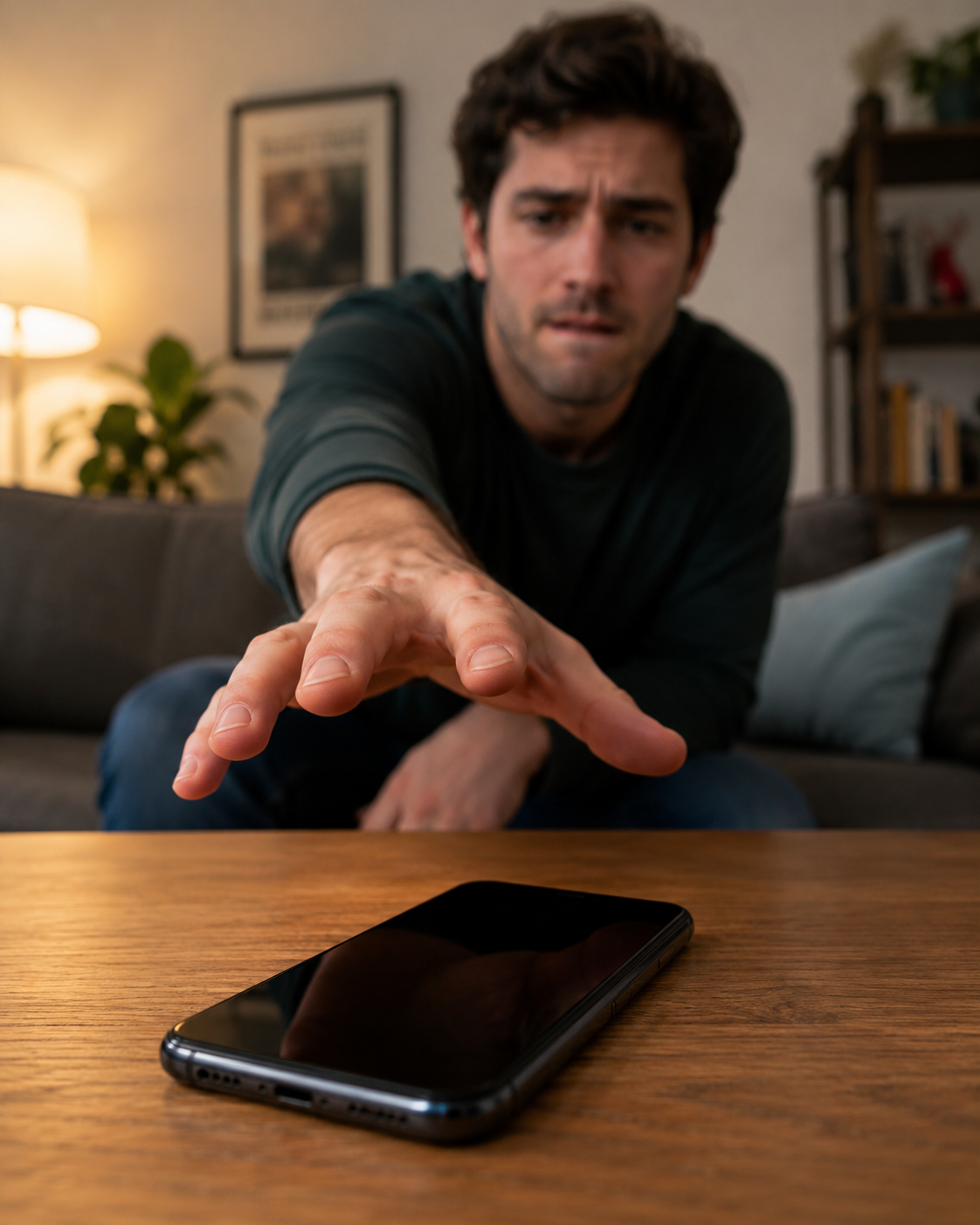
Maybe we can’t “just say no,” but we could say “later.”(Image created by ChapGPT)
There are two completely different groups of people making an argument that it is too much– and both offer a similar strategy to cut back: we need to make our smart phones dumb.
The first argument comes from a bunch of academics. A group led by Noah Castelo of the University of Alberta, writing in the academic journal PNAS Nexus, made one simple change to the cell phones of an experimental group: they turned off the Internet. Subjects could still use their phone to, uh, phone people. They could still use their phone to text people. And if they wanted to go to the Internet, they could still do it – but they had to do it on a desktop. What they couldn’t do was use the Internet on their phone.
Two weeks later, the results for the Internetless group were stunning.
Once the Internet disappeared from the phones of the experimental group (and with it, things like social media, games and gambling apps), average daily phone use declined from an average of 5 hours, 14 minutes per day to 2 hours, 41 minutes per day, a saving of 2 hours, 36 minutes. More surprisingly, after just two weeks, the experimental group showed marked improvement in measures of mental health, ability to pay sustained attention and assessments of their own well-being.
How much improvement? According to the researchers, the subjects showed a greater improvement to mental health than one would expect from taking anti-depressants and about the same positive effect as comes from cognitive behavioral therapy. The effect on improved attention was the same as being ten years younger.
The research team speculates that part of the improvement is that with no access to the Internet, subjects weren’t constantly interrupting activities to check on their phones, or worrying about their phone when they weren’t checking, and, with an additional 2.5 hours a day, they were more likely to use some of that “found” time socializing with others.
The second group calling for turning smartphones into dumb phones is led by a Protestant pastor named John Mark Comer. Comer, the author of The Ruthless Elimination of Hurry, holds up smartphones as a principal villain in our modern-day “hurry culture,” which convinces us that there is always more to do, and keeps us so frantic that we have no time to think. In an article about him in The Atlantic this month, Comer quotes Anne Helen Petersen, who wrote in a 2019 BuzzFeed essay that we are churning out “tired, exhausted souls like a widget factory.” There is today, Comer argues, a “virtual conspiracy against the interior life.”
What to do? Comer argues for a breakup with our phones.
Delete social media. Delete web browsers. Turn off notifications. Set your screen to gray scale, so apps don’t look as attractive. Turn off all your devices on Saturday or Sunday.
Comer is a minister, so he has a clear perspective on we should do with all the time this would free up: stop hurrying; take more time to reflect; reclaim your interior life. Spend more of your free time praying, observing the Sabbath, or discovering how you can be generous to others (what you might call finding your whistle). To find out whether you are heading in the right direction, he suggests you ask yourself questions that may be hard to observe externally: “Am I becoming more gentle? Am I becoming more humble?”
Deep thinking? Less hurry? Less anxiety? More reflection? More generosity? Dial back on phone use and all this can be yours.
I’m writing this, but I already know I am extremely unlikely to go cold dumb-phone turkey — we’ve all gotta find a way that works for us.

Taking the phone off the menu frees up time for more important things (Image generated through ChatGPT)
Maybe it starts with one day a week turning off your phone’s Internet. Maybe you do a survey of which apps you use most (your phone can tell you this) and vow to cut your use of one of them in half. At work you might set aside specific times when you will check on and respond to email (on your phone or desktop)— say 10 am, 2 pm, 4 pm. I’m going to start by checking my phone less frequently — once every 30 minutes vs. every 3 minutes. Then, maybe, a Sunday “phone fast.” And if we’re lucky, over time, the experiments you and I are trying will help us find 2 hours, 26 minutes we’ve been wasting. Imagine what we could do with that….
Let me know what you are trying.
-Leslie
*The average time of daily smartphone use and frequency of checking phones varies considerably depending on what age group you are in and on the exact methodology used to capture data. I’ve chosen a couple of credible figures from among the estimates.
Notes:
Study on what happens when Internet removed from cell phones: https://academic.oup.com/pnasnexus/article/4/2/pgaf017/8016017
Even having a cellphone nearby can cause distraction: https://www.journals.uchicago.edu/doi/full/10.1086/691462
Time on phones and attitudes toward cellphones: https://www.harmonyhit.com/phone-screen-time-statistics/
Asurion study on frequency of checking our phones (other studies put the number of daily phone checks lower, but all agree we do it a LOT): https://www.asurion.com/connect/news/tech-usage/
John Mark Comer on smart phones: https://www.theatlantic.com/magazine/2026/05/john-mark-comer-spiritual-practices/686586/