Quadruple Jeopardy
(Think you’ve got what it takes to be on Jeopardy? At the bottom of the post I include five questions nephew James got right on the show. See how many you can get….)
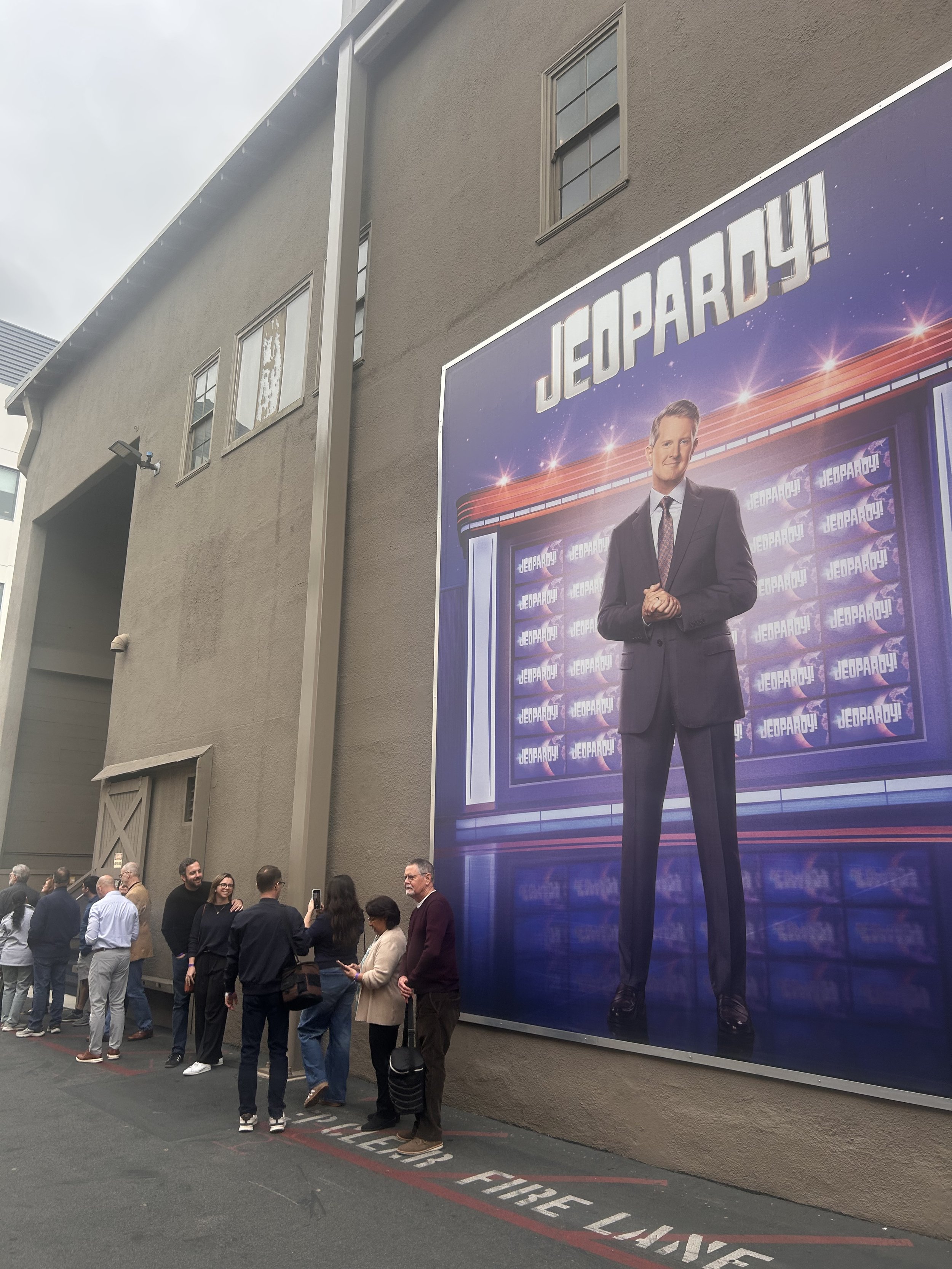
Waiting in line outside Sony Pictures Studios’ Soundstage #10; 10 Downing Street for show fans.
As I’m escorted on to the grounds of Sony Pictures Studios in Culver City California, I notice brass plaques on the side of each of the sound stages we walk past, engraved with the names of the major productions that have been filmed inside each one. The first one we pass, Stage 14, is where The Wizard of Oz was filmed in 1939. Years later, it’s where HBO’s TV hits “Euphoria” and “Barry” were shot.
This morning, 100 or so of us are headed for Stage 10, where in 1938, the plaque tells me, the movie Boys Town (with Spencer Tracy and Mickey Rooney) was filmed. We’re going into that one because, for the past 30 years, the building has been the home of the game show Jeopardy!
I’m there to see my nephew, James Denison, try to defend his title as Jeopardy champion (see my piece on his first game here).
We find our seats (as a family member I get one of our three seats on the front row!) inside the studio, facing a huge multi-color set, at a 90 degree angle to the contestants. We watch a video reviewing the 60+ year history of the show. We receive a series of instructions (applaud when the neon sign says so, no photos inside the studio, no murmuring if you think you know an answer, no note-taking, don’t tell anybody about the show until it airs). Then…. lights dim, lights rise. Cue music. Cue applause. Johnny Gilbert, the show’s long time announcer, intones “This! Is! Jeopardy!” Applause swells. Contestants are introduced, host Ken Jennings emerges, GAME ON.
Game 2: It takes James a few minutes to warm in to the game – at the end of the first set of thirty questions, Katie (a former astrologer turned luxury travel marketer) is neck and neck with him for the lead. She’s gotten the name of the country with the tallest head of state (Albania, of course!); James has shown a ridiculous depth of knowledge of forklifts (yes, seriously). He leads by just $400.
But Double Jeopardy is a smackdown. James finds both Daily Doubles, bets big and gets both of them correct, building up an insurmountable lead going into Final Jeopardy. He can wager a lot of money and still not lose. He bets big, and finishes with what we discover later is the second highest two-day total in Jeopardy history, $81,798. “Wow,” says host Ken Jennings.
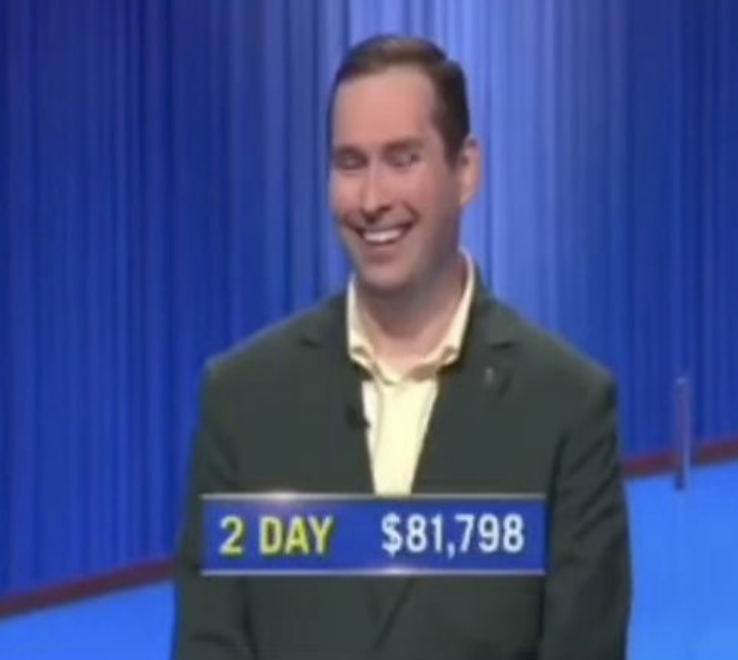
Well that’ll make you smile!
After the game, James is hustled off — we don’t get to see him. Jeopardy films 5 shows a day, two days a week, producing about 250 shows in a 25 week work year (the same studio crew works two more days during the week taping the 250 annual episodes of sister show Wheel of Fortune).
Which means James (and host Ken Jennings) both have to change into new clothes to appear on the next show. In twenty minutes, a new episode will start, and it will be “tomorrow” for the people watching the show when it airs.
We audience members have a few minutes to kill. We spend it milling about in a crowded antechamber, where we can see the thirty or so “Emmy’s” Jeopardy has won over the years, the podium Alex Trebek used to stand behind, photos of Jeopardy sets over the years and the door of the dressing room for contestants.
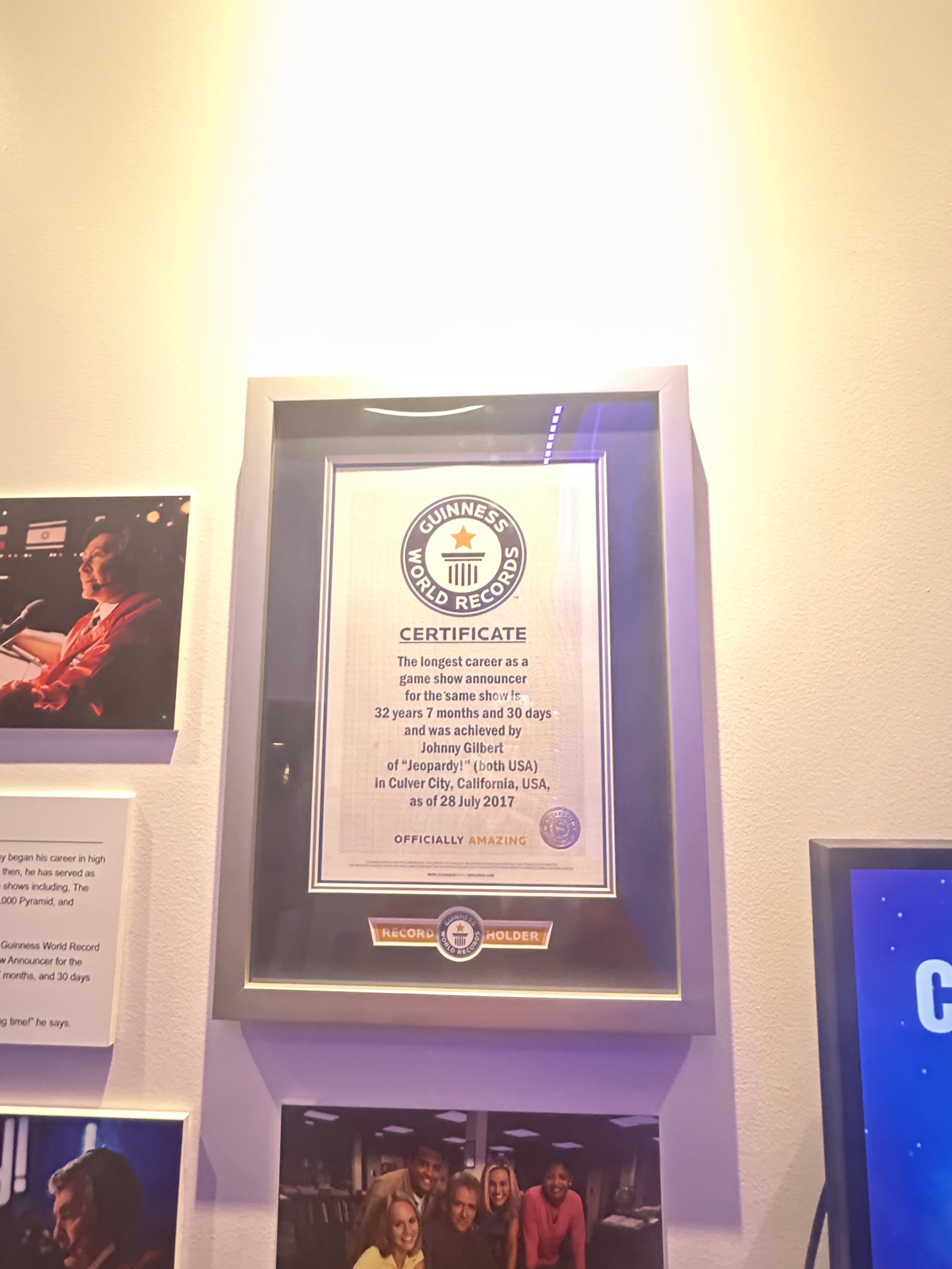
Among the memorabilia at the Jeopardy studios, recognition from Guinness for show announcer Johnny Gilbert, the longest-serving announcer in TV history.
Then it’s back at it for another game, with two new people gunning to take James’ title.
Game 3: Host Ken Jennings praises James for his winnings in the first two games, sharing that James told him it was the most money he had ever made per second during his career as an educator (based on personal experience, that is a wild understatement). This game, James is matched up against Sapana, a congressional staffer (and a triplet) and Tim, a retired actuary with a curious resemblance to Kris Kringle. The entire game is close, with all three leading at various times. James dominates a category about movies starting with “I”; Tim does well in a category of facts about 1926; Sapana gets a little bit in all the categories. After nailing another Daily Double, James leads going in to Final Jeopardy. The clue: “In this 1897 work, the title character enters an inn with his face covered almost entirely in bandages.” Everyone whiffs (correct answer, The Invisible Man), but James bets just little enough to finish ahead of the other two. He’s a three-time Jeopardy champ!
As the games continue I’m starting to learn a few kind of “inside-Jeopardy” pro tips.
Daily Doubles, which give contestants a chance to double their current totals without competition from the other opponents, tend to appear among the middle clues on the board, inside the middle three categories. That’s why you see more contestants picking middle clues first.
Most contestants seem to know the majority of answers in the game, so one of the invisible parts of the game is who can react quickest when a blue light comes on indicating someone can answer the question. Push the button too early and you are locked out for a critical 0.25 seconds; buzz in too late and your opponent answers instead of you.
Sometimes you have to buzz in before the answer is even fully-formed in your head, betting that the words will come together before your five-second window to answer has closed.
Game 4 pits James against Molly, a typewriter poet (read more in the endnotes of the post) from New York City and Chris, a high school history teacher from Pennsylvania. Shortly after Ken Jennings notes that James has been amazing finding, answering and betting big on Daily Doubles, James misses his first Daily Double in the first round, falling all the way back to $0 before going on a tear to lead by the end of the round. There are two ridiculous categories today. The first is one with visual clues designed to illustrate musical groups (sample: image of five volleyball players in red clothes – Answer: “Maroon 5.” Really?). The second is called “Triple Rhyme Time.” (sample: “This happens when all the little kids rebel against taking a long walk in the woods.” Answer: “What is a tyke hike strike?” James got that one.) There’s another nailbiter Final Jeopardy, as all three contestants miss the clue. Once again, James bets the right amount to win anyway. He is a four-time champion!
How does anybody prepare for a game like this, where questions could be about almost any topic? Here’s what I’ve learned from James.
General knowledge: It helps if you come out of the womb fascinated by lists – I think James knew all the US presidents and vice presidents by age 6. He did a quiz bowl team in high school. He currently does trivia leagues.
Study: The night before the games that aired this week, James was still studying kings, rivers and countries. “You wouldn’t think it could help,” he told me, “but you actually can study this stuff.”
Life/luck: Over the course of his run, James found certain answers that came from random life experiences.
· One of his mother’s favorite stories from her childhood involved a “finger bowl” (answer, game 5).
· He watched a cricket match during a recent trip with his father to New Zealand (and learned about a “six-bagger,” a term that was an answer in Game 2).
· After graduation he took a trip to Sri Lanka and got around cities in “tuk-tuks” (answer, Game 1).
· And the evening before one of his games, we’d had a discussion that involved Mary, Queen of Scots (answer, Game 2).
But the randomness of life and luck works for opponents too.
Game 5 starts with James on a roll, building a big lead before missing a Daily Double that brings his opponents closer. Then he surges again. He has a substantial, but not insurmountable lead going in to Final Jeopardy. The competitors lock in their bets in the category: “21st century women,” then see the clue: “The Iowa legislature passed a resolution declaring February 22, 2024 her day across the state.” And here’s where the “randomness of life” problem comes in. James (a walking sports encyclopedia) for some reason can’t come up with the name of Caitlin Clark, the University of Iowa superstar who wore #22. But Luke Henson, a grocer from Illinois, who admits in the postgame he knows nothing about sports, says friends randomly gave him tickets to an Iowa women’s basketball game and Caitlin really stood out. He writes down her name, betting big enough to pass James for the win. Luke is the new champion.
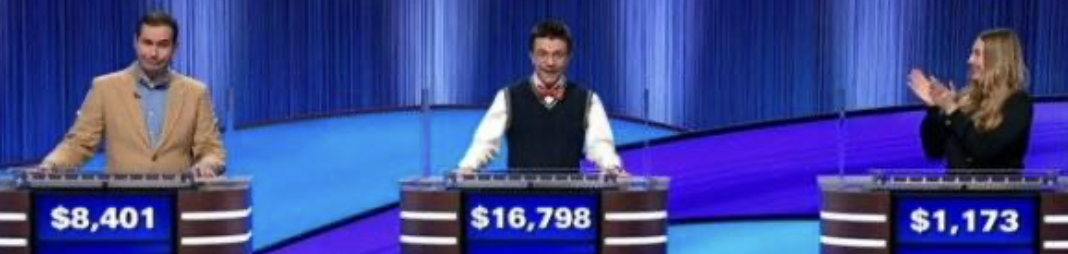
A tough way for James to end his five-game stay…
**********
I’ve been at the ACC men’s basketball tournament this week, and it doesn’t seem to matter which team is playing — the fans are the same. Every call that goes against their team is OUTRAGEOUS — the refs are MORONS (I’m editing their language slightly). The fans are talking about how much they love this coach - he’s worth every penny we’re paying him. Until that ASININE decision he just made on the substitution or the play call or the timeout or the defense. Now he’s a BUM. We should fire him immediately.
Jeopardy nation is no different. There are sites that track data on correct answers and advanced Jeopardy metrics; others that provide armchair players a chance to second- guess every decision of every game. Some of the same people who were amazed James knew the boxing crocodile of Hunky Doo in Australia are shocked — SHOCKED! - in their subreddits and chat circles that he didn’t know the name of the lake that sits next to Venezuela’s principal oil supply or that February 22 was “Caitlin Clark Day” in Iowa. With 20-20 hindsight they weigh in that he bet too much on Daily Doubles. Or that he bet too little on Final Jeopardy. Or that he didn’t smile enough… or smiled too much.
The ump-haters and coach doubters and Jeopardy snarks all have one thing in common: they’re sitting on the sidelines. It’s true in every part of our lives, and even in our games — maybe even especially in our games: most of us would prefer to lob bombs from a safe distances than to stick our own necks out, in part because we know that, if we fail, the haters will be waiting.
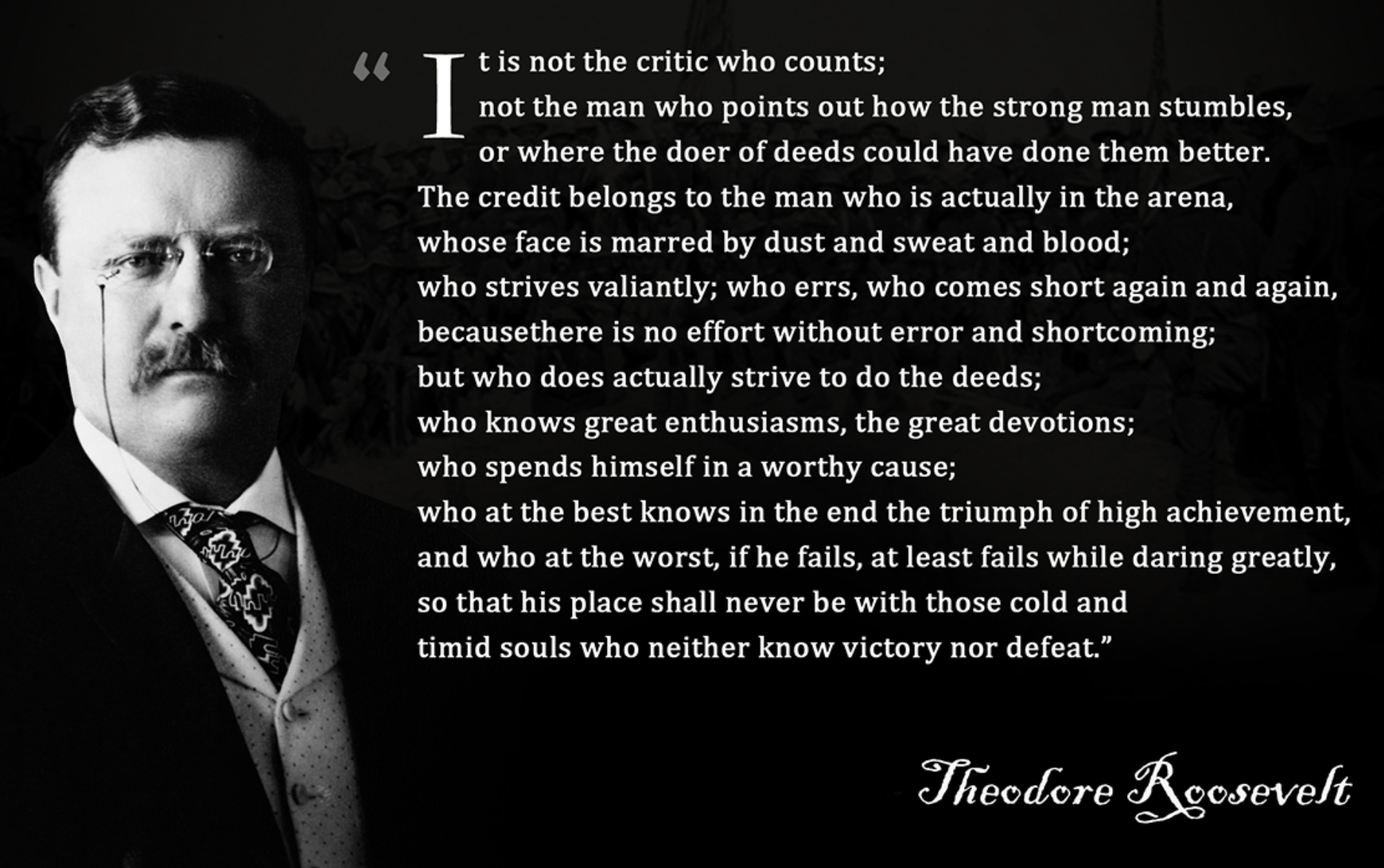
TR was right. When was the last time you swung big?
I like the people who take a chance to do something bold or cool or risky, who take big swings or make big bets. We need more of them willing to found the company or make the grand romantic gesture… or risk it all on Final Jeopardy. They won’t win most of the time, but the world is a better and more entertaining place when there are more of us willing to try.
-Leslie
Bonus content: 5 Questions James got right along the way. Try your luck with them and let me know how many you got right (answers at the end of the post):
1. This end-of-the-alphabet river begins in the central African plateau & drains an area of 500,000 square miles.
2. Chapter 3 of ‘The Souls of Black Folk’ by W.E.B. DuBois is about the views of this educator & rival.
3. Studying a hormone in the venom of this reptile species that may allow it to eat infrequently led to the weight-loss drug Ozempic.
4. It’s not an obsession with Element #7; it’s a process that creates more reactive compounds to help plants grow.
5. Ronald Reagan called this 1984 book, the 1st published by the Naval Institute Press, “the perfect yarn.”
Notes:
Final Jeopardy clue, Game 2: https://www.tiktok.com/t/ZP8VTvW3c/
Story on James’ amazing two-day total: https://www.tvinsider.com/1250565/jeopardy-player-almost-breaks-james-holzhauer-all-time-record-james-denison/
Molly Hackett’s typewriter poetry: https://faircitypoems.com
Appearing on Jeopardy means opening yourself up to good stories and bad: https://wrkr.com/kalamazoo-artist-jeopardy-success/
https://fikklefame.com/final-jeopardy-3-12-26/
There are folks keeping stats on every game: https://thejeopardyfan.com/2026/03/final-jeopardy-3-12-2026.html
James’ correct answers to questions above:
1. What is the Zambezi?
2. Who is Booker T. Washington?
3. What is a Gila Monster?
4. What is a nitrogen fixation?
5. What is The Hunt for Red October?