The Olympics of Trivia
It’s all come down to this: three 20- to 30-something’s stare at a 15x20 foot television screen with these words written on it: “Its island province of Annobon is at 1.4% south latitude; its mainland begins at 0.92 north latitude.”They have thirty seconds to write, in the form of a question, the name of the country that fits that description. Only one of them will emerge with the name “Jeopardy Champion.” The lights on the set dim slightly. Iconic music begins to play. Brows furrow. Contestants scribble.
The taping of the show took place in a Sony Pictures sound studio in Culver City, California in February, while the world was focused on the Milan-Cortina Olympics. It was hard not to think about the comparisons between these three and the Winter Olympic athletes.
The Olympians and the Jeopardists all grew up with some rare, distinctive potential.
The Olympians may have been born with a disproportionate percentage of fast-twitch muscle fiber or big lungs or amazing balance. Maybe they also had dulled pain receptors or an amygdala disconnected from the normal fear response.
The three Jeopardy contestants had brains that processed and sorted and retained and retrieved information differently than most of us.

This is what I imagine Jeopardy contestant brains look like: they must have neural networks that can store and retrieve information better than the rest of us (do I even have a branch that retains world geography?). But infrastucture isn’t enough. If they want to win, they also need to study — a lot — and have some extra creative firepower. (Image generated with openart.ai)
But that’s not enough. With all that potential, Both sets of people, the Olympians and the Jeopardists, had taken that potential, then sharpened and shaped it through years of practice.
The Winter Olympians had spent years laboring in the obscurity of sports not much valued in the world’s consciousness, mustering the will to come back from falls and crashes and lactic acidosis and hockey sticks to the face, fighting through pain that would stop 99.9% of us.
The contestants had spent hours, months and years laboring in the obscurity of trivia nights, then studying, mostly alone, geography, politics, science, literature, movies, sports, pop culture, opera, the Bible, foreign languages, driven by some sort of fascination to know more and more about more things.
And now, like the Olympians, these three stood where tens of thousands of gifted people wanted to, having survived a pitiless winnowing process that only has room for the best of the best of the best.
********
Each year, somewhere north of 120,000 people who think they are smart take a 50-question online test to try out for the show. If they get enough answers right, they might get a call to compete in another online test game. Then they might get a chance to compete in an online three-person mock game. If they do all that well, they might get on a list with a promise that they might be called sometime in the next 24 months to compete. Ultimately about 0.33% of those who apply -- 400 or so a year – are selected as actual contestants. And finally, each weekday night, five nights a week, three of those people appear on the thirty-minute TV show.
Back in 2002, I was one of the tens of thousands of wannabe’s, confident enough to make a 9-hour round trip to Washington DC to try out, and self-deluded enough to be shocked — SHOCKED! — when I was eliminated immediately.
Last night, a quarter century later, I was doing something more exciting and (slightly) less stressful, elbowing my way to a prime seat at a watch party to bask in the glory reflected from my nephew, James Denison, an art history professor in Michigan.
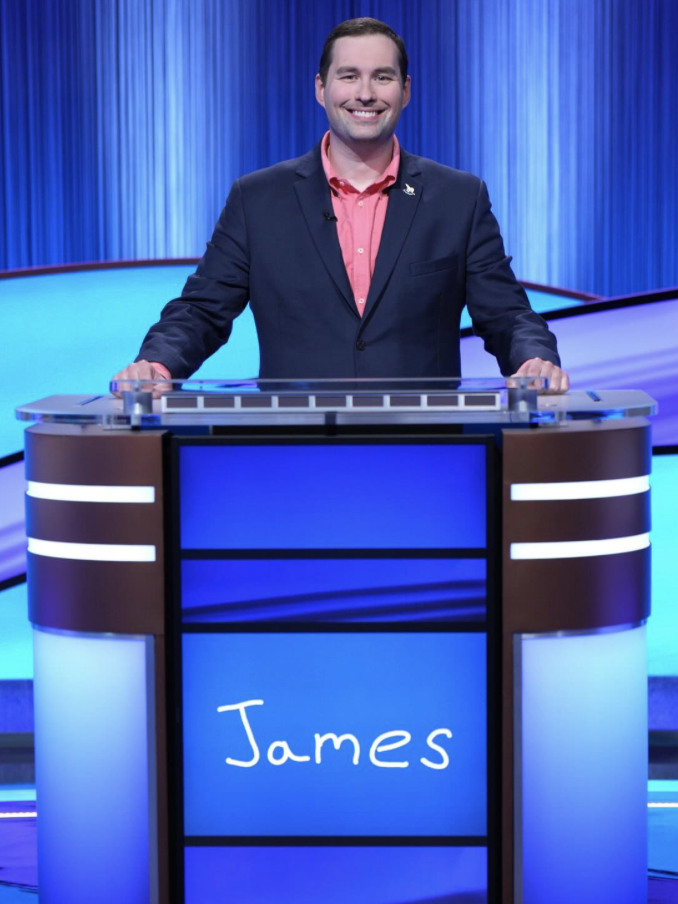
This photo was from before the game. Then things got a little more stressful.

Stress levels were equally high at the watch party (Photo Brian McMerty).
He was one of those three people America was watching up on that Jeopardy stage.
He and his opponents had already survived 60 questions to get to the Final Jeopardy moment. But this one question would decide the game.
*******
The Jeopardy! show wasn’t supposed to be this special when it was dreamed up. Back in 1964, in fact, the proposed show was called “What’s the Question?” Producer Merv Griffin reportedly heard studio executives saying “There isn’t enough danger in these games. They need more jeopardy.” “Hey, there’s a good name,” said Griffin.
Sixty-two years later, Jeopardy! (the “!” is officially part of the name) is a cultural touchstone. During that time, it’s outlasted 400 other game shows and now airs every weekday night in every television market across the US and Canada.
Former host Alex Trebek welcomed us to more than 8,000 shows. After winning the show a record 74 consecutive times and an overall total of $4.5 million, current host Ken Jennings has been the full-time host for the past three years.
At various times, there’s been a “Rock and Roll Jeopardy!” and a “Sports Jeopardy!” Currently the spinoffs include “Celebrity Jeopardy!”, “Pop Culture Jeopardy!” and, on Saturday Night Live, a recurring sketch called “Black Jeopardy!”
There are even DIY Jeopardy-esque computer programs that you can create and populate with clues for parties (I created one for a reunion of one of my college singing groups last year).
At various times there have been versions of Jeopardy on TV in 35 countries. There are current spinoffs running in Australia, Azerbaijan, England, Estonia, Poland, Russia, Slovakia and Sweden.

The Russian version of Jeopardy, Своя игра, or “One’s Own Game,” has been hosted for most of the past 32 years by Pyotr Kuleshov. Is it harder or easier than the American version? Test your knowledge with this 1500 ruble clue in the “Russian History” category: В 1695 году в этом сибирском остроге служилые люди подняли бунт против воеводы Башковского, тянувшего с выплатой жалования. Беспорядки прекратились только через пять лет с приездом воеводы Петра Мусина-Пушкина * (See end of the post for the answer).
But the “Olympics” of Jeopardy! is the OG American game. On an average night it attracts about 9 million viewers — with its partner show Wheel of Fortune, that’s more than any other American non-sports show.
And, so far on this show, Season 42, Episode 130 (Show #9515), nephew James has been killing it.
He’s known the name of the royal who was officially diagnosed as deranged in 1810. (King George III)
He’s gotten the name of the popular three-wheeled transportation used in southeast Asia. (Tuk tuk)
He’s known what an Italian advises when he wants you to speak very quietly. (Sotto voce)
And he’s bet big on the Daily Double, wagering $9000 that he would know the answer in the category of “10 Letter Words”: “A French doctor advocated for this instrument to be used to make execution as painless as possible.” (Guillotine)
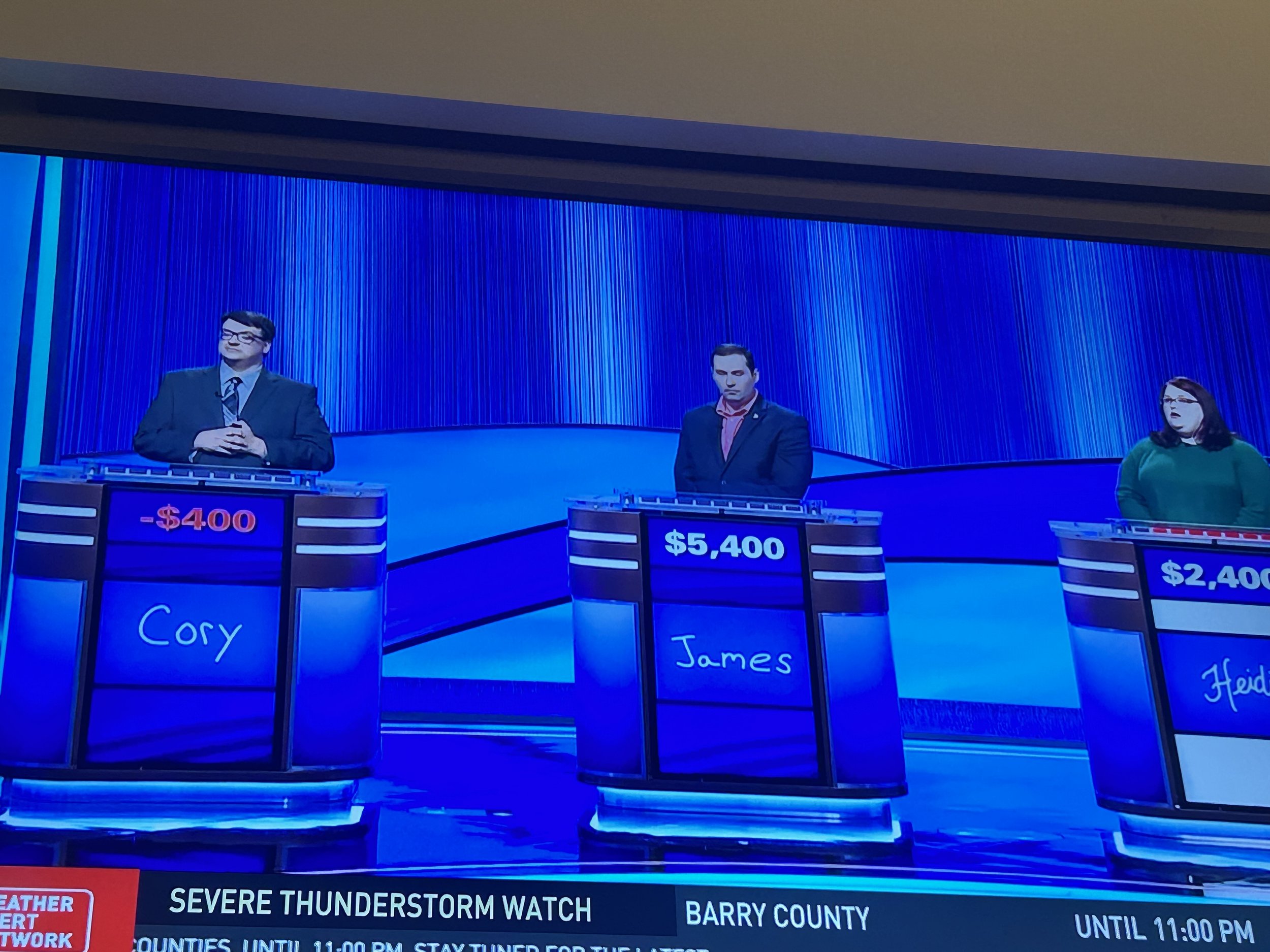
James got off to an early lead but had trouble shaking Heidi.
Despite all that, James has not clinched the game going in to Final Jeopardy. If he gets it wrong and his opponent Heidi gets it right, he’s going home. He’s still in, well, Jeopardy.
He’s had to make his decision about how much to bet knowing only that the answer would be the name of one of the “Countries of the World.” Now he has thirty seconds to see if he can dredge up the correct answer.
*********
After the show, I asked James what was going through his mind during that thirty seconds. Here’s how he described it:
He read the clue before Ken Jennings finished reading it aloud — and knew immediately he didn’t know the answer for sure.
So he started going through countries he knew were close to the equator. “My first thought was a colonial island territory in the Atlantic like St. Helena but then I was like no way, it’s just one island and feels kind of obscure.”
So his mind started making a mental circuit of the equator, gliding over South America, then briefly to the Pacific islands.
Then he landed on Equatorial Guinea. Turns out he actually knew a fair amount about the country.
He had served as a teacher assistant in two classes on African Art while getting his Ph.D. — they included some Equatorial Guinean art. In those classes he’d asked his students to fill in a blank map with the names of all the countries in Africa, so he knew Equatorial Guinea was located geographically between Gabon and Cameroon.
He’d been studying the history of African colonialism for some time, so he knew Equatorial Guinea was a relatively unusual case — taken over by the Spanish, not the French or British.
He knew the color and shape of the flag (he knows “almost” all the flags of all the countries, a long-time interest).
And because he had been studying world capitals recently for his appearance on the game, he knew that Equatorial Guinea’s capital was Malabo (in the past month, it has been replaced by Ciudad de la Paz).
So, wow. Bonus points to any of y’all who know any of that.
But….
He didn’t know if Equatorial Guinea had an island south of the equator.
That’s where a little bit of lateral thinking kicked in. “Final Jeopardy answers,” he told me, “are rarely truly obscure… there is always a sort of logic there.” The clue within the clue for this one, he realized, was the reference to the country being both north and south, and, somewhere in his massive prep for the game, James had recently been reminded that while most of Equatorial Guinea is on the mainland, there’s also an island in the Atlantic.
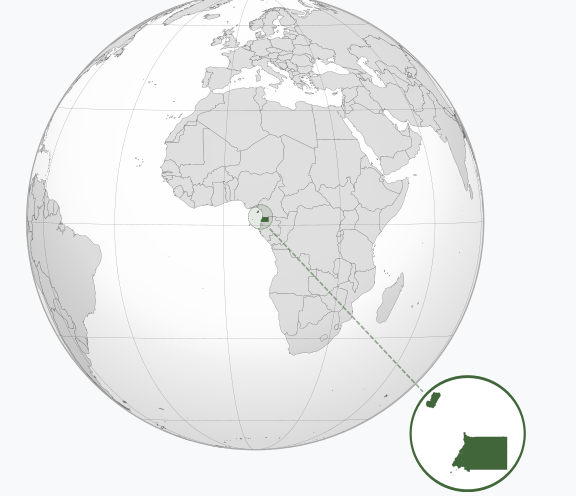
That, of course, is Equatorial Guinea (population 1.8 million). The mainland and its main island are north of the equator. Its southern island (population 5,385) is so small it does’t show up on most maps.
Here’s what amazes me. All that thinking happened, he said later, by the time Ken Jennings finished reading the clue.
********
Now we’re back to the game and James has 30 seconds to make a decision. Should he go with his gut, this mix of an informed/wild guess?
Nobody watching knows what he or anyone has decided to wager on this final answer, and as the music plays, nobody watching knows if any of the contestants knows the correct answer.
At the end of that thirty seconds the music ends, with a conclusive descending synthesizer note.
Player number 1, defending champion Cory Aiello ( a development officer from Indianapolis, whose twin brother apparently appeared on the show sometime back), doesn't matter (bless his heart) — he doesn’t have enough money to win. He guesses Singapore. He is wrong.
Player number 2, though, Heidi Schmechel (a vet from Rumson NJ), still has a chance. If she bets everything and is right and James is wrong, she will win.
She has, indeed, bet it all and she has guessed right — the answer is Equatorial Guinea. That gives her a $200 lead.
All eyes turn to James. He can only win if he has written the correct answer and has bet at least $201. What did he decide?
He gives a look that is impossible to decipher —until his answer is revealed. Equatorial Guinea. Game over!
Cue upbeat music. Cue host Ken Jennings. “James Denison, you are our Jeopardy! champion! Thanks for watching. We’ll be back on the Alex Trebek stage on Monday!”
There’s no Olympic theme, national anthem or medal ceremony, just a few bars of the Jeopardy! theme. But James is looking pretty golden to me.
-Leslie
Note: You can find James’s Jeopardy shows on Hulu or Peacock. Look for Season 42, beginning with Episode 9515.
Another note: Ten days after the episode aired the Jeopardy staff received four mugs addressed to James, along with an invitation to visit their embassy, from the government of Equatorial Guinea. Apparently they don’t get much international recognition!
*Translation of the Russian Jeopardy clue (thanks to a different nephew, budding Russian scholar John Autry!): The “answer”(in the category: Russian history for 1500 rubles): “In 1695, in this Siberian prison, bonded persons rose up against Governor Bashkovsky, who was delaying payment of their salaries. The unrest only ended five years later with the arrival of Governor Pyotr Musin-Pushkin.” The question: “What is Krasnoyarsk?” But you knew that, right?
Notes:
History of Jeopardy!: https://en.wikipedia.org/wiki/Jeopardy!_(franchise)
Ratings for Jeopardy!: https://www.nytimes.com/2023/06/29/business/media/tv-game-shows-thrive.html?smid=nytcore-ios-share
Jeopardy game rules: https://jeopardyhistory.fandom.com/wiki/Jeopardy!_History_Wiki
Summary of the process for getting selected to be on Jeopardy! It might be easier to get into the astronaut program: https://people.com/how-to-get-on-jeopardy-8646595
Jeopardy from a contestant’s viewpoint: https://www.jeopardy.com/jbuzz/contestants/amy-schneider-what-i-learned-my-jeopardy-experience
Beyond its appearance as a Final Jeopardy! answer, Equatorial Guinea has some issues: https://en.wikipedia.org/wiki/Equatorial_Guinea