“Too much of a good thing is a good thing.” Alan Jackson
“Too much of a good thing can be wonderful.” Mae West
“Can one desire too much of a good thing?” William Shakespeare
“Too much of anything is bad, but too much good whiskey is barely enough.” Mark Twain
Any way you figure it, the game should have been a slaughter. This week a soccer club called Fleetwood Town, ranked 84th in English soccer, faced off against the top-ranked team in English soccer, Arsenal, in an annual tournament called the League Cup. Arsenal is three leagues above Fleetwood Town. It pays its players an estimated $307 million, 90x more than Fleetwood Town’s payroll of $3.5 million. And yet somehow, playing in their tiny, 5000 seat stadium Tuesday night, Fleetwood Town won. Some are calling it the biggest upset in League Cup history.
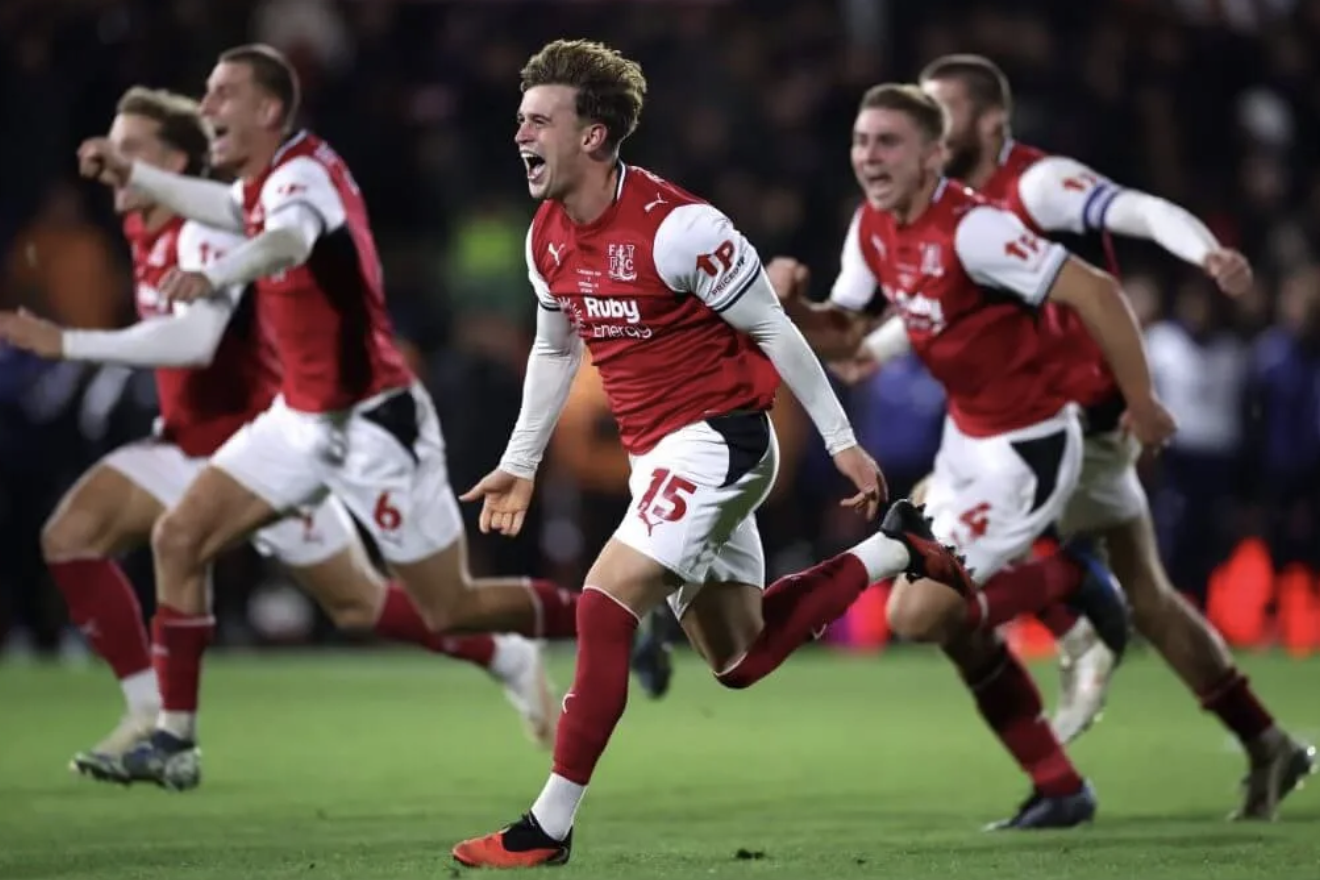
This is what joy looks like. Fleetwood Town beating Arsenal in soccer is the equivalent of my alma mater, Division III Amherst College, taking down the NFL Super Bowl champion Seattle Seahawks in football (photo Lewis Storey, Getty Images).
Back in the US, two woefully-underfinanced baseball teams faced off for the biggest prize in the game, the World Series championship. The Milwaukee Brewers, a team that is paying its players about $146 million this year, won. They got to the series by knocking off the mighty Los Angeles Dodgers, which paid its players about $340 million. The Brewers’ opponent, the Tampa Bay Rays, have the third-lowest payroll in baseball, paying its team $95 million this year. The last obstacle between the Rays and the Series this year? Cleveland, the cheapest team in baseball, which paid its players $74 million – about 1/5 of what the New York Mets, who didn’t make the playoffs, pay their team.
Money isn’t everything.
I wrote last month about how the explosion of money in college football was creating haves and have-nots, and might make games completely uncompetitive. How, I wondered, could Boston College, paying its players about $8 million this year, possibly stand a chance against Miami, which has bought players costing them $47 million this year?
That BC-Miami game is still to come in November, but it’s been fun to see how many low-spending college football teams have beaten high-spending teams already. The Athletic did a calculation earlier this week that showed that when the payroll gap between two teams is $5-$10 million, the teams with the smaller budget are actually 26-25 vs. their higher-paid opponents. And there are plenty of examples of upsets in games between teams with even bigger spending gaps.
· Oklahoma State pays its players $34 million less than Oregon this year, but OSU won their game.
· Kentucky, paying its players less than half of the top-spending SEC teams, is in first place in the conference.
· And last weekend, Cincinnati, the lowest-spending team in the Big 12 Conference, took down Texas Tech, the highest-spending team in the Big 12, 37-24.
The idea that money can’t always buy you success goes far beyond sports. There are examples in every part of life.
General Magic was, until AI companies came along, probably the most enthusiastically-capitalized company in history. It was founded by renegades from Apple in 1990 with a breathtakingly exciting idea. The founders imagined that they could build a small portable device with a touchscreen that could simultaneously handle phone calls, voice mail, calendaring and internet access. Sound familiar? They were trying to build the modern smartphone nearly two decades before the iPhone. Investors pumped gazillions into the company.
There are a lot of reasons you’ve never heard of General Magic. On some levels it was ahead of its time – some of the technology they needed hadn’t been invented yet. There were management problems.
But the most commonly-cited reason General Magic failed is that the company had too much money.
Tony Fadell, one of the early employees of the company, told Planet Money that because there was so much money, nobody at the company had to set priorities. Nobody seemed to worry about producing an actual usable product. There was always another bell or whistle they could add: “You can have too much money,” he said. “Because you don't have constraints to make you think hard. When you know the clock is ticking, and the account is draining, and you have to really understand what it is you're building, it focuses people.”
Without focus, the company meandered – until it finally ran through all the money with no usable product to show for it.
***
The concept of the inverted “U” shows up in a wide variety of settings.
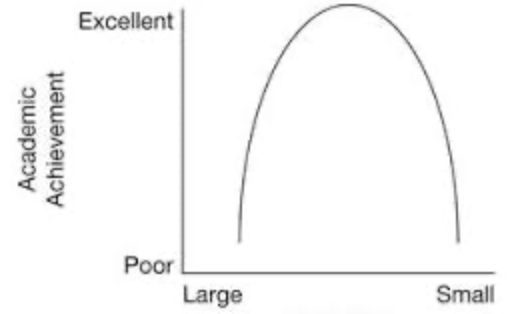
Here’s a classic “inverted U” chart. Spending some to reduce class size improves student achievement; spending more can actually be counterproductive.
· Spending more money to reduce classroom size is very helpful initially. Student achievement improves significantly when classrooms go from 40 to 18 students. But further reductions after that begin to show negative returns. Eighteen turns out to be a sweet spot for learning.
· Early studies suggest that buying more and more AI compute power can initially increase employee productivity and innovation, but then it starts to decrease creativity and initiative.
· Children getting love and support from their parents do better than those who don’t. But studies find that parents engaging in “material overindulgence” for our children may actually reduce their ambition, work ethic and happiness.
· The rate of innovation in companies increases as the size and wealth of the company increases, but only up to a point. That’s why General Motors and Microsoft are more likely these days to buy innovative ideas from scrappy startups than to innovate inhouse.
The Power of Tactics
Remember the story told in the book and movie Moneyball from a few years ago? Having not-quite-enough money forced the Oakland A’s to dramatically change the way they evaluated players and played baseball. They were able to locate cheap players who were able to do undervalued things very well. They would never have figured that out if they had unlimited resources.

In the early 2000’s, the Oakland A’s were forced to take an analytics approach to finding players that could generate runs and get outs in unconventional ways. Their tactics changed the game.
This year both Tampa Bay and Milwaukee zigged when other teams zagged, emphasizing “small ball” tactics, encouraging their players to draw walks and hit singles while other bigger-money teams were swinging for the fences. Tampa Bay players had the highest rate of any team in ten years of swinging at the ball and making contact. More bat-ball contact, in turn, either makes opposing pitchers throw more pitches, gives opposing teams more chances for errors, or generates more hits.
Tactical thinking growing out of desperation can make up a money gap in all sorts of areas. Americans invented guerilla warfare in the 1770’s because they had to – they could never compete with the better-resourced Redcoats in a straightup fight; the Vietcong applied the same lesson against the US in the 1970’s.
The Power of Tech
For other underdogs it’s tech that makes the difference. One the A’s started hiring players based on analytics and algorithms, not on good looks and home runs, they started beating higher-spending clubs. David used sling-tech to defeat the traditionally-armored Goliath. The Ukraine used cheap drones to turn Russia’s big-money invasion from a rout to a stalemate.
The Power of Tenacity
What every under-resourced underdog has to find to have a chance is a sense of desperation. In the Revolutionary War and the US wars with Vietnam, Afghanistan and Iran, the higher-resourced favorite was fighting for a concept; the underdogs were fighting for their homeland.
Favorites typically fight to keep their reputation intact, and try not to lose; opponents bristle at insults and fight to win.
For the past three years, the Milwaukee Brewers heard that no team could possibly beat the Dodgers, winners of two straight championships. So they changed tactics and used the underestimation to fuel a passion to win.
All season Cincinnati quarterback JC French IV listened as his own fans told him he couldn’t compare athletically to his predecessor, Brendan Sorsby, who had jumped ship for a $5 million contract to play for Texas Tech. The game was French’s biggest showcase, his last best chance to prove to the Cincinnati fans, to Texas Tech haters and to his potential future employer in the NFL that he should be taken seriously. He had the game of his life, throwing four touchdown passes.
And for the past two weeks Fleetwood Town had heard they had no chance against Arsenal. But then they played the game. “Biggest night in the club’s history," Fleetwood Town’s manager Matt Lawlor told Sky Sports. "We’re not stupid or egotistical enough to think that we can go to the best team in the country, the most organised team in the country, the best at the basics with world-class players, and outplay them. We had to ride our luck, deny them space and options. We did that really well the majority of the game.” Result? A win for the ages.

There are three T’s to tackling your opponent as an underpaid underdog (Image AI-generated with Dreamina)..
Money buys so much success so often in this world that we deify it. But sometimes, occasionally, miraculously, the lack of money provides just enough incentive for David, with just the right tactics or tech or tenacity, to knock off Goliath. It’s just one of the things that makes sports — and life — delightful.
-Leslie
Notes:
Fleetwood Town over Arsenal in perspective: https://www.espn.com/soccer/story/_/id/46093270/is-fleetwood-town-defeat-arsenal-biggest-upset-league-cup-history
Wikipedia history of General Magic: https://en.wikipedia.org/wiki/General_Magic
One telling of the story of General Magic: https://podcasts.apple.com/us/podcast/cautionary-tales-with-tim-harford/id1484511465?i=1000788891693
Major League baseball payrolls: https://www.spotrac.com/mlb/payroll/_/year/2026
College football payrolls: https://www.nytimes.com/athletic/7714108/2026/10/23/college-football-spending-strategy-winning-losing/?unlocked_article_code=1.K1E.8t8g.fDFEi6FBflBM&source=user_shared_article&smid=ta-ios-share
Texas Tech-Cincinnati payroll disparity: https://www.nytimes.com/athletic/7720817/2026/10/24/texas-tech-football-cincinnati-score-results/?unlocked_article_code=1.LlE.tz99.qDqS8KADlQ6t&source=user_shared_article&smid=ta-ios-share
Gladwell on inverted U: https://www.forbes.com/sites/knowledgewharton/2013/12/05/272013/
Psychology Today on “too much of a good thing.”: https://www.psychologytoday.com/us/blog/happy-together/202203/is-it-possible-to-have-too-much-of-a-good-thing
Consequences of “material overindulgence”: https://www.natgeokids.com/uk/parents/why-too-much-stuff-can-make-kids-unhappy/
AI’s “flattening” effect on creativity: https://pmc.ncbi.nlm.nih.gov/articles/PMC12562033/
Easier for small companies to innovate: https://cabb.org/news/why-do-small-companies-spearhead-innovation
Tampa Bay strategy shift: https://www.mlb.com/news/explaining-the-rays-contact-oriented-approach-in-2026
Brendan Sorsby, despite his success as a quarterback, never made it onto the field for Texas Tech. He had much bigger challenges: https://www.espn.com/college-football/story/_/id/49277965/college-football-texas-tech-brendan-sorsby-eligibility-ncaa-big12-nfl