This is the week when end-of-year fundraising begins — by email, snail mail, text, phone calls. I’m resharing a piece I originally wrote in 2024 about how we make our decisions when we donate money to others. I’ve updated numbers for this year and include a link to GiveWell and to Nicholas Kristof’s “Giving Guide” for this year (see the Notes at the end of the piece).
Back in 2006, a couple of hedge fund guys who’d made a boatload of money wanted to figure out where they could most effectively give away some of their money to others. They were amazed that nobody seemed to be evaluating which charities did the best job in maximizing their impact. So Holden Karnofsky and Elie Hassenfeld decided to apply hedge fund principles to philanthropy and created their own index to rate charities. They formed an organization called GiveWell, with the goal of determining which organizations did the greatest good for the greatest number of people for the fewest dollars.
After a series of fits and starts and hiccoughs, GiveWell can now tell you exactly how much it costs the best charities to save a human life: $3500.
If you give $3500 to the Helen Keller International (a US foundation combating Vitamin A deficiency, preventing blindness and malnutrition); $4000 to the Malaria Consortium (UK-based, focuses on preventing childhood malaria) or $5500 to the Against Malaria Foundation (also UK-based, focused on mosquito netting), GiveWell’s data says you can be confident your gift will save a life.

After careful analysis, most of GiveWell’s top recommendations for charitable giving are in charities serving developing nations, like Burkina Faso (Photo: Malaria Consortium/Sophie Garcia)
From a quant’s perspective, this was another brilliant, data-informed answer to another tricky question. Now that people knew where their gifts were most effective, GiveWell reasoned that we would (of course!) redirect our charitable giving into the most statistically-effective charities, and ignore other charities that had either lower ROI or couldn’t quantify their impact. The organization moved to Silicon Valley, and connected to what has come to be known as the “effective altruism” movement. It has continued to grow. Organizations like Open Philanthropy have since evaluated the effectiveness of charities in other areas, including artificial intelligence, global health, biosecurity, and criminal justice reform. Their goal is to “equalize marginal returns across different interventions to maximize overall impact.” I don’t know what that means, but it sounds really smart.
Once you leave Silicon Valley, though, the movement has gone basically nowhere.
It turns out that when real people are surveyed, only 3% of us say having more data and clearer results makes a difference in our charitable giving.
For the most part we just kinda know where we want to give: calculations of impact have little to do with it.
So why do we give money, and where?
First a big rollup number: “Giving USA 2026,” the latest report on American giving, finds that in 2025 American a combination of individual giving, bequests from estates, foundations and corporations gave a total of $617.2 billion to charitable causes, up 5.7% from the previous year, and higher than the rate of inflation. Just under two-thirds of that giving came from individuals.
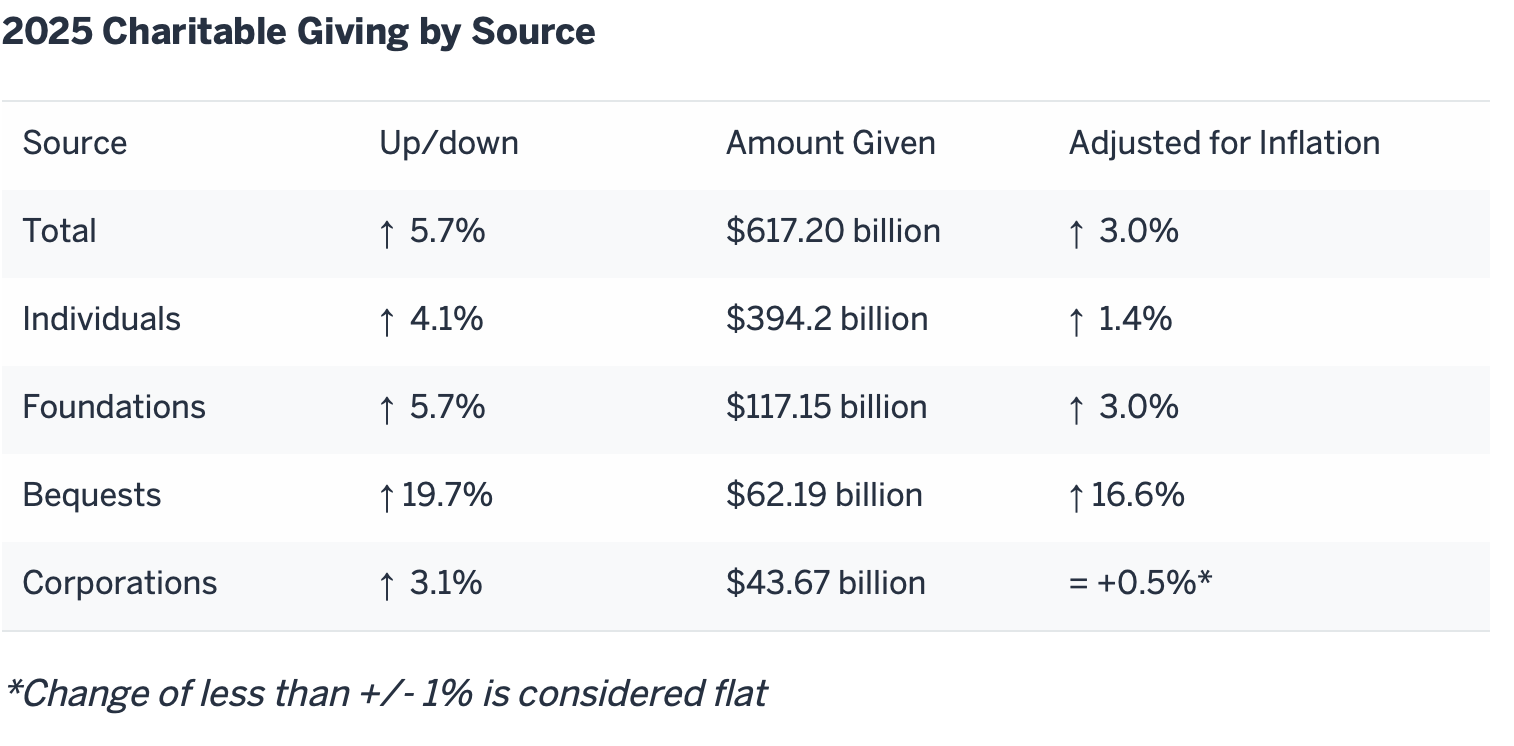
If you look at what Americans say about why we give, then look at where our money goes, you get confirmation that we are not especially motivated by data. Instead there appear to be 3 different key drivers:
Religious belief: Just under a quarter (23%) of our donations go to support a variety of faith-based organizations. While some of this is then redistributed to other causes, we also spend a lot supporting the institutions themselves — our local houses of worship or our broader expressions of faith. These aren’t exactly data-based decisions: it would be impossible, for example, to quantify the “return on investment” of the restoration of the Notre Dame Cathedral in Paris, but 340,000 people from 150 countries raised nearly $900 million to do that.
Belief in causes: We support other causes we believe in: we give to support improved health outcomes for others (13% of our giving); making society work better (11%); international causes (5%); arts and culture (4%), animals (4%) and the environment (4%). The causes we support tell us something about our core beliefs. As Emma Goldberg noted in an article called “What if Charity Shouldn’t Be Optimized?”:
“Charitable giving gets at what we choose to let into our hearts, what fires up our empathy and then churns it into impact. Deciding where to give means deciding what crises move us.”
Personal experience: And we support things that we often know from our own lives can make a difference to others. The broad category of human services, if you bundle up its various parts, gets 28% of our giving. Educational institutions, particularly those we attended, get 14% of our donations. Studies show that we underestimate how good giving our money away to people or organizations we “know” makes us feel.
What does all that giving add up to?
Americans feel pretty good about our generosity. The most recent big survey I could find, by a group called the Camber Collective, showed 75% of us think we give an above-average percentage of our earnings to others – a statistical impossibility. How much do we actually give? Go ahead and calculate in your head what percentage you give, then I’ll tell you what the data shows about Americans as a whole.
The median percentage of our income that we give – meaning half of us give more, and half less – may surprise you.

What percent of each $100 we make do we give to charity?
Spoiler alert: It’s not 10% -- the percentage that all of the world’s Abraham-based religions – Judaism, Christianity and Islam – suggest or require that we “tithe” (we should also, they say, give additional amounts to charitable causes outside of the church).
It’s not 5%.
It’s not even 1%.
The median amount of our earnings that Americans give to charity – churches, education, health care, human services, the environment, all added up -- is…. 0.4%. If we make $100, half of us give away 40 cents or less, half more than 40 cents.*
Seriously? 40 cents?
For the past few decades, the percentage of total giving by individuals to charity has been trending down. In 1990, individual giving accounted for 80% of the giving total in the US; these days it’s 64% (the slack is being taken up by bequests, foundations and corporate giving). Among individuals who have stopped giving, a majority agreed with this statement: “there are people out there with significantly more money who should give to charity instead of me.”
That makes some sense. Individuals who have more should give more, and they are: There are substantial increases each year in bequests and foundation giving (most of which originates from individual gifts).
But that doesn’t give the non-Musks among us a pass.
Whatever the reason we cite for giving – good data, religious faith, belief in causes, or personal experience, we need to find a way to do better than 40 cents/$100 — in this season and every season.
And if you’re really stuck on where to give, well, $3500 to save a life sounds pretty good.
- Leslie
*The average amount a US family gives away is 1.7%. That number is higher than the median of 0.4% (half give more, half give less) because some families give much more than 0.4%.
Notes:
If you like the approach GiveWell is taking, go to their website to check out their recommendations: https://www.givewell.org/
Background on GiveWell: https://en.wikipedia.org/wiki/GiveWell
Nicholas Kristoff does an annual guide to particularly effective charities: this is his 2026 guide: https://www.nytimes.com/2026/11/21/opinion/charity-holiday-gift-saga-luminos-edesia.html
A bit more on effective altruism and Open Philanthropy: https://en.wikipedia.org/wiki/Open_Philanthropy
Emma Goldberg’s pushback on optimization of charity: https://www.nytimes.com/2024/12/07/business/charity-holiday-giving-optimized.html?smid=nytcore-ios-share&referringSource=articleShare
Giving to restore Notre Dame Cathedral: https://apnews.com/article/notre-dame-donations-restoration-7e5f17ed830dfa6f1bb3ad43aef37022
Lilly School of Philanthropy analysis of Giving USA 2026 report: https://philanthropy.indianapolis.iu.edu/news-events/news/_news/2026/giving-usa-report-2026.html
Tithing by religious tradition: https://en.wikipedia.org/wiki/Tithe
Camber Collective survey of our perceptions of our own giving: https://web.archive.org/web/20160804025900/http://static1.squarespace.com/static/55723b6be4b05ed81f077108/t/56957ee6df40f330ae018b81/1452637938035/$FG+2015_Final+Report_01122016.pdf
Annual Giving USA report 2026: https://give.org/news/giving-usa-2026-charitable-giving-trends
Why do folks say they have stopped giving?: https://give.org/donor-trust-report