The Winter LLMpics
If you’ve noticed one technological innovation in this year’s Winter Olympics, it’s probably drones. There is nothing cooler than the view from a tiny video transmitter, following skiers or borders or jumpers, to help you appreciate how fast an athlete is traveling and what they are seeing.
Think of the drone as this Games’ high visibility individual technology star – the Johannes Klaebo of Milan.
But for overall impact on this Winter Olympics, Artificial Intelligence is — slowly, quietly, behind-the-scenes — racking up a medal count that no other technology can match. Think of AI as a dominant Olympic team – the Norway of the Games.
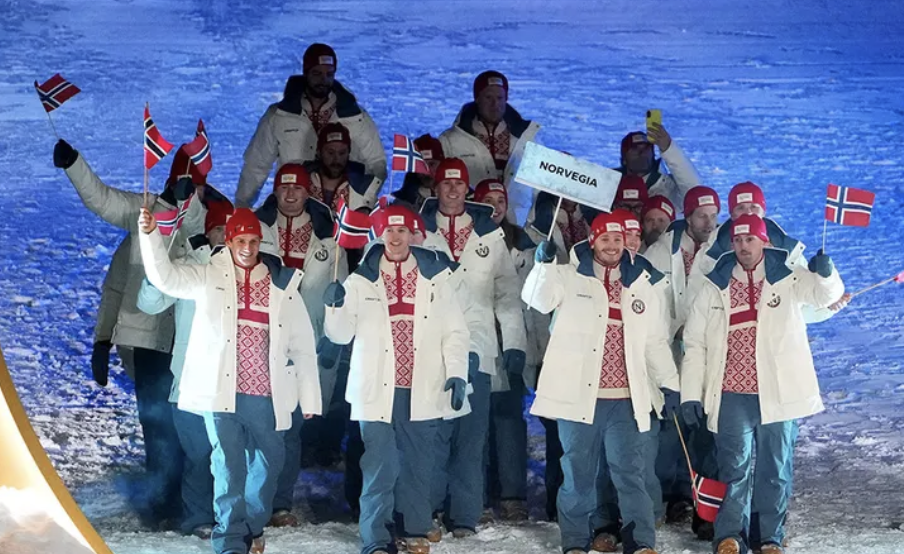
Like Norway’s juggernaut of a team, AI is making its presence felt in multiple areas of this year’s Winter Games.
This is the first Olympics where the full range of AI capacity has shown up, even if we can’t always see it.
Logistics: The un-sexiest use of AI is also the area where AI is being used most. The Olympics presents a perfect opportunity for a tool with infinite capacity to sort through the ambiguity and complexity of a ridiculous logistical challenge. The 2026 Milan-Cortina Games span 8,500 square miles, with venues 530 miles apart, a thirteen-hour driving circuit. Organizers have to maintain different courses with completely different kinds of ice and snow and wind in wildly fluctuating conditions, ensuring safety for athletes, spectators and travelers. They have to coordinate 25,000 workers, including 18,000 volunteers (chosen from among 135,000 applicants) from 98 different countries doing 70 different jobs, while ensuring that 2871 different athletes, their coaches and about two million spectators get all the information they need to show up for the 116 medal events at the right time.
Harried human beings have historically managed all this. AI can manage it better.
Organizers have created “digital twins” of the two host cities, with AI being used to simulate and predict traffic patterns to optimize public transport for athletes and spectators. AI chatbots are handling customer service inquiries. AI is being used to manage supply chains, from food to equipment to volunteer management, using predictive modeling. AI bots are autonomously making the call on exactly when to turn the thermostats up and down — under the ice or in the air — at indoor venues to maximize fuel efficiency.
Broadcasting: Broadcasters are using more than 800 cameras, including 25 drones, 140 robotic cameras, railcams (and a few cameras inside athlete’s goggles), all linked by a 100G fiber network (the Paris Olympics operated on a 10G network) to broadcast 6500 hours of content. NBC has more than 2600 employees (1600 in Stamford CT and 1000 on site) working the games. Other broadcasters have their own teams – China has 500 employees coordinating its coverage of the Games.
AI is being used by broadcasters in the same “boring” ways as it is being used by Games organizers: to manage logistics. But it’s also taking the “replay” to a level human beings never could. AI is doing some of that replay generation in real time at events but, more importantly, it has the ability to create edits personalized to me alone, showing me exactly what I want to see when I want to see it, with an AI voice narrating my personalized package.
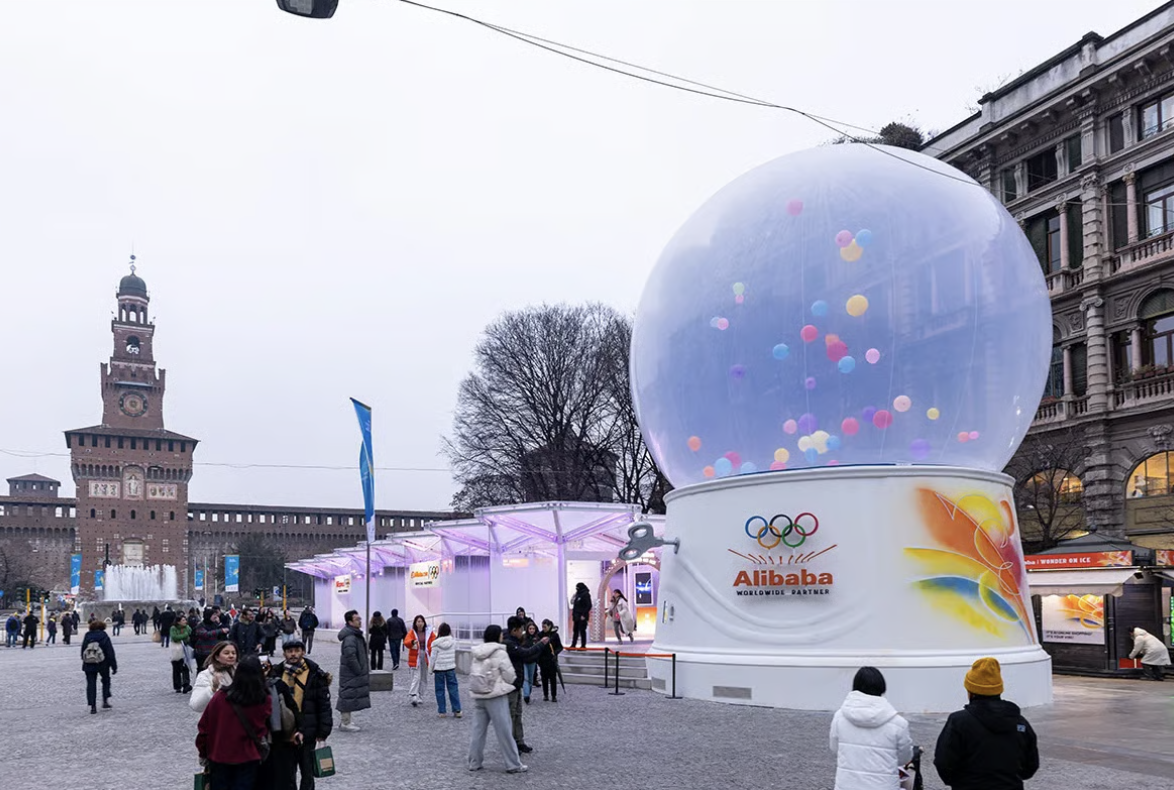
Alibaba’s Wonder on Ice snow globe displays more than 100 Olympic-related images created by AI in response to user prompts. Separate technology enables visitors to use avatars to get personalized information on their favorite events.
Translation: At the Games, there are three official languages: Italian, French and English. In Beijing in 2022, the Games provided translation services for 21 languages. Very generous. But there are people from more than 200 countries attending the games, many of them needing assistance in their native tongue. No single volunteer can possibly speak all the languages of all the spectators needing directions or advice. Enter AI: at this Olympics, volunteers are equipped with AI translation technology that can translate any question from any language to volunteers, then translate the volunteer’s answer back.
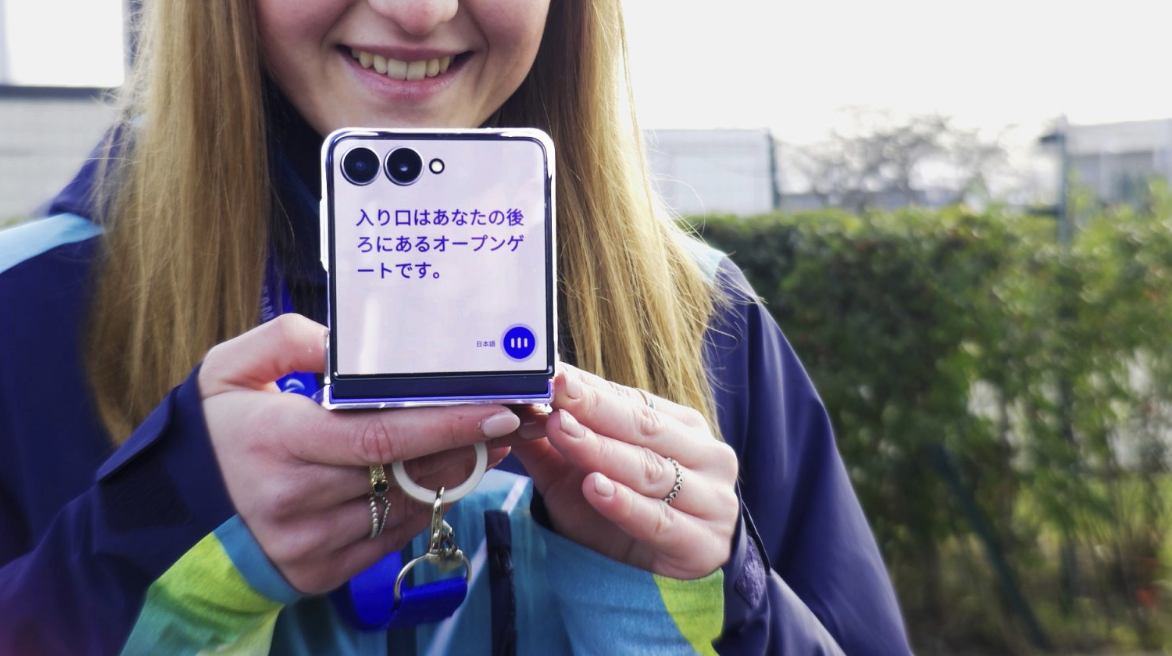
Samsung’s AI translator provides instantaneous translation of conversations for Olympic volunteers.
Coaching: At this point it won’t come as a surprise that some athletes are also using AI to analyze physical performance. And Hansi Lochner, a German gold-medal-winning bobsledder, has outsourced his mental health maintenance to an AI coach called naia. Naia, after a decade of training from human sports physiologists and therapists with athletes, analyzes his personal stress indicators in real time, then offers very specific suggestions to help him manage his anxiety. He told Cosmopolitan Magazine that “naia helps me structure my thoughts, reflect with clarity, and stay mentally disciplined...especially during high-pressure competition moments.”
Data crunching/judging: AI is able to synthesize data in every sport quicker than human data-crunchers. That’s where you are getting the instant information about how high a snowboarder jumps off the half pipe, how fast a downhill skier is traveling, how many revolutions per minute a spinning figure skater is making. According to Mark Wallace, the Olympic Broadcast Service’s Chief Content Officer, “We’re using computer vision to measure jump height, airtime and speed. And we’ve developed a jump map that tracks where skaters take off and land. It’s fast, it’s precise and it adds a whole new layer to the storytelling.” Next Olympics? Look for judges to be able to use sensors in boots or cameras and AI instantly determining if a skier or skater actually pulled off the full 4 spins in a quadruple axel, not 3.99, or the skier did a 720 degree spin off the grind or just a 710.
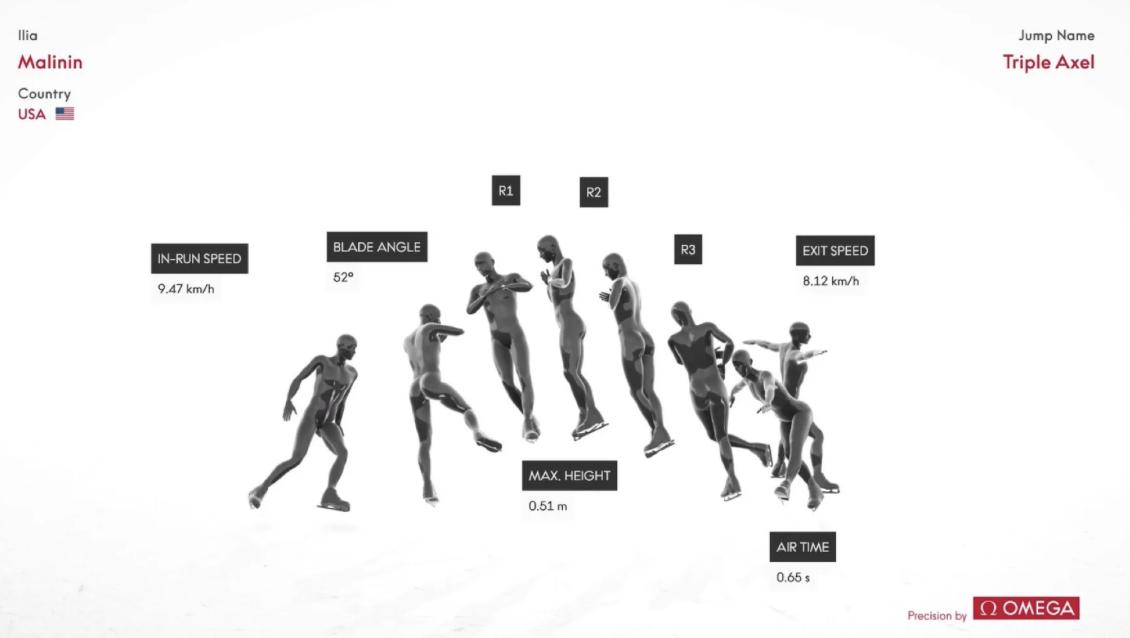
Omega, the official timing and measurement detector of the Games, uses 14 cameras in the ice skating rink to feed data into an AI that computes jump height, jump length and rotation of each jump, detecting movements that “can’t be seen by the naked eye.” This graphic captures one of Ilia Malanin’s jumps. The technology hasn’t replaced judges - yet.
Does AI enhance the Games or take away the joy of the Games? If I’m an attendee, I don’t want to be stuck in traffic – I want to see the Games. As a viewer on TV, I love knowing how high the snowboarder went and how fast the downhill skier is going. I like the idea of being able to get a highlights package that shows me snowboarding and biathlon highlights without having to watch another hour of curling.
But every ounce of efficiency brings 28 grams of trade-offs. The AI time-maximization traffic grid prediction probably means I’ll never get to meet the Tongan couple on the bus while we’re stuck in traffic in Cortina. Interacting with a Samsung translation device won’t be quite the same as trying to ask the Milano volunteer where to find the best pasta in town. If I get too bombarded by the whizbang axel spin computation on my TV screen I may miss the beauty of the figure skating. And if the only highlights I see are of the sports I think I know, I may never get a chance to learn about, and fall in love with, cool new events like skimo.
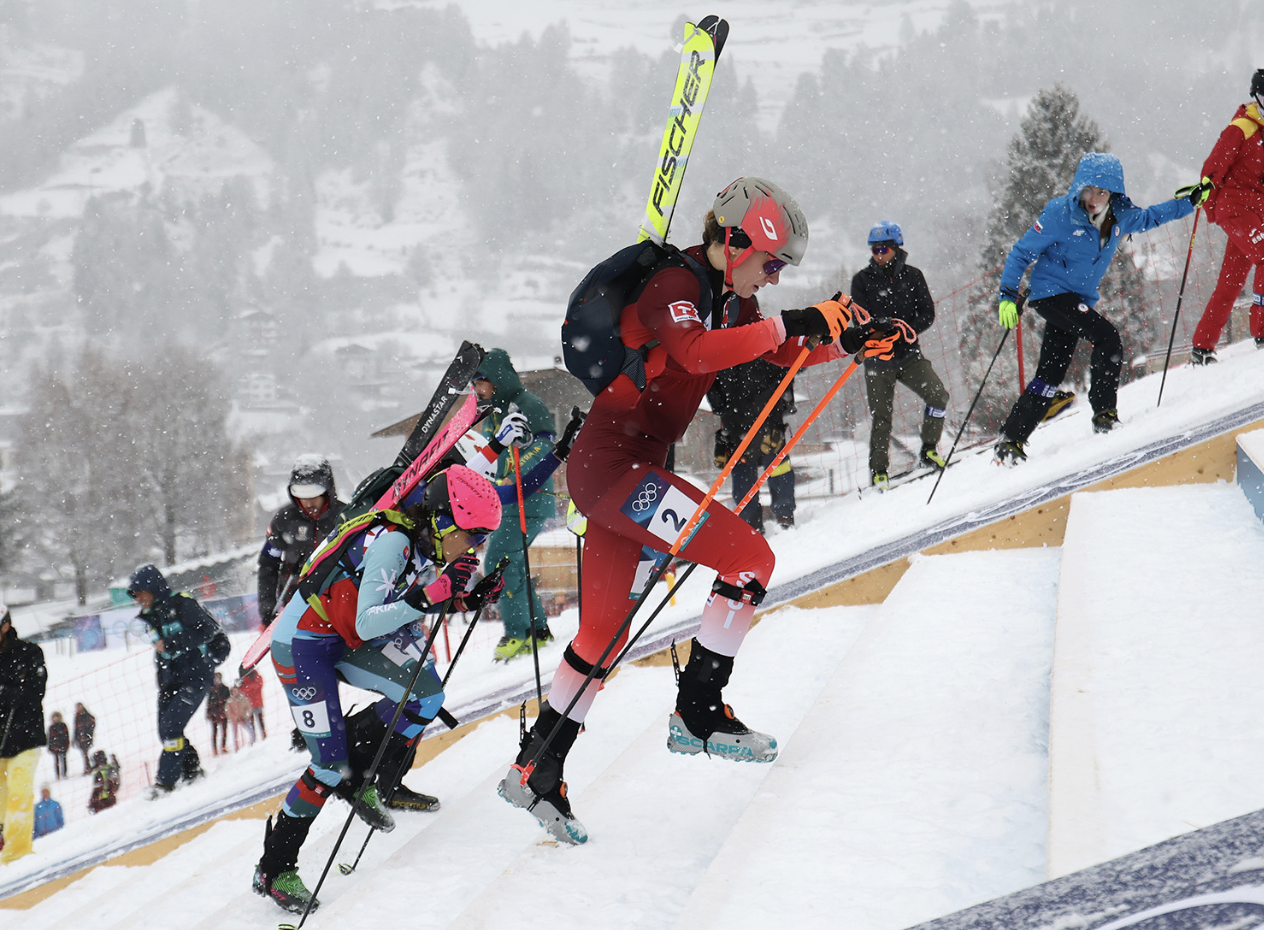
Would an algorithm ever have been able to predict my strange fascination with skimo?
AI is good – and getting dramatically better, quickly – at making it possible to live our lives more efficiently. The danger is that it tempts us to get so hung up on our more efficient life that we miss out on, well, life. We’re all going to have to figure out pretty soon how we find that balance.
Notes:
Medal totals by country: https://www.olympics.com/en/milano-cortina-2026/medals
Olympic workers: https://www.olymspics.com/ioc/news/key-to-the-games-experience-18-000-volunteers-are-powering-milano-cortina-2026
AI use in broadcasting: https://www.viaccess-orca.com/blog/behind-the-scenes-of-broadcasting-the-2026-winter-olympics
Digital twins: https://www.intel.com/content/www/us/en/customer-spotlight/stories/digital-twinning-olympics-customer-story.html
Cosmo on AI coaching: https://www.cosmopolitan.com/entertainment/celebs/a70406732/olympics-2026-ai-athlete-protection/