A Good Walk, Improved
There may have been an admissions price for the Azalea Open pro golf tournament in my hometown of Wilmington, North Carolina, but I don’t think I ever paid it. Especially not on that Sunday in April 1968. Instead, I walked out the back door of my house, scooted through fifty feet of woods and started following whatever group of golfers happened to be at the 12th green when I got there.
I got lucky. The pairing I stumbled into included one of the only golfers I recognized, future-Hall-of-Famer Gary Player, clad in his trademark all-black, and a guy I discovered later wasn’t even officially on the golf tour, Steve Reid. For the next two hours I and a couple of hundred others got close enough to see the sweat fly off of Player’s cheek when he swung. We could hear the sizzle of the ball exploding off the tee. We waited through the delays as the group ahead of the players took their own sweet time planning shots and Player and Reid groused. And we felt like a genuine part of a fierce golf duel, standing about as far away from them as a mid-range putt. As the sun set, Reid won on the second hole of sudden death, taking home a check for a whopping $5000 (Player seemed to recover from the loss just fine: two months later he won his second British Open).
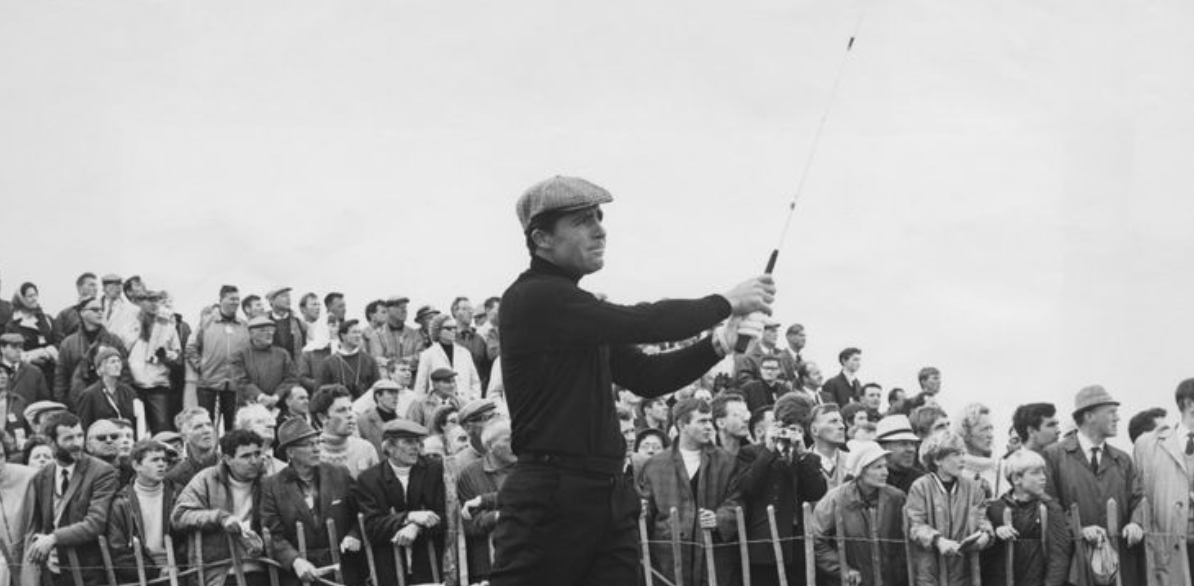
At the Azalea Open in 1968, fans got even closer to Gary Player, “The Black Knight,” than they did at the British Open that year (Photo: The Open Championships).
These days most of us watch pro sports from our homes, on our TV’s or phones and, mostly, we don’t even watch them live. Instead we watch curated highlights that leave out anything non-spectacular. If we do get in to a live sports event, unless we’ve sold a kidney or happen to have Spike Lee as a bestie, we have to sit more like a mid-range iron away from the action, with a better view from the Jumbotron or our cell phones than our seats.
Players have agents and posses and security to surround and separate them from us. We can love them, but only from a distance.
So maybe you can imagine my shock last week when my son and I arrived last Thursday evening in Charlotte NC at the Queen City Classic, the North Carolina stop on the professional disc golf tour.
We’d read there was a “Player’s Party” the night before the event started, and decided to go to the venue on the off-chance that we might see one of the players before they went into a private room for what we assumed was a private party.
Instead we walked in to a beer garden, turned right and almost collided with two-time world champion Isaac Robinson, who was standing behind a table stacked with colorful round plastic objects, doing his endorsement duty as a brand representative for the disc maker Latitude 64.
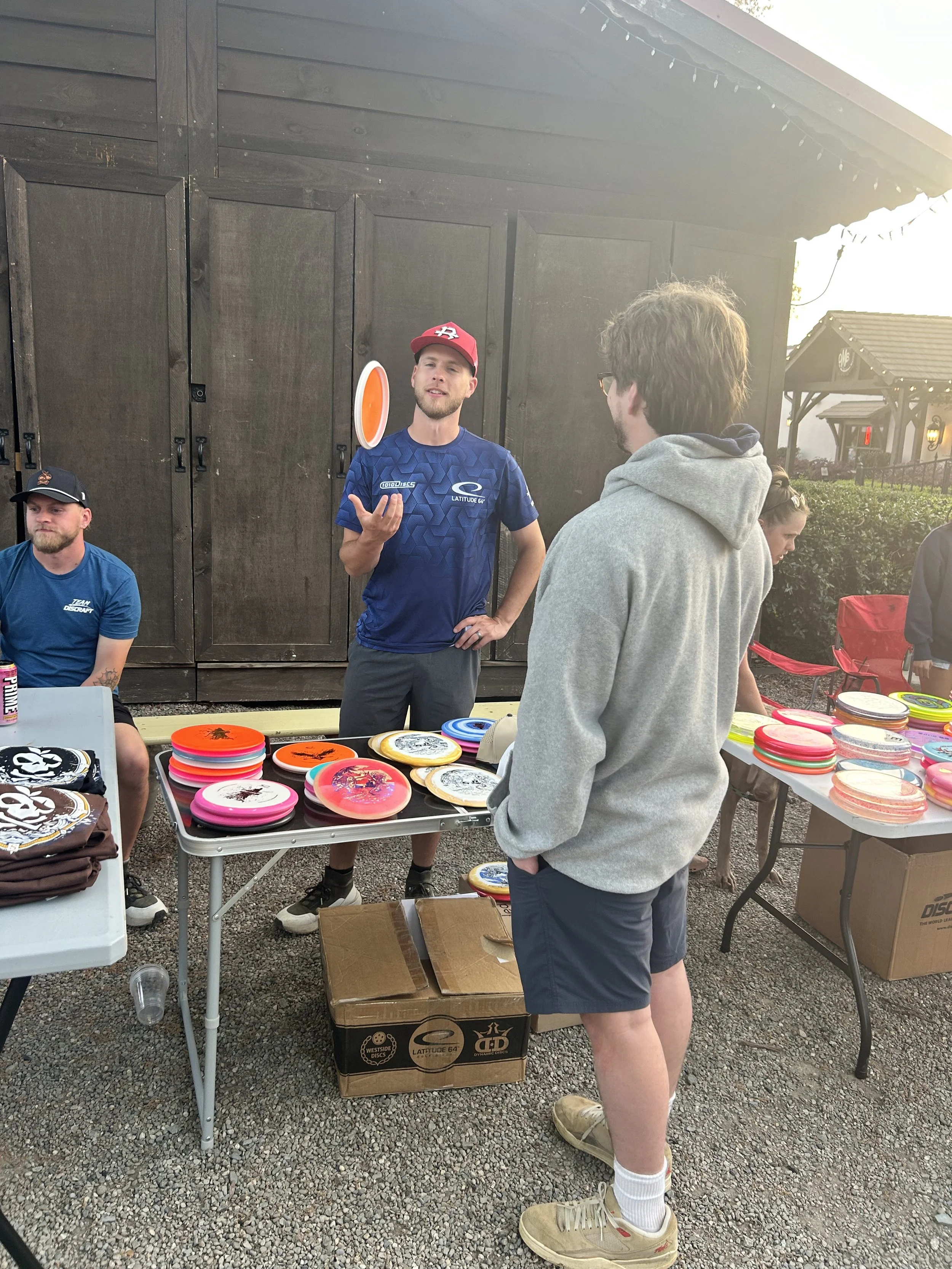
That’s Isaac flipping the disc. Conversations with world champion players? Check.
After stumbling through a conversation about, as I recall, what shot he was planning for the first hole the next day, we realized that a couple of tables down was the lead broadcaster on the Disc Golf Network (yes, there is one). After a long, unhurried conversation with him about, among other things, his favorite kinds of beer, which one of the favorites was nursing an injury and where he got his nickname, “Big Jerk” gave us a free tutorial on how to tuck the elbow to increase distance on a forehand shot. As we were leaving, he asked if I would be willing to get him a burger so he wouldn’t have to leave his table unattended. He gave me $20.
By the time we left the event a couple of hours later, we’d bought beers for a couple of players. We’d chatted up the women’s world champion and her husband. We’d picked up an autographed disc from an up-and-coming player. And we were totally stoked for the start of the tournament the next day.
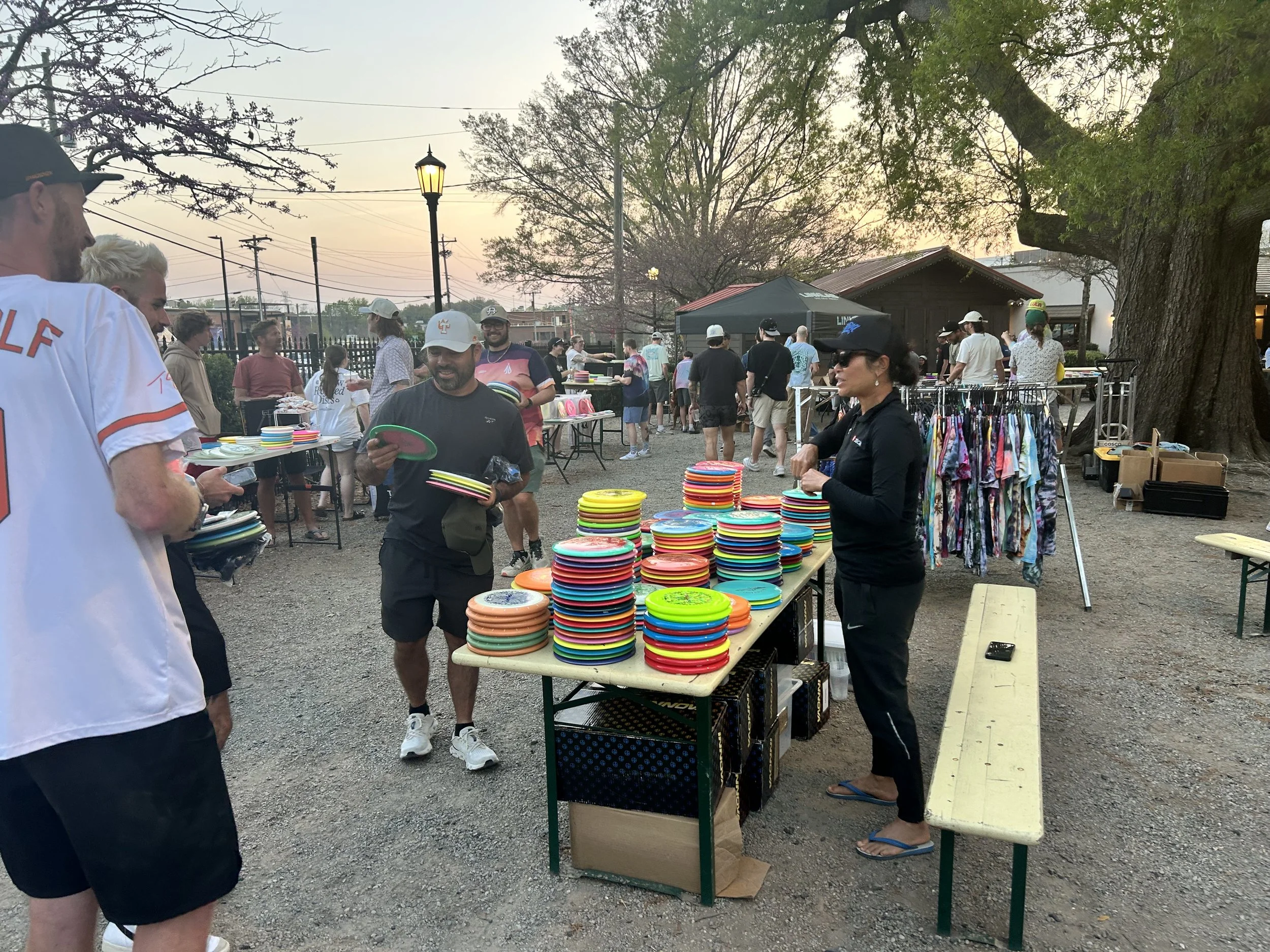
Unlike most pro leagues, male and female disc golfers share many dates and venues. That’s defending world women’s champion Ohn Scoggins on the right.
The idea of “golf” with hand-thrown discs started, coincidentally, about the same time the Azalea Open with club-hit balls was ending in 1968, with the original players figuring out it could be fun to throw Frisbees over and around trees and bushes and lightpoles and into 50-gallon barrel trashcans. As the sport grew, the disc receptacles became chained baskets, and courses sprung up near golf courses, in public parks and beside walking trails.
Over time, players developed an evolving range of throws, starting with forehands and backhands, but now including “tomahawks,” “thumbers,” “rollers,” “turbos” and “grenades,” as well as a variety of unnamed contorted throws necessitated when a player tries to figure out how to throw out of or around ditches, bushes and trees.
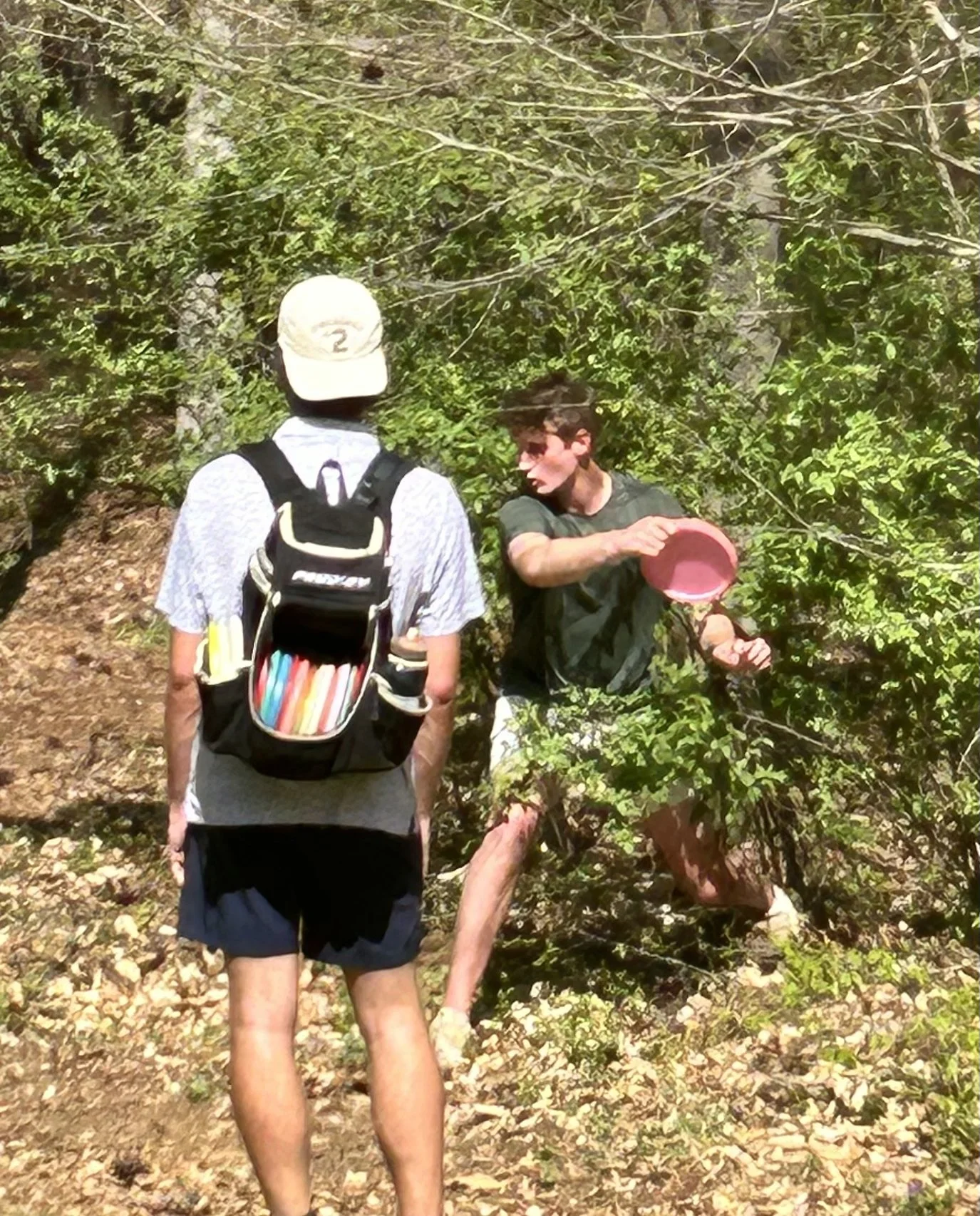
If you throw into the bush, you gotta throw out of the bush. That makes for some creative stances and throws — and more entertainment for the fans.
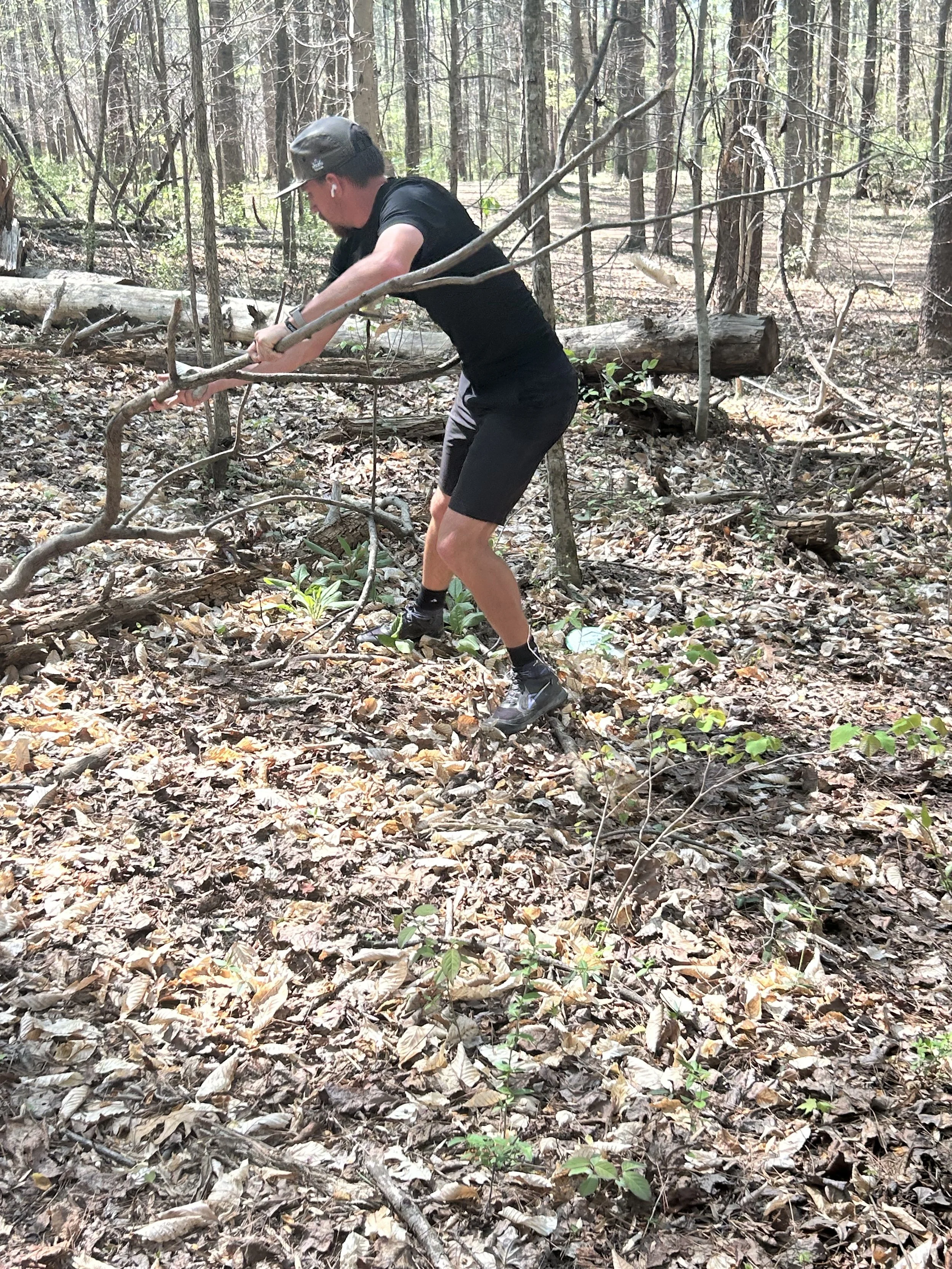
,,,and if the disc flies under a branch, it’s up to the player to move the branch.
To make all those different throws possible, small manufacturers started up, creating specialty discs that performed different tricks in the air.
· “Drivers” that could soar and bank through a three stage flight, traveling (for a professional) maybe 500-600 feet (the world record is 1109 feet, more than three football fields, but that was wind-aided and mutant).
· Different kinds of “mid-range” discs that could do different things – dive right or left, or flip over and roll for long distances.
· “Putters” that could fly predictably and straight for shorter distances.
As the sport has grown, so have the number of disc golf courses – there are now more than 17,000 courses in 99 countries around the world, three-quarters of them in the United States. And with an estimated 5.5 million players worldwide, it makes sense that a professional version of the game would develop.
******
My son and I spent the morning after the player’s party playing disc golf on another Charlotte course. For two hours we walked in the woods, trying to get our discs from tee to basket on holes ranging from 300 to 1000 feet (par ranges from 3 to 5), dodging tree branches and bushes, culverts and water hazards along the way. Playing on the course was free, as are 90% of all courses. We didn’t need to rent a cart. The vibe was chill. It was easy to talk. No pressure from other players to speed up or slow down – we were all out there to fling some discs. Ten thousand scenic steps later, we were done. It took about two hours, if you don’t count the 20 minutes we spent looking for a prized disc on Hole 2 (it had bounced off a tree and hid under some leaves).
The chill vibe continued at the tournament site. Parking was free; checkin took us 30 seconds. Just outside the course, a quiet disc carnival was going on in a small tent village. Disc manufacturers displayed their discs for sale; a couple from Charlotte sold resin bags they’d sown themselves; food trucks served food. Players, male and female competitors, pre-round and post-round, were all there, just hanging out.
And then, well, it felt a lot like the 1968 Azalea Open. My son and I and a group of maybe twenty others jumped in to follow a foursome of players that included two of the longest throwers in the world – 26-year-old Anthony Barela (AB to his friends) and college student Jasper Tyll.
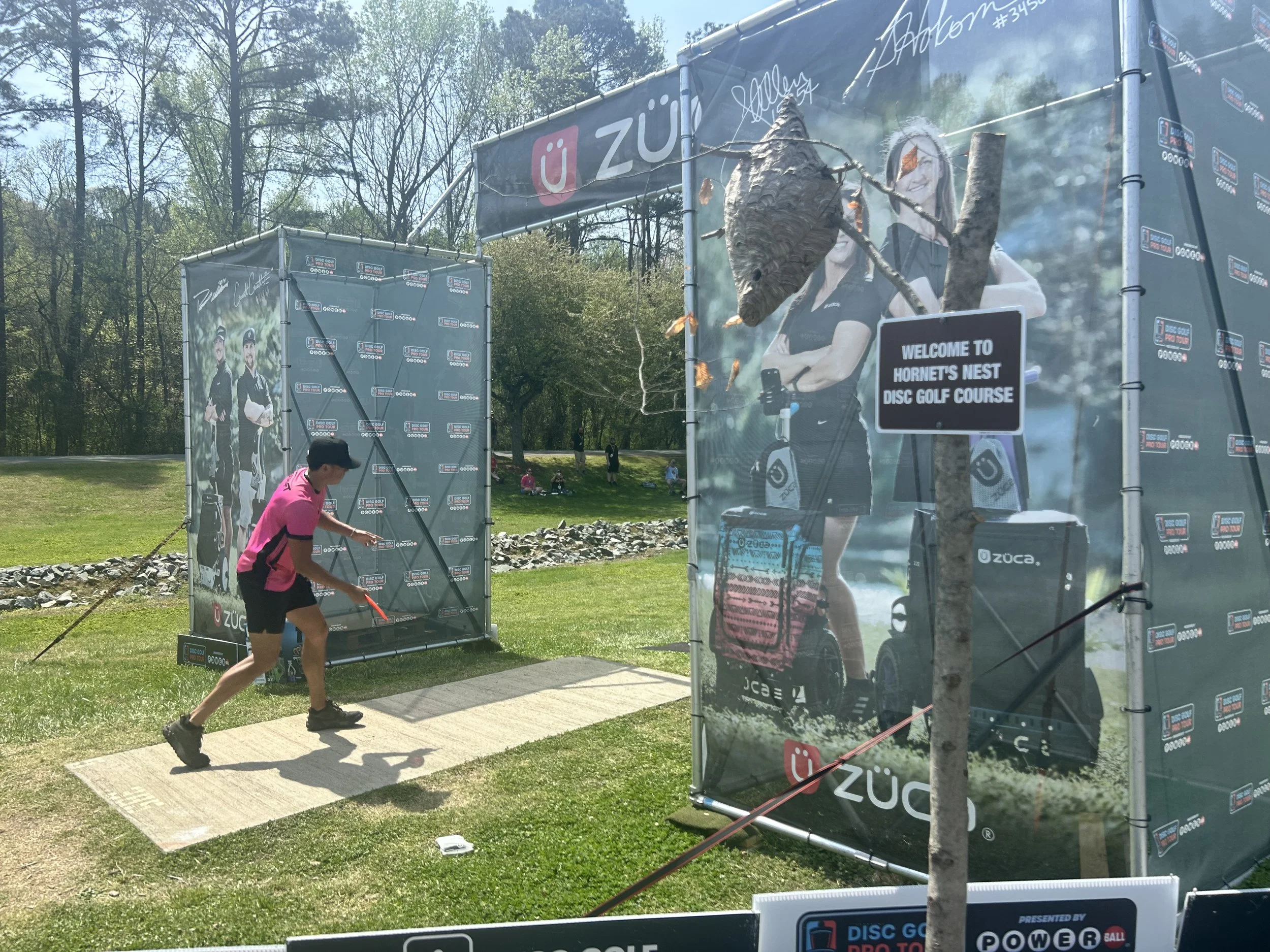
No more than a couple dozen spectators joined us at the first tee to see AB start this round.
Standing 20-30 feet from the players, we were able to hear the THWAP! their fingers made as they released the disc at 80 miles an hour and the WHOOSH! of the passing disc as it whizzed past at 1200 rpms. During pauses in the round, my son was able to have conversations with the players themselves (two of them, carrying their own bags of discs, turned down his offer to serve as their caddy). They responded personally to every cheer of encouragement.
Tracing our way back to hole 1, we followed the final group of the day and got really lucky: we (and maybe 50 others) watched as two of my son’s favorite players – 20-year-old phenom (and defending world champion) Gannon Buhr and fellow UNC grad Evan Smith -- cranked out two of the best rounds of the day, bombing monster drives, scrambling out of trees and underbrush, nailing impossibly long putts. We shared it all, and banked another 10,000 steps along the way.
The day ended like the night before had begun. Back in the village, players sat after their rounds, hoping to sell a few more discs, having a few more conversations with each other and the fans. On our way back to the parking lot, we saw a tall, rangy guy sitting alone behind one of the tables, ostensibly selling Innova Discs, but mostly cooling off after a hot six-under round. It was last year’s tour championship winner, Calvin Heimburg. My son bought a $25 “Calvin Destroyer” disc, got an autograph and a photo, but mostly just settled in for a discussion of the round Calvin had just finished and his plans for tomorrow. Just a fan and a pro, sitting around talking shop.
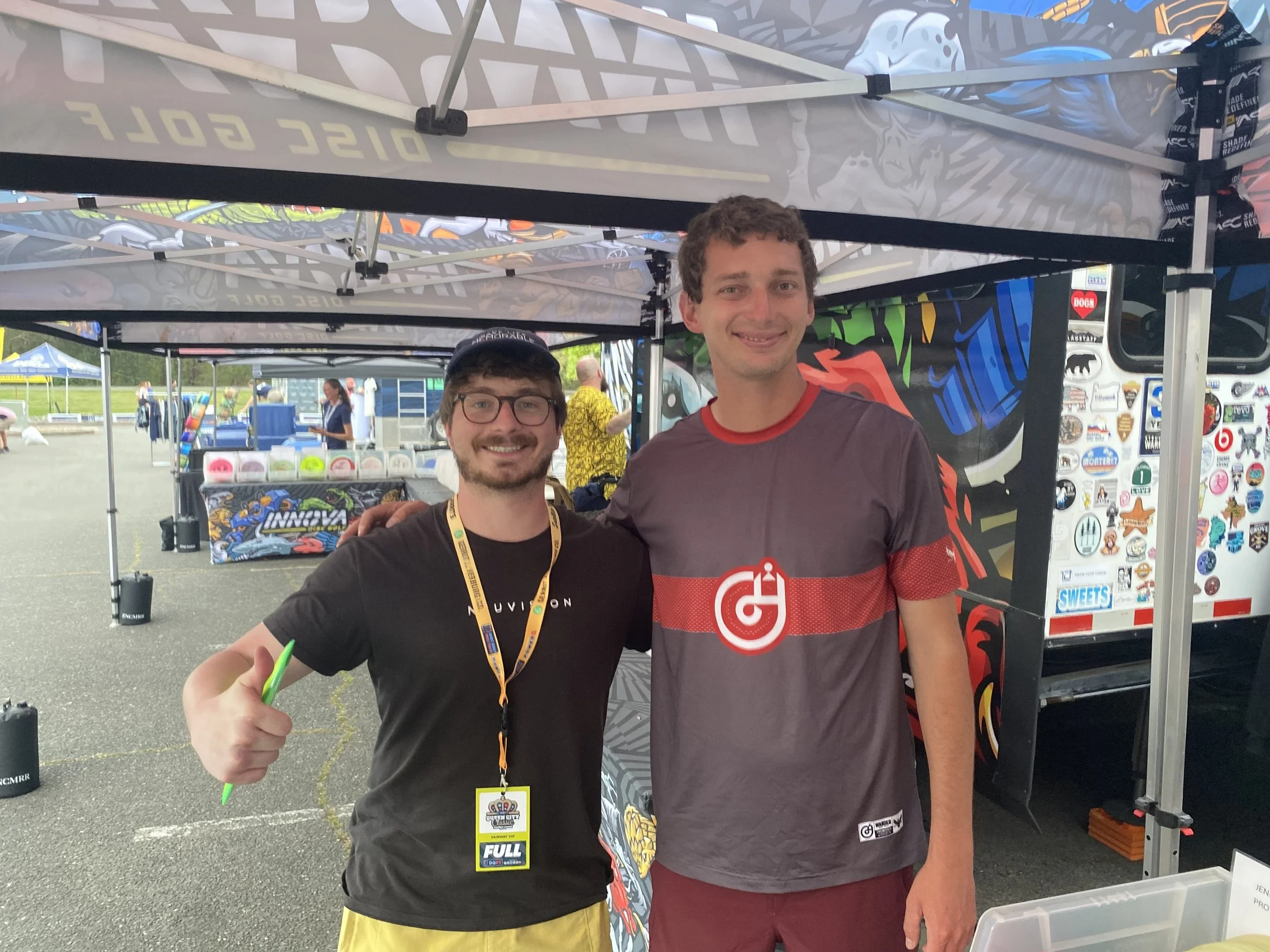
Calvin Heimburg (right) finished 11th at the Queen City Classic, but not before he sold a lot of discs… and won a lot of fans.
Every sport grows up, and with every new sponsorship or TV contract the fans move back another fifty feet and prices go up another fifty bucks. That’s great for the players and the leagues and the networks, and I begrudge them nothing. But occasionally we get a glimpse of sport in a simpler time and get reminded that there are still places where the fans and phenoms can come together to share their love of a sport, and go on a good walk together.
Notes:
John Feinstein didn’t coin the description of golf as “a good walk, spoiled,” but he wrote a book by that name, about the PGA tour: https://www.amazon.com/Good-Walk-Spoiled-Days-Nights/dp/0316011541#:~:text=Book%20overview,want%20to%20play%20it%20again%22
The Steve Reid-Gary Player duel:
https://www.nytimes.com/1968/04/22/archives/reid-tops-gary-player-in-azalea-golf-birdie-on-second-decides.html
Wiki on history of disc golf: https://en.wikipedia.org/wiki/Disc_golf
A big collection of facts about disc golf: https://udisc.com/disc-golf-growth-report
Final scorecard for the Queen City Classic: https://www.pdga.com/live/event/96403/MPO/scores?round=2