
(Image generated by deepai.org)
Imagine the United States as an overgrown yard. There’s one group of folks who sees the landscape and wants to make sure we protect all plants and animals before we do anything. There’s another group wielding a chain saw, convinced that what we really need is to focus on clearcutting the trees.
It feels good to protect wildlife. And operating a chain saw is a blast. But what voters seemed to say last week is, “We just want someone who can help me get the yard in shape.”
For the past ten years, American voters (Independents, centrist Republicans and Democrats) have been weaving back and forth between parties as struggling families try to find someone who will focus on making the challenges they face every day better. Our wages aren’t going up enough to keep up with the rising cost of education and housing and healthcare and hamburgers, and we’re worried we might not have jobs at all in the future. But every time we elect someone who says they will work on pocketbook issues, they seem to get distracted by louder voices on the fringes of their party, so we vote them out and get more and more disenchanted.
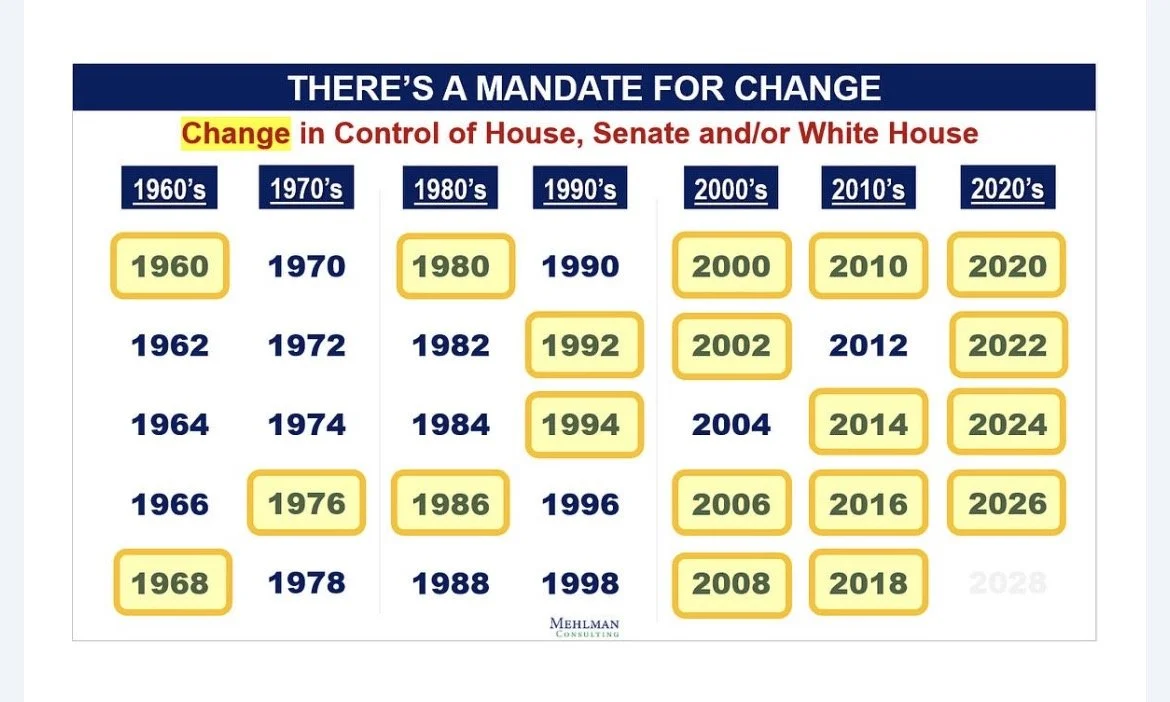
For the past seven national election cycles, disenchanted Americans in the middle have voted for change (graphic by Bruce Mehlman, chart wizard).
No wonder that one pre-election polls showed just 29% of voters had a positive view of the Democratic party and just 38% had a positive view of the Republican party, with more than half having a negative view of both parties. Those numbers are anemic: For reference, 37% have a favorable view of the IRS; 36% of ICE.
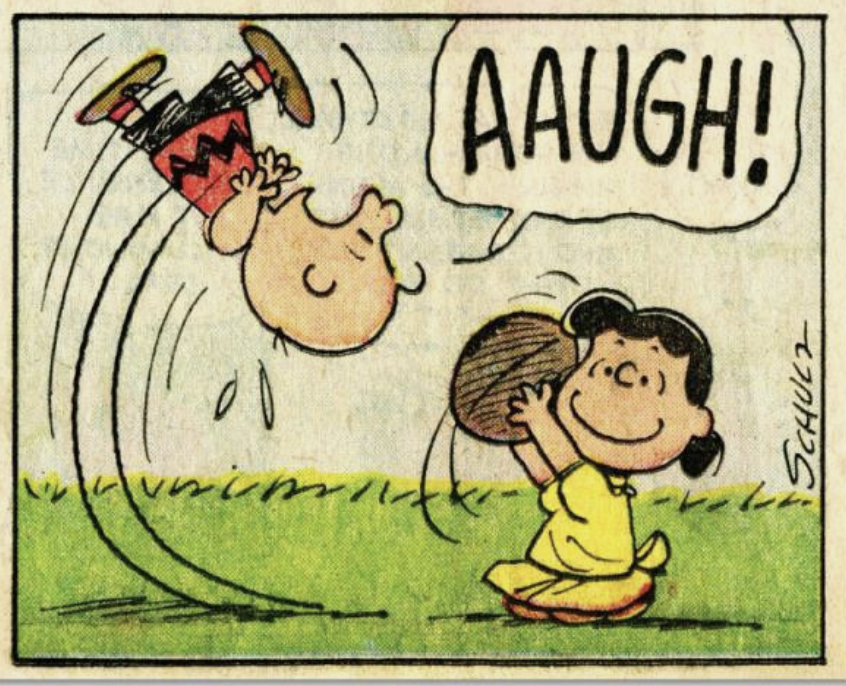
Just when Charlie Brown thought Lucy would hold the football for him to kick, she would snatch it away — every time. Think of Lucy as the politicians they keep electing; Charlie Brown is the voters (from the Charles Schulz archive)
Is there any chance this time the newly-elected could put pricing over politics? Maybe. All the newly-elected senators, representatives and governors who won seats in formerly red districts and states seemed to campaign on “get ‘er done” platforms that emphasized effectiveness over party fealty, cherrypicking ideas from both parties. Call them “Dempolycans.”
· “America is being torn apart by politicians on both extremes,” said Adam Hamilton, the new senator from Kansas.
· James Talarico from Texas and Mary Peltola from Alaska advocated for an “all of the above” approach on energy, continuing to boost oil while advocating for new development of clean energy sources.
· Roy Cooper from North Carolina played up his opposition to defunding the police in TV ads (“He bucked his party to oppose defunding the police, worked with Republicans to strengthen bail laws and partnered with President Trump to crack down on fentanyl.”) while also defending his record on pardons. Scott Colom from Mississippi supported gun rights and cracking down on violent crime, while defending new approaches to nonviolent crime.
· Successful Democratic candidates spent equal amounts of time denouncing ICE excesses and open borders.
The new politicians appear to be legitimate examples of a nearly-extinct species — centrists.
They also seem to be closely aligned with where the country is on each of those issues – bring down energy prices, keep us safe, don’t do crazy stuff.
But more importantly, every one of the successful Democratic candidates beat the drum on affordability. Democrat Roy Cooper from North Carolina’s is a poster child for that focus. His central campaign argument was as direct as it could be: “Make Stuff Cost Less.” On his website he laid out a series of steps he proposed to lower the cost of energy, housing, child care and groceries. It resonated. In a deep purple state, he won by almost 20 points.
For those newly elected, Congressman Jake Auchincloss, a former Marine Republican-turned-Democrat from Massachusetts is suggesting an intense focus on making government work better for real people, an idea he calls “Make Politics Boring Again.” Its basics: “an excellent education by 18 years old, a home of your own by 30, and a dignified retirement by 65.” Governor Josh Stein of North Carolina has focused attention on process improvements like shortening wait times at DMV; Governor Josh Shapiro in Pennsylvania has worked to speed up government processes that snarl road repairs.
It’s the kind of work that either party’s leaders could do, and neither party’s extremes will get excited about. But it’s exactly what real people might actually appreciate.
In an ideal world, this new appreciation for the value of a “get ‘er done” agenda could mean that politicians work together on at least a few big issues in the center (see my earlier piece on a potential “polycracy”) while the party zealots fight it out over more controversial topics. A current bill shows what that might look like.
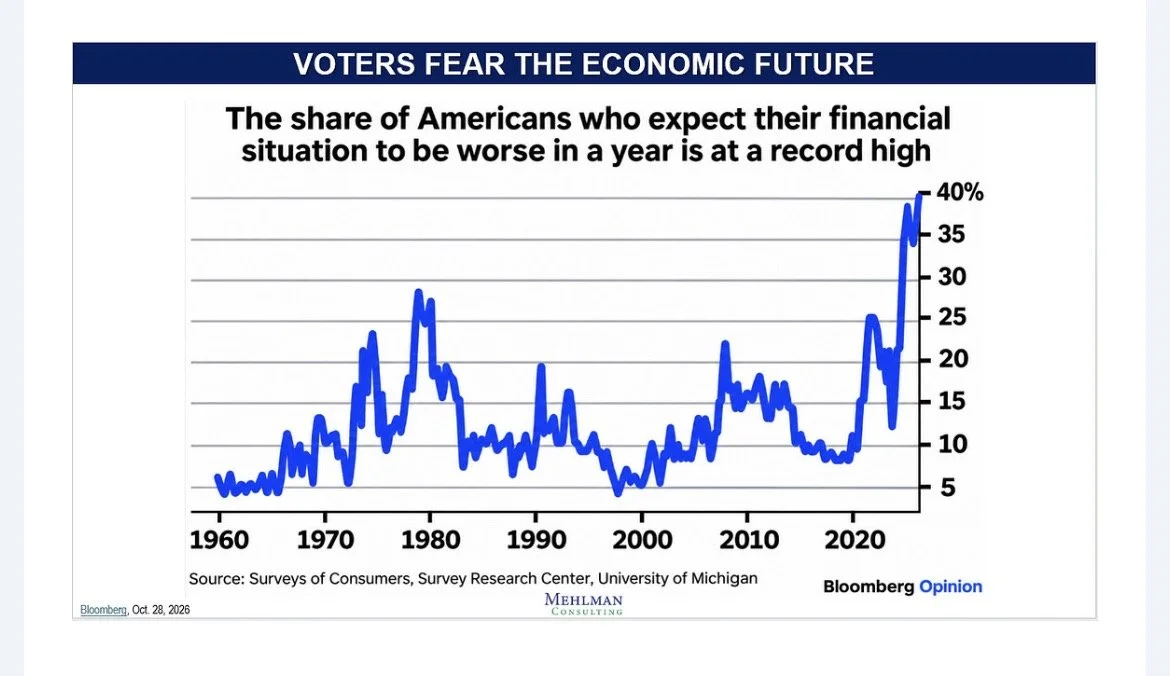
American swing voters (and c’mon, everybody) will likely look favorably on politicians who make their lives more affordable (another chart from Bruce Mehlman — see link to his website in Notes below)
Earlier this week the Senate passed the Bipartisan American Affordability and Jobs Act, which aims to make it easier to get permits approved for new energy sources. The bill, over time, is projected to save an average American between $60-$80 month and would increase wind capacity by 25%, solar capacity by 28% and battery storage storage by 70%. It’s a hard-won compromise, not a perfect bill in the eyes of either party. President Trump is reportedly upset because it would permit more wind energy — get rid of wind and it will be perfect; House Minority Leader Hakeem Jeffries is upset over one of the Senate amendments. And the Senate Democrats who voted against it have said it doesn’t do enough to protect clean water and wildlife. Those Democrats would like to wait till their new colleagues arrive in January and try for a perfect bill. Which President Trump has promised he would veto.
“The perfect is the enemy of the good.” Voltaire, 1770
The performative is the enemy of the gooey.” Boney, 2026
Both sides are going to have plenty of opportunities to perform over the next couple of years. Trump will sign executive orders in defiance of Congress to show he’s still the boss — he can try. Congress will hold corruption hearings on dozens of Trump administration officials to show they are holding them accountable — they should. Democrats will pass some bills knowing Trump will veto them — fine. Trump will veto some bills knowing the vetoes will be overridden — sure.
But at the end of the day whichever party finds enough time to do the hard, boring, gooey work of making everyday life better for Americans is going to win the next election — and, as a bonus, perform its job as public servants.
That good work may involve compromise. It may be less than perfect, but it will be better than nothing.
Will somebody please just mow the yard?
Notes:
Dissatisfaction with the economy: https://www.nbcnews.com/politics/2026-election/poll-voters-demand-change-check-trump-fueling-steep-democratic-midterm-rcna606183
Approval ratings of parties: https://news.gallup.com/poll/715523/democrats-advantage-party-image-issues.aspx; + https://www.nbcnews.com/politics/2026-election/poll-voters-demand-change-check-trump-fueling-steep-democratic-midterm-rcna606183
The winning combination for 2026 victors: https://www.nytimes.com/2026/11/09/opinion/democrats-midterms-populism.html?smid=nytcore-ios-share
Democrat capture of 2026 moderates: https://www.nytimes.com/2026/11/11/us/elections/trump-voters-democrats-priorities.html; + https://pac.org/impact/independent-voters-final-future-say
Change in voting patterns for Latinos, Blacks and young people: https://www.npr.org/2026/11/04/nx-s1-6028080/voter-polls-midterms-demographics
Permitting reform bill status: https://fox59.com/hill-politics/senate-advances-bipartisan-permitting-reform-bill-teeing-up-passage/
Roy Cooper “Make Stuff Cost Less”: https://roycooper.com/costless/
Auchincloss agenda: https://www.theatlantic.com/politics/2026/11/majority-democrats-denver-election/689358/
If you find the world complex, Bruce Mehlman is regularly brilliant at coming up with easy ways to understand hard concepts: https://mehlmanconsulting.com/infographics/